Information service of the Pontifical Mission Societies since 1927
Internet
Karthoum (Agenzia Fides) - "Silence has never saved us. And today, once again, global silence is enabling genocide. What is happening in Darfur is nothing new. Since 2003, non-Arab groups in Darfur, the Fur, the Masalit, the Zaghawa, have faced persecution for who they are, and retribution for daring to survive." This is the voice of a Sudanese women's rights advocate who collaborates with the Strategic Initiative for Women in the Horn of Africa (SIHA Network) from Darfur. In a statement released by the local press, the woman denounces the state of siege, terror, and devastation in which the population of Darfur finds itself.
"The war that officially broke out in Sudan in April 2023," she emphasizes, "only began to peel back the curtain on what we in Darfur have long known to be a given, that our land was already under siege, and our people under attack. El Fasher stood alone for over 500 days until it was captured by the Rapid Support Forces (RSF) in October 2023 (see Fides, 27/10/2025). We warned the world. We documented what was coming. But when it did happen, there was no outcry. No outrage."
Pope Leo, during the Angelus prayer on November 2, 2025, expressed "great sorrow following the tragic news coming from Sudan, especially from the city of El Fasher in the war-torn region of North Darfur," highlighting one of the tragic conflicts that tear apart the African continent, denouncing the substantial passivity and impotence of the international community (see Fides, 2/11/2025).
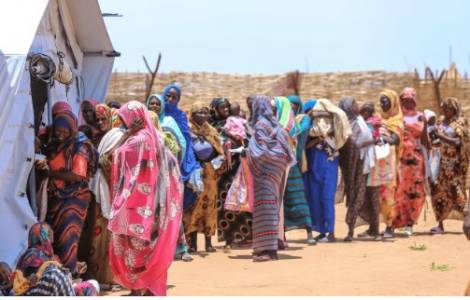
"Mass executions, ethnic profiling, abductions, and sexual violence," continues the woman, who is also the protection coordinator for refugee women and internally displaced persons in Darfur. "We are observing a war waged with women’s bodies, a war meant not just to be bloody, but to tear down communities. Rape is a weapon, a tool not just of violence but of erasure. In Zalingei, Fur women report that they’re living as slaves. In all over Darfur, RSF personnel occupy detention centres, where women are held, some in sexual captivity." The human rights advocate emphasizes the resilience of these victims, testifying how many "women who have survived rape now lead community kitchens to feed other displaced families in many parts of Darfur. In Tawila, survivors are helping peers hold space for each other in psychosocial groups. Women are risking their lives in Tura to deliver medicines, to transport survivors to safer ground.
At SIHA, we do what we can. We deliver medical care, safe relocation, legal documentation, and psychosocial support. We build survivor networks. But the fact is that’s not enough. The world needs to do more than observe a crisis. We cannot wait 20 more years for justice," she complains. "Darfur is not only a location of suffering. It is a place of resilience. It is a place where women are constructing futures while the world turns away." This is the conclusion of the woman who asks "do not let this be one more forgotten war." (AP) (Agenzia Fides, 5/2/2026)