
Information service of the Pontifical Mission Societies since 1927
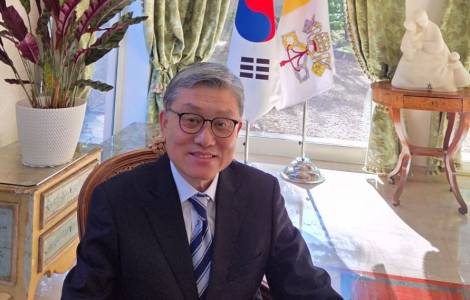
Korea Embassy to the Holy See
by Paolo Affatato
Vatican City (Agenzia Fides) – "We intend to leave behind the era of confrontation and inaugurate a new stage of peaceful coexistence and shared growth, promoting a sustainable peace that guarantees a prosperous future for all the peoples of the Korean Peninsula. By renouncing hostile acts and the logic of assimilation, we extend a hand of reconciliation to North Korea.” These words from Hyung Sik Shin, Ambassador of the Republic of Korea to the Holy See, mark a change of pace compared to the past in the approach to relations with North Korea. A Catholic, academic, and committed to the study and practice of democratic processes—in organizations such as the Asia Democracy Network, the Korea Democracy Foundation, and the Institute for Popular Sovereignty—Ambassador Shin explains this in an interview with Fides.
Q - Ambassador Shin, after the dramatic events of a year ago with the impeachment of President Yoon Suk Yeol, how is the Korean nation experiencing social and political life?
For many in Korea, last year was a transformative time of recovery. We moved through a painful yet pivotal shift—leaving behind an era of confrontation to embrace one of reconciliation and unity. Our people experienced a living “masterclass in democracy” seeing exactly how it can be challenged and, more importantly, how it can be restored through collective will. At this moment, the Korean public is experiencing a profound sense of political efficacy. As sovereign citizens, they are more active and critical than ever, precisely because they understand the direct impact of governance on their well-being. What some might perceive as turbulence is, in fact, the 'maturation of our democracy'—a healthy normalization process that is making our society more robust and transparent.
Q - Are there new "antibodies" to prevent authoritarian tendencies?
Indeed, Korea has developed a robust 'social immune system' that operates on two distinct yet reinforcing levels.
First, we have cultivated a cultural antibody through what I call the 'Civic Oversight.' Our citizens have deeply internalized the principle that no authority is sacrosanct before the Constitution and the rule of law. The capacity of our civil society to monitor governance and respond instantaneously to the overreach of power has reached an unprecedented level of maturity.
Second, there is the structural antibody of "Systemic Guardrails": we have meticulously redesigned our legal and institutional frameworks to ensure that checks and balances function as a constant.
Q - After a difficult process and period, has the population regained full confidence in democratic institutions?
Building trust is an ongoing journey rather than a destination. Although the impeachment was a painful moment of institutional crisis, it served as a turning point where our constitutional order proved its strength.
Our citizens successfully transformed 'the voice of the street' into a peaceful, law-bound renewal of governance. This confirmed that our institutions are fundamentally sound when operated with integrity. Today, we are redefining the relationship between the state and its people, ensuring that 'the state protects me and hears my voice.' We are placing the collective intelligence of our sovereign citizens at the very heart of the administration. Through innovative measures like live-broadcast briefings and citizen-led policy recommendations, we are normalizing transparency in every department. We understand that rebuilding deep-seated trust takes time, but the foundations for a more transparent and inclusive Korea are now firmly in place
Q - What are the most relevant internal challenges and issues that the new president and the new government must face, today and in the coming years?
In his New Year's address, President Lee charted a bold course for Korea, centered on an economic leap, inclusive growth, and national integration. This vision signals a paradigm shift: moving from 'capital-centered growth' to 'decentralized, regionally-driven development,' ensuring that the fruits of prosperity are distributed equitably. It is a commitment to a society where safety is the bedrock of sustainability and where culture and peace define our national identity.
As Ambassador to the Holy See, I view our most sacred mission as the establishment of enduring peace on the Korean Peninsula. Current global tragedies remind us that peace is not an option, but a non-negotiable prerequisite for human dignity, democracy, and prosperity. Our government remains steadfast in its efforts to de-escalate military tensions and restore mutual trust. We believe that exchange and cooperation are the most effective instruments of peace. By expanding these channels, we aim to transcend the era of confrontation and inaugurate a new era of 'peaceful coexistence and shared growth'—a sustainable peace that ensures a flourishing future for all people on the Peninsula.
Q - The government has finalised a 3 billion won allocation to support World Youth Day of 2027, while preparations are in full swing: what do you think of the upcoming WYD in Korea?
What will it mean for the nation?
World Youth Day 2027 in Seoul will be a milestone for Korea as we step forward as a leading global nation. More than an event, it is a universal message of peace emanating from the Korean Peninsula to the world. To ensure its success, I will dedicate my utmost diplomatic efforts to bridging the Holy See's vision with the administrative excellence of the Korean government.
Managing an influx of one million young pilgrims requires extraordinary logistical precision in housing, transit, and public safety; this is a responsibility our government takes with the highest gravity. Most significantly, we hope that Pope Leo XIV’s presence will provide the momentum needed to open a new chapter of peace in East Asia. If an environment conducive to a papal visit to North Korea is realized, it would be a watershed moment for global peace. As Ambassador, I will stand at the forefront of this effort, acting as a diplomatic bridge to ensure that WYD 2027 becomes a transformative beacon of 'peaceful coexistence and shared growth' for all.
Q - The South Korean government has stated its intention to resume dialogue with North Korea. What are the prospects for 2026? Will it be possible to reopen dialogue? What conditions will be necessary? What concrete commitments will the South Korean government make?
The Korean government is committed to transforming the Peninsula into a space of mutual trust and prosperity. By renouncing hostile acts and the logic of absorption, we are extending a hand of reconciliation to the North. We believe that building peace is not a singular event, but a process of normalization through persistent exchange.
Our approach focuses on tangible gestures of goodwill. By halting psychological warfare activities, we have signaled our readiness for peace. We now look to North Korea to restore communication channels as a first step toward trust-building. Furthermore, we believe that humanity must precede politics. Addressing the pain of separated families (whose members are divided between North and South Korea, ed.) is a moral duty that the international community and both Koreas must prioritize together.
We are actively coordinating with our global partners to create an environment conducive to peace. The robust cooperation demonstrated in the Korea-U.S. summits, coupled with the renewed openness for high-level dialogue, provides a powerful impetus for our diplomatic efforts. Korea will continue to serve as a proactive mediator, ensuring that the dream of a peaceful Peninsula becomes a shared global reality.
Q - According to recent studies, the desire for reconciliation and unification with the North has significantly weakened among the younger generation of South Koreans. Do you believe it is still important to keep alive in the minds and hearts of Koreans, especially young people, the hope for a future of reconciliation and unity? How and what can be done?
As the 80th year of division passes, we recognize that the yearning for unification among the youth is increasingly defined by reason rather than sentiment. Therefore, the government is focusing on creating a 'Participatory Peace Process.'
Our mission is to inspire young Koreans to see peace as a bridge of hope toward a broader global role. We seek to demonstrate that reconciliation is the ultimate strategic imperative for a flourishing nation. As we prepare for World Youth Day 2027, we see it as a historic opportunity to stimulate a 'Culture of Encounter.' It will be a moment for the youth of the world to stand in solidarity with Korean youth, reimagining the Peninsula not as a land of division, but as a starting point for global peace and Eurasian connectivity
Q - President Lee Jae-myung paid a state visit to China (4-7 January), the first in nine years, to‘restore the strategic partnership and economic cooperation between South Korea and China’. What is the significance of this visit in terms of the international geopolitical scenario?
Do you think this partnership could also have a positive impact on the beginning of a rapprochement between North Korea and South Korea?
The unprecedented exchange of state visits between Presidents Lee Jae-myung and Xi Jinping (who visited Korea on October 30, 2025) has effectively reset the trajectory of Korea-China relations. Beyond the symbolic protocol, this summitry has solidified a shared vision for a stable and prosperous East Asia. The exceptional layout of the official Chinese media reflects a significant shift in diplomatic sentiment, signaling a renewed emphasis on our bilateral cooperation.
Furthermore, both leaders reached a critical consensus: that peace on the Korean Peninsula is a shared strategic interest. President Xi’s commitment to constructive engagement provides a vital foundation for a favorable external environment, which is essential for the normalization of inter-Korean relations. The aforementioned Seoul-Pyongyang-Beijing rail link project is tangible proof of this. At the heart of this breakthrough is President Lee’s diplomatic philosophy of 'recognizing divergence while broadening convergence.' This principled pragmatism has recalibrated our relationship, allowing us to move past sensitive security frictions toward a path of sustainable progress and mutual respect.
Q - South Korea shares with the Holy See the vision and commitment to a peaceful world. How is this vision and commitment expressed and realised in concrete terms? How do you view Pope Leo XIV's constant appeal for disarmament and peace?
The partnership between Korea and the Holy See is rooted in a shared commitment to the integral development of humanity. Our history of resilience serves as a testament to what is possible when a people chooses the path of peace. We understand, perhaps more than any other nation, that peace is the indispensable sanctuary for human dignity.
Inspired by Pope Leo XIV’s prophetic appeal for global disarmament, Korea is leading the charge for a more secure future, particularly through our advocacy for youth-led disarmament. We also believe that true security is not found in the silence of weapons, but in the transparency of hearts. For us, the pursuit of a nuclear-free world is a moral imperative. By embracing the wisdom to 'turn swords into plowshares,' Korea aims to prove that an enduring peace—one founded on dialogue and mutual respect—is not only possible but necessary for the survival of the human family.
Q - In Pope Leo's address to the Diplomatic Corps accredited to the Holy See, would you like to quote and comment on a passage that seems to you particularly significant and appropriate for the situation in East Asia and that could inspire your action?
The Pope said: "A diplomacy that promotes dialogue and seeks consensus among all parties is being replaced by a diplomacy based on force, by either individuals or groups of allies." Pope Leo XIV has articulated a truth that strikes at the heart of our current global crisis: the dangerous shift from dialogue to the diplomacy of force. As a representative of a nation that has endured the harshest lessons of history, I strongly advocate for the restoration of diplomatic spaces where voices are heard with egalitarian respect. Peace is never a passive state; it is, as the Pope reminds us, a 'tireless commitment' that opposes the nihilism of war. Our global history—marked by the scars of two World Wars—is a stark testament that force alone cannot secure the future. True security arises only when we have the political courage to choose consensus over coercion. Inspired by this vision, Korea will continue to champion a diplomacy that prioritizes the dignity of the person and the sanctity of peace through persistent engagement. (Agenzia Fides, 16/1/2026)



 ASIA/UNITED ARAB EMIRATES - Abu Dhabi celebrates the 800th anniversary of the death of Saint Francis. Bishop Martinelli: He became a man of peace from the horrors of war he experienced
 Leo XIV to the John Paul I Vatican Foundation Conference: peace is a daily Mission
 Brazil - October 4 elections could shape the Country’s future
 POPE IN FRANCE/XI - Leo XIV in Metz: Europe seeks peace in the "Lantern of the Good Lord"
 To use AI wisely, first know what you want to preserve, G20 Interfaith forum highlights
 AMERICA/UNITED STATES - At the "G20 Interfaith Forum" Apostolic Nuncio Caccia points out that technologies and innovations "do not tell us what the good is”