Information service of the Pontifical Mission Societies since 1927
Avona
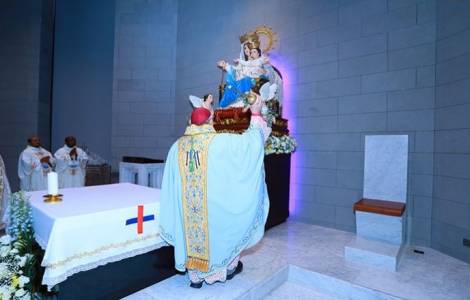
Awali (Agenzia Fides) - The Saturday (or Sunday) after the Baptism of the Lord is celebrated throughout the Arabian Peninsula as the Solemnity of Our Lady of Arabia (OLA).
This year, the celebration in Bahrain was presided over by the Apostolic Vicar of Northern Arabia, Aldo Berardi, O.SS.T., on Saturday, January 10, in the Cathedral of Awali, before he departed the following day for Kuwait, where he awaited the arrival of the Secretary of State, Cardinal Pietro Parolin, for the consecration of the Church of Our Lady of Ahmadi as a Minor Basilica of the Vicariate (see Fides, 1/8/2025), which includes Bahrain, Kuwait, Qatar, and Saudi Arabia. Bishop Berardi also confirmed to Fides that the Solemnity of Our Lady of Arabia will be celebrated in the other churches of the Vicariate on Saturday, January 17.
The following is a story, taken from a publication of the Confraternity of Saint Arethas and Companions of the Vicariate of Northern Arabia, headed by the Apostolic Vicar, about the origins of this Marian devotion and how it developed in the Gulf.
Veneration of the Blessed Virgin Mary under local or national titles is a hallmark of Catholic spirituality, reflecting the intimate bond between Mary and the diverse peoples of the world. From the earliest centuries, Christians have invoked the Mother of God in ways that speak to their own history, culture, and lived experience. Thus, every country—and often every town or region—treasures a Marian title that expresses how the faithful perceive Mary's maternal presence in their midst. Pope Francis, for example, coming from Argentina, held a deep devotion to Our Lady of Luján, patroness of his homeland. Japanese Catholics look to the Virgin of Tsuwano, who symbolizes the survival of Christianity in Japan when it was being suppressed. Spain boasts an extraordinary abundance of Marian titles, from Our Lady of Montserrat to Our Lady of the Pillar, each born from centuries of prayer, miracles, and popular devotion.
Amid this vast and colorful tapestry of Marian affection, the title of Our Lady of Arabia stands out with a unique spiritual resonance. Unlike many Marian invocations rooted in Christian-majority cultures or centuries-old traditions, this title emerged in a region where Christianity lives quietly, humbly, and often without external signs. Yet, precisely here in the heart of the Arabian Peninsula, Mary has been embraced as a mother, protector, and companion by millions of Catholics far from their homelands. Her title speaks not only geographical identity, but to the deep trust of a Church living in diaspora, finding in Her a tender guardian who watches over Her children as they navigate life and faith in the Gulf.
The roots of the devotion to Our Lady of Arabia trace back to the mid-20th century, when the Discalced Carmelite Fathers, coming from Iraq, arrived in Kuwait in the late 1940s to minister to the growing Catholic community. Among their pastoral priorities was the spiritual nourishment of a diverse flock: workers, families, and migrants who longed for a sense of home and divine protection in a land far from their own. It was in this context that the Carmelites introduced a Marian image, later known as Our Lady of Arabia, to serve as a unifying motherly presence for Catholics scattered across the Gulf.
The present image is derived from a 1919 statue of Our Lady of Mount Carmel originating from the Basilica of the Stella Maris Monastery in Haifa, Israel. A lithograph of this image, brought to Ahmadi, Kuwait, on May 1, 1948, was publicly venerated beginning on the Feast of the Immaculate Conception of that same year, thanks to the efforts of Father Teofano Ubaldo Stella, O.C.D., the first Apostolic Prefect and then Apostolic Vicar of Kuwait, commissioned by Pope Pius XII.
In 1949, as devotion grew, the Legion of Mary began using its own image of Our Lady of Miracles, prompting Fr. Stella to commission a new statue in Italy. Sculpted in cedar of Lebanon, the statue of the Madonna and Child was taken to Pope Pius XII for a blessing. On December 17, 1949, on the eve of the Holy Year of Jubilee, Pope Pius XII personally blessed the newly crafted statue in the Vatican Palace and was photographed praying before it, an extraordinary gesture that profoundly marked the beginnings of the devotion. The statue was flown to Kuwait and joyfully received on January 6, 1950, at the Ahmadi Shrine, where it soon became the focal point of daily prayer.
Pope Pius XII further showed his affection for this Marian title when, in 1956, he presented the Ahmadi Shrine with a large, decorated candle selected from among those offered to him during the Candlemas celebration of that year. The following year, responding to the request of the new Apostolic Vicar of Kuwait, Victor León Esteban San Miguel y Erce, the Holy Father issued the decree Regnum Mariae, dated January 25, 1957, formally declaring Our Lady of Arabia the Principal Patroness of the territory and the Apostolic Vicariate of Kuwait.
The greatest early triumph of this devotion came in 1960, the tenth anniversary of the statue's arrival in Kuwait. In gratitude for the countless favors believed to have been received through Mary's intercession, the Vicar Apostolic of Kuwait invited the faithful to contribute throughout 1959 toward the creation of a precious golden crown. Crafted in fine detail, weighing over two pounds of pure gold, and adorned with diamonds, rubies, and Gulf pearls—including one offered personally by the Vicar Apostolic—the crowns were brought to Rome and presented to Pope Saint John XXIII on March 17, 1960. Through the Secretary of State, Cardinal Domenico Tardini, the Pope delegated Cardinal Valerian Gracias, Archbishop of Bombay, to crown the statue in his name. After a solemn Pontifical Mass, the cardinal placed the golden crowns upon the heads of the Child Jesus and the Our Lady, sealing one of the most beautiful chapters in the early history of the devotion.
In modern times, the late Bishop Camillo Ballin, MCCJ, a passionate Marian devotee and visionary shepherd, spearheaded a renewed Marian identity for the Church in the Gulf. Under his leadership, the statue of Our Lady of Arabia was solemnly and canonically crowned in Ahmadi in 2011, in a ceremony presided over by Cardinal Antonio Cañizares Llovera on behalf of Pope Benedict XVI. On January 5, 2011, Pope Benedict XVI approved the patronage of Our Lady of Arabia as Principal Patroness of the Arabian Gulf, of both the Apostolic Vicariate of Kuwait and the Apostolic Vicariate of Arabia, which were subsequently reorganized into the Apostolic Vicariate of Northern Arabia and the Apostolic Vicariate of Southern Arabia. Bishop Ballin also petitioned the Holy See to fix the Solemnity of Our Lady of Arabia on the Saturday after the Baptism of the Lord, with pastoral permission to celebrate it on Sunday. As the crowning expression of his devotion, he initiated and guided the construction of the Cathedral of Our Lady of Arabia in Bahrain, later consecrated in 2021 by Cardinal Luis Antonio Tagle, then Prefect of the Congregation for the Evangelization of Peoples and now Pro-Prefect of the Dicastery for Evangelization, Section for First Evangelization and New Particular Churches (see Fides, 9/12/2021).
Building upon this foundation, Bishop Berardi, Ballin's successor, has further affirmed the enduring significance of this Marian presence. In 2025, he oversaw the elevation of the Ahmadi Shrine, home of the venerated original statue, to the dignity of a Minor Basilica. Bishop Aldo notes that the uninterrupted presence of a Marian statue for more than 75 years in the heart of the Arabian Peninsula is extraordinary, given the cultural and religious context of the region, where sacred images are generally restricted. Its survival and continuous veneration testify not only to Mary's discreet yet powerful protection, but also to the steadfast faith of a Church that lives its witness quietly, humbly, and with profound devotion. Today, the devotion to Our Lady of Arabia continues to deepen. Her image stands as a symbol of unity for the remarkably diverse Catholic community of the Gulf, a beacon of hope for migrants and workers, and a reminder that the Mother of God accompanies Her children even in lands where Christian expression must be lived with discretion and humility. This flourishing devotion—shaped by missionaries, strengthened by pastoral vision, and sanctified by the prayers of millions—remains a radiant testament to the living Marian heart of the Church in the Arabian Peninsula. (AP) (Agenzia Fides, 13/1/2026)