
Information service of the Pontifical Mission Societies since 1927
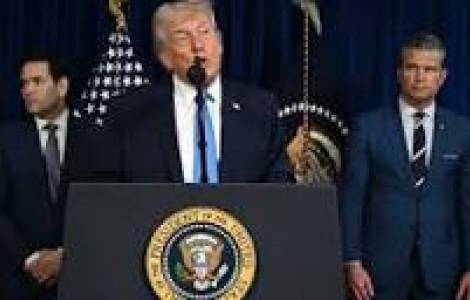
Caracas (Agenzia Fides) – “A spectacular assault never seen since World War II.” “One of the greatest displays of US force ever carried out, comparable to the attacks against Soleimani, Al-Baghdadi, or the Iranian nuclear sites.”
With these and other hyperboles, US President Donald Trump described and commented, during a lengthy press conference held at his Mar-a-Lago residence, on the military operation carried out on Friday night by US special forces in Venezuelan territory. Through the operation dubbed “Absolute Resolve,” the United States has overthrown Venezuelan President Nicolás Maduro, who has been arrested and taken out of the country along with his wife.
The operation has been formally justified with the accusation against Maduro of managing drug trafficking to the United States.
In other parts of his speech, President Trump expressed his intention to continue controlling Venezuela "for as long as necessary," as well as to allow the intervention in the country of "our huge U.S. oil companies, the largest in the world, which will spend billions of dollars, repair the badly damaged infrastructure, the oil infrastructure, and start generating wealth for the country." When questioned about who would assume leadership of the country, the U.S. president stated, "We are appointing the people; we will tell you who they are." In the first hours following the U.S. operation, no significant statements were issued by the Venezuelan Episcopal Conference. However, just days before the U.S. special forces operation, the Venezuelan bishops had expressed their critical stance regarding both the threatening military deployment carried out by the United States off the coast of Venezuela and the country's political situation.
In its 2025 Christmas message, the Venezuelan Episcopal Conference emphasized that the Christmas season in Venezuela had been marked by “repeated and contradictory reports of military actions near our shores, with deplorable loss of human life,” as well as by “the presence of a foreign military power in international waters of the Caribbean Sea.” Faced with the risk of the situation escalating, the bishops invoked an “unarmed and disarming” peace, echoing words used in numerous appeals by Pope Leo XIV. In the same message, the Venezuelan episcopate drew attention to “the deprivation of freedom of national and foreign citizens due to their different political opinions,” and to the “widespread impoverishment” of the population, a consequence of “rampant inflation” and a “destabilized economy.” The bishops' message emphasized the urgent need to guarantee authentic peace based on social justice, respect for human dignity, and the rejection of "unrealistic" solutions. A peace that is not built by force, but by everyone assuming responsibility, "first and foremost, the State." (GV) (Agenzia Fides, 3/1/2026)



 The BRICS between “global governance” challenges and the growing role of African countries
 Litoměřice: New commemorations for victims of anti-German massacres of 1945 during the “Jubilee of Reconciliation”
 The Manual of Latin American Ecclesial Communities to address the addiction crisis: A story of Communion
 AFRICA/SIERRA LEONE - Illegal drugs are a national problem
 POPE IN FRANCE/XI - Leo XIV in Metz: Europe seeks peace in the "Lantern of the Good Lord"
 United States lifts sanctions on Eritrea