
Information service of the Pontifical Mission Societies since 1927
CoptsToday
by Marie Symington
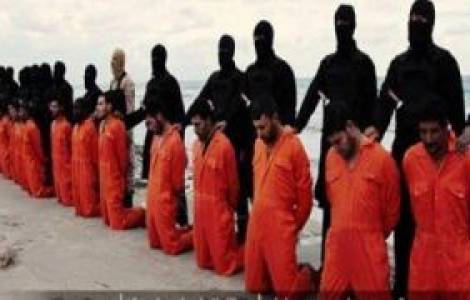
Rome (Agenzia Fides) - In Rome, on the day of the celebration of the Exaltation of the Holy Cross, the Basilica of Saint Paul Outside the Walls hosts the ecumenical commemoration of Christian martyrs and witnesses to the faith of the past 25 years. This Jubilee event, also attended by Pope Leo XIV, is also a precious opportunity to reflect on what it means to be a martyr in the Catholic Church, and the bond that unites martyrdom, baptism, and the salvation of souls.
The word "martyr" stems from the Greek word μάρτυς (màrtus), which refers to a witness capable of bearing witness to an event of which they have direct knowledge through personal experience. In this sense, the Apostles were "witnesses" to the life and teaching of Christ and, even more importantly, to his death and resurrection.
With the growth of the Church, the term martus was used by many Christian authors to refer to a person who, although they had never seen or heard Jesus Christ during his lifetime, firmly believed in the truth of the Christian faith and accepted death rather than deny it.
Jesus promises that martyrdom assures our salvation, as indicated in Luke’s Gospel “whoever loses his life for my sake, he will save it” (Luke 9:34) and in Matthew’s Gospel “Blessed are those who are persecuted for righteousness’ sake for theirs is the kingdom of heaven. Blessed are you when men revile you and persecute you and utter all kinds of evil against you falsely on my account. Rejoice and be glad, for your reward is great in heaven, for so men persecuted the prophets who were before you” (Mt 5:10-12).
Indeed, the martyr bears witness to Christ and is saved from eternal death and separation from God just as Christ witnessed to the world and opened the gates of heaven through his Passion and death.
Saint Thomas Aquinas considered martyrdom as an act of virtue: "it belongs to virtue" Aquinas writes, "to safeguard man in the good of reason. Now the good of reason consists in the truth as its proper object, and in justice as its proper effect, as is clear from what has already been explained. Now, martyrdom consists essentially in standing firmly to truth and justice against the assaults of persecution. Hence it is evident that martyrdom is an act of virtue." (Summa Theologiae, [44147] IIª-IIae, q. 124 a. 1 co.).
Thomas Aquinas considers a possible objection that one could make to this claim: Given that a virtuous act can only be qualified as such if it is voluntary - and for the sake of the good - and that not all acts of martyrdom are strictly voluntary, such as in the case of the Slaughter of the Innocents, it seems that one cannot regard every act of martyrdom as an act of virtue.
Thomas Aquinas’ response to this remark can shed light on the deeper significance of martyrdom in the Christian faith:
"it is better to say that these babes in being slain obtained by God's grace the glory of martyrdom which others acquire by their own will. For the shedding of one's blood for Christ's sake takes the place of Baptism. Wherefore just as in the case of baptized children the merit of Christ is conducive to the acquisition of glory through the baptismal grace, so in those who were slain for Christ's sake the merit of Christ's martyrdom is conducive to the acquisition of the martyr's palm." (Summa Theologiae, [44148] IIª-IIae, q. 124 a. 1 ad 1).
It is precisely God’s grace that is central to our understanding of martyrdom - and that justifies Aquinas’ conclusion that acts of martyrdom are indeed acts of virtue, a virtue that is not achieved through one's own efforts, as a personal achievement, but received and nurtured as a gift of grace.
Aquinas establishes a parallel between God’s grace in the sacrament of baptism and His grace in martyrdom, referring to Saint Augustine of Hippo’s sermon on the Epiphany:
"A man that does not believe that children are benefited by the baptism of Christ will doubt of your being crowned in suffering for Christ. You were not old enough to believe in Christ's future sufferings, but you had a body wherein you could endure suffering of Christ Who was to suffer." (De Diversis 116)
Saint Augustine also speaks of the saving grace received through martyrdom in his book "The City of God":
"Those who, though they have not received the washing of regeneration, die for the confession of Christ—it avails them just as much for the forgiveness of their sins as if they had been washed in the sacred font of baptism. For he that said, If anyone is not reborn of water and the Spirit, he will not enter the kingdom of heaven [John 3:5]. He made an exception for them in that other statement in which he says no less generally, Whoever confesses me before men, I too will confess him before my Father, who is in heaven [Matt. 10:32]” (The City of God 13:7 [A.D. 419]).
Many Christian authors consider martyrdom to be a "baptism in blood."
- Saint John Chrysostom: "Do not be surprised that I call martyrdom a baptism, for here too the Spirit comes in great haste and there is the taking away of sins and a wonderful and marvelous cleansing of the soul, and just as those being baptized are washed in water, so too those being martyred are washed in their own blood” (Panegyric on St. Lucian 2 [A.D. 387]).
- Tertullian: "We have, indeed, a second [baptismal] font which is one with the former [water baptism]: namely, that of blood, of which the Lord says: I am to be baptized with a baptism [Luke 12:50], when he had already been baptized. He had come through water and blood, as John wrote [1 John 5:6], so that he might be baptized with water and glorified with blood. . . . This is the baptism which replaces that of the fountain, when it has not been received” (Baptism 16 [A.D. 203]
- Saint Cyprian: "[...] they certainly are not deprived of the sacrament of baptism who are baptized with the most glorious and greatest baptism of blood." (Epistle 72, Article 22. To Jubaianus, Concerning the Baptism of Heretics).
“[...] the cause of perishing is to perish for Christ. That Witness who proves martyrs, and crowns them, suffices for a testimony of his martyrdom.” (Epistle 55, Article 4. To the People of Thibaris, Exhorting to Martyrdom).
In other words, it is ultimately Christ who makes people saints and martyrs.
Thus, the Catholic Church teaches “Those who die for the faith, those who are catechumens, and all those who, without knowing of the Church but acting under the inspiration of grace, seek God sincerely and strive to fulfill his will, are saved even if they have not been baptized [with water]” (Catechism of the Catholic Church (CCC) 1281; the salvation of unbaptized infants is also possible under this system; see CCC 1260–1, 1283).
(Agenzia Fides, 14/9/2025)



 Assembly of the Pontifical Mission Societies: Archbishop Nwachukwu invites us to proclaim the Resurrection of Christ to the world, following the example of the martyrs
 Amidst persecution, a story of grace. Beatification of the martyred priests Bula and Drbola on June 6
 KOREAN MISSIONARIES IN THE WORLD/5 - Father Lim's 33 Bolivian chapels
 ASIA/VIETNAM - Archbishop Joseph Vu Van Thien: “The Church in Vietnam, grateful for the missionaries and martyrs, sings its Magnificat”
 Faith according to Joseph Ratzinger: “Like a child in his mother’s arms”
 ASIA/PHILIPPINES - Archbishop of Cebu: Celebrations for the Feast of Santo Niño should not be financed by sponsors linked to the gambling industry
 EUROPE/SLOVAKIA - Mission at the heart of the Jubilee Year dedicated to the first Rector of the "Russicum", Vendelín Javorka