
Information service of the Pontifical Mission Societies since 1927
by Gianni Valente
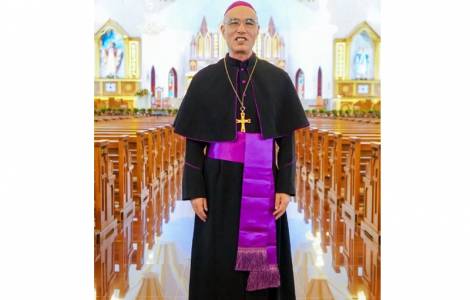
Beijing (Agenzia Fides) – Today, September 12, the liturgical feast of the Most Holy Name of Mary, at 9 a.m., the official installation ceremony of Joseph Ma Yan'en as auxiliary bishop of the new diocese of Zhangjiakou, in the Chinese province of Hebei, began. The ceremony also marked the recognition of Bishop Ma's episcopal ministry by the Chinese authorities, who had not recognized the episcopal office he previously held in the diocese of Xiwanzi.
Chinese ecclesiastical news sites such as xinde.org report that the installation ceremony, which took place at Zhangjiakou Cathedral, took place with the approval of the Hebei Provincial Committee for Catholic Religious Affairs. The ceremony was presided over by Joseph Wang Zhengui, ordained Bishop of the Diocese of Zhangjiakou two days ago, Wednesday, September 10 (see Fides, 10/9/2025). Father Yang Yu read the letter of approval of the appointment by the "College" of Chinese Catholic Bishops.
During the installation ceremony, Chinese church news sites report, Bishop Joseph Ma Yan'en pledged to respect the Constitution and state laws, to support national unity and social harmony, to love both the country and the Church, and to persevere on the path of the "sinicization" of Catholicism in China.
After the ceremony, the Eucharistic liturgy was celebrated by Bishop Joseph Wang Zhengui, and concelebrated by Bishop Joseph Ma Yan'en himself. More than 150 people participated in the liturgical celebration, including priests, nuns, and lay Catholics from the Diocese of Zhangjiakou.
Born on January 15, 1960, in Baoding (Hebei Province), Joseph Ma Yan'en was ordained a priest on October 20, 1985, for the Apostolic Prefecture of Yixian, where he served as Vicar General. He received episcopal ordination on December 20, 2010. On January 30, 2013, he was appointed Bishop of Xiwanzi, a diocese of which he took canonical possession on March 28, and which was suppressed by Pope Leo XIV on July 8.
Also today, Friday, September 12, in the same Zhangjiakou Cathedral, another ceremony took place during which the political authorities also recognized the episcopal dignity of Augustine Cui Tai, Bishop Emeritus of Xuanhua, a diocese also suppressed by Pope Leo on July 8.
During the ceremony, attended by about fifty people, the letter of approval sent by the Chinese Catholic Bishops' Conference was also read. Bishop Cui delivered a speech in which he declared himself ready to work for the good of the Church and the country and to persevere on the path of the "sinicization" of Catholicism in China. Bishop Joseph Wang Zhengui also gave a brief address.
Today's two ceremonies mark the culmination of the process that prepared for and led to the reconfiguration of the ecclesial structure in the Hebei territories, where Pope Pius XII established the dioceses of Xuanhua and Xiwanzi in 1946. This process, agreed upon between the Holy See and the People's Republic of China, is characterized by noteworthy details.
On July 8, Pope Leo suppressed the dioceses of Xuanhua and Xiwanzi, and at the same time established the new diocese of Zhangjiakou. This decision was taken—as explained in the official statement of the Holy See on the suppression and establishment of the aforementioned dioceses—"With the desire to promote the pastoral care of the Lord’s flock and to attend more effectively to its spiritual good.”
The territorial reconfiguration carried out by decision of the Pope also responds to the demands of political authorities, which are pushing to align the boundaries of ecclesiastical circumscriptions with those of civil administrative jurisdictions, which have been modified in recent decades at the initiative of the government.
In this process of accommodation, the steps between the Holy See and the Chinese political authorities have taken place in a concerted manner, without any unilateral initiative being recorded. Given that a diocese can be created, suppressed, its boundaries modified, or merged with other dioceses with the consent and decision of the Pope.
Moreover, the tendency to align the configuration of ecclesiastical circumscriptions with that of political-administrative divisions appears to be a constant and traditionally prevalent orientation in the choices of the Holy See and the local Churches.
It is also worth remembering that the Council of the Church of China, held in Shanghai in 1924, had already expressed in one of its "Vota" sent to the Holy See the request for a new subdivision of the regions and ecclesiastical circumscriptions, in order to adapt them – as far as possible - to the subdivisions of the civil provinces of China at the time.
More recently, on October 28, 2024, following the same approach, Pope Francis first suppressed the Diocese of Fenyang (created in April 1946 by Pope Pius XII and vacant since January 2, 2023, with the death of Bishop John Huo Cheng, aged 96) and simultaneously erected the new Diocese of Lüliang, entrusting it to the pastoral guidance of Anthony Ji Waizhong, who was appointed Bishop of the new diocese the same day and ordained bishop on January 20, 2025.
Zhangjiakou, the first steps of a "community journey"
The new Diocese of Zhangjiakou—established by Pope Leo on July 8—
has been headed by Joseph Wang Zhengui, and on that same day, Pope Leo appointed Father Wang Zhengui as its first Bishop, “having approved the candidacy in the framework of the Provisional Agreement between the Holy See and the People’s Republic of China."
Joseph Wang Zhengui was ordained Bishop of Zhangjiakou two days ago, on September 10 (see Fides, 10/9/ 2025).
The remaining issue was the two bishops who headed the two suppressed dioceses, Augustin Cui Tai (75) and Joseph Ma Yan'en (65). Both had received episcopal ordination before the signing of the Provisional Agreement between the Holy See and the People's Republic of China on the appointment of Chinese bishops. Joseph Ma was ordained bishop in 2010. Augustine Cui was ordained bishop in 2013. However, neither bishop had been recognized in his episcopal ministry by the political authorities and their apparatuses. With today's ceremonies, the ministry and episcopal dignity of Ma Yan'en (Auxiliary Bishop of Zhangjiacou) and Cui Tai (Bishop Emeritus who has reached the age limit) are also recognized by the civil authorities. The definition—inappropriate but dominant in the media—of "underground bishops" no longer applies to them.
The events that have taken place in recent days in Zhangjiakou—the director of the Holy See Press Office, Matteo Bruni, emphasized in a statement released today— constitute "a further fruit of the dialogue between the Holy See and the Chinese Authorities and is an important step in the journey of communion of the new Diocese." (Agenzia Fides, 12/9/2025)



 "Why are you here?": the legacy of a Korean missionary in Mongolia
 Theologian Bevans: "Contextual Theology" and new paths of mission
 OCEANIA/AUSTRALIA - Cardinal Bo to the Pontifical Mission Societies: "Your collaboration with us is not just charity, it is communion"
 ASIA/CHINA - "Encounter with the Lord, a synodal journey": the first spiritual retreat of the Chinese bishops
 ASIA/HONG KONG - Cardinal Tagle's blessing: "May the face of Jesus always shine upon Hong Kong"
 ASIA/HONG KONG - A music prayer service for the "Blessing" of Hong Kong on the 80th anniversary of the establishment of the Diocese