Information service of the Pontifical Mission Societies since 1927
Latin Patriarchate of Jerusalem
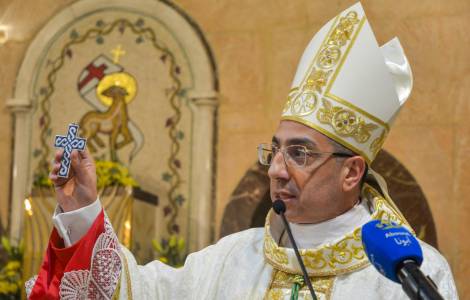
Rome (Agenzia Fides) – The solution of two peoples and two states in the Holy Land is "the only solution, if there is a desire to live in peace and justice." This is what Iyad Twal, auxiliary bishop of the Patriarchal Diocese of Jerusalem of the Latins for Jordan, affirms. He is currently in Rome for the "Formation Course for New Bishops" (see Fides, 2/9/2025).
In an interview with Fides, the bishop reiterated that the two-state solution, "as indicated in the 1970s with UN resolutions," is the only way to live in peace. "The alternative would be to build a state like in South Africa, that is, apartheid. But the land is very small. Either we live together, or there is no real solution."
Referring to the recent Israeli attacks against Qatar, where Hamas leaders had met to discuss a possible ceasefire and the release of hostages, Twal described what happened in Doha as "bad news. Wars in the history of humanity are a tremendous evil, and we don't learn. Every day we try to find hope, but unfortunately, events contradict us." What might appear to be sabotage in the search for "a solution to the conflict" is, above all, "a violation of international law. The entire world must understand that there is no justice for all in the Middle East and that we cannot continue living like this."
The bishop recalled the words of his Patriarch, Cardinal Pierbattista Pizzaballa: "The devil, evil, will certainly not win in the end." "We believe in justice and in God's love for all of us. This gives us hope every day, despite the harsh reality we live in," Twal added. "We continue to pray and trust in the possibility of living together." "I regret that this is happening while I am far from my people, in Rome, but I feel the support of the other bishops, our brothers in faith. Here you can breathe the spirit of the Catholic Church, which is truly universal. Like a family, they pray with us for peace, and in this way we all feel close to them."
Regarding the situation of the faithful in Jordan, the bishop explained that they live "with profound pain. Our young people ask us: Where is God? It is an existential question that is also a temptation, but at the same time it is an opportunity to come closer to peace. We must ask ourselves: I, a young person, I am not a ruler, how can I make peace live in my heart, even before it becomes a reality among the nations?" Twal reiterated that Christians in the Middle East "are called to live peace personally, to be witnesses of it in society. In Jordan, thank God, the Catholic Church is committed to this not only internally, but also with our Muslim brothers and sisters living in the country."
The bishop defined Jordan as "an oasis of peace, where we live in dialogue with everyone: from the king to the least of us, everyone tries to help." We have supported our Christian brothers and sisters in Gaza, the West Bank, and Palestine. The more we are disappointed by armed conflicts, the more we are committed to helping those who suffer.
Twal also addressed the religious and political background of the conflict in Palestine: "Religion in the Middle East can be an element of peace, but also of war. Here, religions are part of the problem and the solution. The challenge begins with the concept of the State: we have not yet managed to separate State and religion as in Europe. But how can we live our religious differences from the perspective of citizenship, rights, and justice if we continue to say, 'My God is the only true one and gives me every justification for my actions'? That is fanatical thinking. Instead, faith, and I say this as a bishop, calls me to live justice for all, respecting human dignity."
And in conclusion, he warned: "If we continue on the path of war and violence, hatred will be passed down from generation to generation like a diseased root." (GV/FB) (Agenzia Fides, 10/9/2025)