
Information service of the Pontifical Mission Societies since 1927
by Gianni Valente
"For the love of money is the root of all evils," writes the Apostle Saint Paul to Timothy. This is the same realism with which the Church has always collected and distributed money and material goods as a sign and expression of gratitude for the gift of new life in Christ, which is greater than all expectations, a precious pearl that surpasses all treasures.
The newly appointed bishops, gathered in Rome to participate in the formation Courses prepared for them by the Dicasteries of the Holy See, had the opportunity to exchange ideas and reflect on the mysterious genetic transformation by which even what Basil of Caesarea called "the Devil's dung" can become an instrument of their episcopal concern for the mission of the universal Church, in the bond of communion that unites every Successor of the Apostles to the Successor of Peter, the Bishop of Rome.
The afternoon session yesterday, Tuesday, September 9, was held in the Aula Magna of the Pontifical Urbaniana University. The participants included both the bishops enrolled in the course organized by the Dicastery for Evangelization (Section for First Evangelization and the New Particular Churches) and those enrolled in the similar formation course organized by the Dicastery for Bishops.
Providing food for thought and discernment were presentations by members of the Missionary Dicastery, including the Pro-Prefect, Cardinal Luis Antonio Tagle.
The "Paradigm" of the Acts of the Apostles
The "missionary communion" between the Catholic bishops of the entire world and the Bishop of Rome, according to Cardinal Tagle, "is not a sentimental or decorative attribute of the Catholic Church." The Pro-Prefect of the Missionary Dicastery referred to the witness of the first Christian community, as described in the Acts of the Apostles, in which "the breaking of bread, prayers, and the sharing of goods were the distinguishing features of the Church as a community and missionary witness in its beginnings." "These marks," the Cardinal added, "cannot be different in our time. We need to draw from this wellspring again and again."
The "missionary communion" of every bishop with the Successor of Peter and the Church of Rome, according to Tagle, entails "solicitude and care of all bishops for the whole Church." This universal concern finds expression in the support of each bishop and his particular Church for the universal mission of the Pope. In every bishop, he emphasized, "there exists a dynamic and vital 'tension' between caring for one’s particular Church and for all other Churches." A tension that "should not be eliminated because through the Bishop’s ministry, a particular Church remains within the Universal Communion and only within that communion will a particular Church be a true Church."
Instruments of Missionary Communion
In the mandate to proclaim the Gospel, which Christ Himself entrusted to His Church, all bishops of the world are called to express their shared responsibility for the ministry of the Successor of Peter through tangible signs and concrete actions.
Over time, the missionary co-responsibility of the bishops with the Bishop of Rome has been manifested and structured through practices, canonical provisions, and concrete instruments, the relevance and fruitfulness of which Giuseppe De Summa, a member of the Dicastery's administrative staff responsible for accounting and finance, addressed in his presentation. Instruments that "form a network of solidarity and support" capable of crossing and connecting continents and generations. These are community structures that do not arise from a clerical effort to imitate modern marketing techniques for fundraising, but rather have their origins "in the early centuries of the Church, when Christian communities collected donations to support the Church of Rome and thus the needs of the poorest."
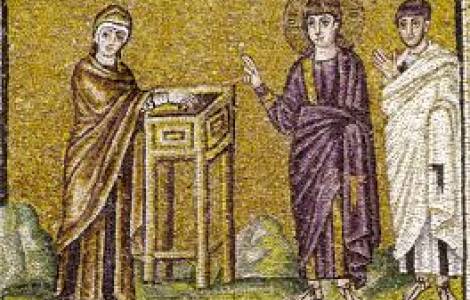
In his remarks, De Summa recalled the origins and developments of these instruments, beginning with the Peter's Pence, a voluntary donation that anyone can make to the Pope through the Episcopal Conferences and Nunciatures. The Peter's Pence recalls the widow's "small gift" from the Gospel of Mark. The practice officially originated in England as early as the 7th century, "when King Offa of Mercia introduced an annual tribute to the Pope called the Denarius Sancti Petri (Saint Peter's Money)." This instrument was taken up again in its modern form “shortly before the end of the Papal State (1870) and from the consequent loss of the income from the territorial possessions, that led to an initiative which arose throughout Europe and overseas to provide material assistance to the Pope.”
In recent years, "this donation was the focus of attention due to the misuse of the funds." "The Holy See responded with criminal proceedings, increased transparency, and administrative reforms."
De Summa also referred to Canon 1271 of the current Code of Canon Law, which also draws on early church practice and reaffirms the obligation of dioceses to provide financial support to the Holy See. The article discussed in detail collections and material resources that, due to their direct connection with missionary work, are under the control of the Dicastery for Evangelization: instruments such as the "Fondo Ecclesiae Sanctae" (established after the Second Vatican Council, which collects contributions from dioceses to the Dicastery to support "universal missionary priorities" (including the "more thorough formation of missionary agents") and the Pontifical Collection "Pro Afris," which "was established for the liberation of slaves in Africa but was later expanded by Leo XIII to include all forms of slavery in the world."
The administration officer of the Missionary Dicastery repeatedly emphasized the strict transparency criteria that must be observed in the management and communication of donations, as well as the need to regularly inform donors about the projects realized thanks to the contributions collected.
Pontifical Mission Societies: "most important resource" of the Bishops' missionary communion with the Pope
The Pontifical Mission Societies (PMS) are an important instrument and symbol of the "missionary communion" that unites all bishops with the Bishop of Rome. Father Tadeusz Nowak, Secretary General of the Pontifical Society for the Propagation of the Faith, described them in his address as "a worldwide network at the service of the Holy Father in his concern and care for the Church in the territories where the Gospel is being proclaimed for the first time and where the Church is young and developing." The Canadian priest of Polish origin, who belongs to the Oblates of Mary Immaculate (OMI), emphasized that the "instrument" of the Pontifical Mission Societies, in its structure and functioning, expresses and reflects the "missionary communion" that unites the Holy See with the particular Churches.
The network of the Pontifical Mission Societies, according to Father Tadeusz, "consists of 120 National Directors appointed by the Holy See upon proposal of the Bishops' Conference of a particular country or region, and diocesan directors appointed by the bishop of the local Church.” The staff of the General Secretariats of the four Pontifical Mission Societies, based in Rome, are “employees of the Holy See,” while “the national directors and diocesan directors are not employees of the Holy See.”
“For this reason,” he continued, “the Pontifical Mission Societies are unique, as they directly involve both the Holy See and all the local Churches of the world in communion with the Successor of Peter.” And it is precisely for this reason, Father Nowak added, “our network cannot function adequately or fully fulfill its mission without the full cooperation of the entire Church: the Holy See and all the local Churches that make up the Catholic communion.”
Pope Leo XIV, citing the Second Vatican Council’s decree “Ad Gentes,” affirmed in his May 22 that “the Pontifical Mission Societies are indeed the ‘primary means’” to awaken a sense of missionary responsibility in all the baptized and to support ecclesial communities in areas where the Church is still young.” For this reason, Father Nowak emphasized, “the Pontifical Mission Societies are not aid agencies like many other laudable Catholic and secular non-governmental organizations.” Rather, they are a network to support the Church’s evangelizing mission with the “primary task” of “promoting and strengthening the missionary spirit in the hearts of all the baptized by inviting them to look beyond the boundaries of their parish, diocese, and nation to see and appreciate the great needs of the Church throughout the world and far from their homeland.”
For this reason, Father Nowak added, once again referring to the distinctive features of the Pontifical Mission Societies, “unlike other missionary support initiatives, including those of individual dioceses and episcopal conferences, the Pontifical Mission Societies are of universal scope and strive to help all the churches for which the Dicastery for Evangelization is responsible." The work of the Pontifical Mission Societies, emphasized the Secretary General of the Pontifical Society for the Propagation of the Faith addressed to recently appointed Bishops - can only be effective "with the full cooperation and participation of all the bishops of each local Church and of the bishops' conferences of each country and region." Therefore, it is the task of all the bishops of the local Church "to ensure that the network can fulfill its mission by appointing the diocesan directors and supporting the work of the national directors."
Although the Pontifical Mission Societies are not merely aid agencies, their original charism is "to facilitate the sharing of material goods to support local Churches that have not yet achieved an adequate degree of self-sufficiency." With regard to the specific tasks for which each of the four Pontifical Societies is responsible (in addition to the Society for the Propagation of the Faith, the Society of St. Peter the Apostle, which supports priestly formation, the Society for Holy Childhood, and the Pontifical Missionary Union), Father Nowak highlighted the wide range of ordinary and extraordinary subsidies distributed by the Pontifical Mission Societies to support the mission of the Church and recalled the criteria of transparency and sustainability guaranteed by the procedures for granting funds. (Agenzia Fides, 10/9/2025)

 ASIA/LEBANON - General Abagnara (UNIFIL): “The Pope’s visit confirms us in our peacekeeping mission”


 AFRICA/KENYA - The pilgrimage of hope and solidarity of the missionary children of the Diocese of Kakamega
 AMERICA/PERU - Pontifical Mission Societies and the National Office for Catholic Education join forces for missionary formation in the country's schools
 ASIA/LEBANON - Leo XIV to the Lebanese: Rebirth begins with small lights and small shoots