
Information service of the Pontifical Mission Societies since 1927

Collegio Urbano
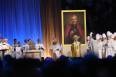
Rome (Agenzia Fides) - "Brothers and sisters, may our new Doctor of the Church and the Patron of our University inspire us in our life and work as a University and as people sent on mission," said Cardinal Luis Antonio Tagle, Pro-Prefect of the Dicastery for Evangelization, this morning in the chapel of the Pontifical Urban College, before more than 300 faculty members, students, and staff of the Pontifical Urbaniana University, who had gathered for a Mass of Thanksgiving for, "the gift of a new doctor of the Church, who is also our alumnus and our patron, St. John Henry Newman."
Pope Leo XIV had declared Saint Newman a Doctor of the Church on the occasion of the recent Solemnity of All Saints and, because of the special connection that unites the English theologian to the community of the Pontifical Urbaniana University and the entire Missionary Dicastery, also named him patron saint of the Pontifical Urbaniana University.
Today, at the start of the celebrants' procession, the entire assembly gathered at the Pontifical Urbaniana University and sang in English the hymn "Praise to the Holiest in the Heights," written by Newman and filled with grateful awe at the mystery of Christ's incarnation, which saw "the flesh and blood that failed in Adam" fight "again against the enemy" and "prevail."
Proclaiming the Gospel in friendship with Christ
At the beginning of his homily, drawing on a passage from Saint Paul's Second Letter to Timothy, which was among the readings for the liturgical commemoration of Newman, Cardinal Tagle reminded those present that Jesus' word of healing and liberation "must be proclaimed whether the situation is favorable or not, both in times and contexts when it is easy to win a hearing for the Gospel, and in situations when it is difficult." And "Newman's whole life work was "to proclaim the Gospel for the people of his time, with their 'inconvenient' questions and challenges."
The Cardinal cited in particular two works by the new Doctor of the Church: ‘The Essay on the Development of Doctrine’ "took seriously the difficult question of change and of history when applied to the life and teaching of the Church," and ‘The Grammar of Assent’, precisely in a time of growing unbelief, faced the challenging question of how people come to faith, and whether this is a humanly responsible act."
One becomes and remains a Christian, and one also becomes a missionary—the Cardinal said, referring to the passage from the Gospel of John that had been read earlier—not as a result of an intellectual conclusion, but because one has experienced the friendship of Christ: "We hear Jesus address his disciples in a surprising way. 'I call you friends.' Not servants. Not admirers. Not fans. Friends. Not followers on Instagram. Friends."
"Cor ad Cor loquitur"
The friendship of Christ was the source of Newman's Christian witness. And it was precisely this friendship, the Cardinal emphasized, that was therefore the true form of his witness to the men and women of his time.
The last sermon he gave as an Anglican, before converting to the Catholic Church, Cardinal Tagle continued, was entitled "The Parting of Friends," precisely "reflecting on Jesus as a true friend to his disciples." And "in another sermon, on "The Tears of Christ at the Grave of Lazarus," Newman meditates on the meaning of the tears Jesus shed for his friend, Lazarus, and he concludes by inviting his listeners to have faith that, as Christ was a friend to Lazarus, so he is to us."
"Wherever faith in Christ is," Newman said in this sermon "there is Christ Himself." And "Nothing can rob us of this consolation: we will be as certain, through His grace, that He is standing over us in love."
Inspired by the friendship of Christ, Newman lived the Gospel of friendship deeply. His "Letters to Friends" are collected in over thirty volumes. He dedicated himself to the reform of the Anglican Church "not alone, but with a group of friends." And when he became a Catholic, "he chose to be an Oratorian to live his faith in community." And when he became a Cardinal, Newman chose as his motto "Cor ad Cor loquitur," "Heart speaks to heart," an image that recalls how the Heart of Jesus speaks to his friends in the depths of their hearts."
Newman's entire life—Cardinal Tagle remarked—was "a witness to the Jesus," whose friendship he valued above all, and who "inspired him to be a friend to others."
Following Newman's example, the Cardinal suggested, addressing the faculty and students of the Pontifical University of which he is Grand Chancellor, that "in our teaching and research, we may face “inconvenient” questions of our time, of new and emerging cultures, with the light of the Gospel, with intellectual courage, creative fidelity, patience, and charity." Newman also embodies, with his own unique characteristics, the paradigm of the “Church of closeness” so often suggested by Pope Francis: “like our Lord who became close to us in his Incarnation, we too must be a Church of closeness.”
Like Newman—Cardinal Tagle concluded—even today "we too can be missionary preachers of the Word," so that "our world may know the blessedness, the transforming joy of being loved by Jesus and loving him in return. Only a heart that speaks with the heart of Jesus can speak to the heart of humanity." (GV) (Agenzia Fides, 12/12/2025)



 “Contextual theology” and the network of theological institutes are the focus of a Study Day at the Pontifical Urbaniana University
 Urbaniana University hosts study day of the “Velasio de Paolis Chair” on Law in the life and mission of the Ecclesial Community
 The seed of the Gospel and mission: Archbishop Sangalli concludes the formation Course for bishops in Nemi with a meditation on St Charles de Foucauld
 Letter from the Dicastery for Evangelization to Cardinal Tagle “on the occasion of the death of his beloved father”
 Fulton J. Sheen proclaimed Blessed. Cardinal Tagle: “Blessed is the earthen vessel that draws power from Jesus”