
Information service of the Pontifical Mission Societies since 1927
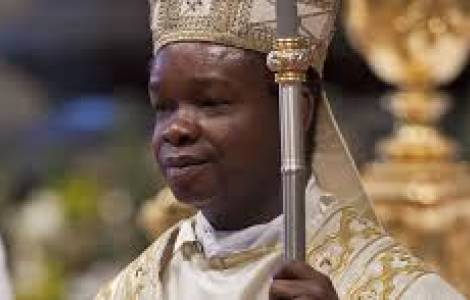
Photo KNA
by Gianni Valente
Rome (Agenzia Fides) – "Tribalism and ethnocentrism have not spared the Church. On the contrary, they have often pierced and wounded the Body of Christ," and "when cultural, ethnic, or caste identity is exalted above the new birth of baptism, the faith of the faithful and the unity of the People of God are in endangered," emphasized Nigerian Archbishop Fortunatus Nwachukwu, referring to a problem "whose persistence cannot be denied" and "whose gravity must not be downplayed."
In his address on Friday, September 5, at the formation course for newly appointed bishops, the Secretary of the Dicastery for Evangelization explained how tribalism and ethnocentrism in many local Churches also compromise the processes for appointing bishops and the distribution of the various ministries within ecclesial communities. He also cited recent cases in which bishops appointed as diocesan bishops were rejected by the clergy and local civil authorities because they did not belong to the dominant ethnic and tribal groups in the region. He recalled the divisions that exist in seminaries between seminarians of different castes or ethnic groups.
The "Son of the Soil" Syndrome
Archbishop Nwachukwu diagnosed this as the "son of the soil" syndrome: the persistent belief that the leadership and administration of ecclesiastical ministries must belong to those born in the circumscription in question or who share the same tribe, ethnicity or caste, namely the "sons", of the circumscription.
A Matter of Faith
Tribalism and ethnocentrism, which have crept into ecclesiastical dynamics, must be opposed, not for reasons of prestige or "political correctness." As a biblical scholar, the Secretary of the Missionary Dicastery also pointed out how the harmful significance of these phenomena contradicts the entire history of salvation, from the miraculous gift of creation to the even more beautiful mystery of Redemption, which began with the Incarnation of Christ. It is a "theological challenge that undermines the reconciling power of the Cross and the unity of the Spirit."
In Creation, "God himself delights in the richness of diversity," like "an artist who composes a mosaic with many colors rather than a single hue." The various created species spoken of in the Book of Genesis "can be compared analogously to our various tribes and ethnicities, castes, and so-called races." Diversity, he said, is "beauty" according to the Creator's plan, as can be seen in the difference between man and woman, who are "distinct yet equally made in God’s image." It was when humanity turned from God, when it "moved its focus away from God and as it were, began to do 'selfie,' that it saw only its own nakedness." Only after the original sin could difference become a source of division, blame and violence.
Instrumental references to "Inculturation"
According to Archbishop Nwachukwu, the danger of tribalism and ethnocentrism that have crept into the Church is also confirmed by attempts to justify these phenomena by invoking the recognized need to adapt the forms of the Church's presence and the proclamation of the Gospel to the particularities of local culture and situation.
In reality, Nwachukwu clarified, so-called inculturation is "a gift when it draws cultures into Christ, purifying and elevating them." On the other hand, it becomes a danger when cultures turn invar, fostering division rather than comunion.
Christ himself, in the mystery of the Incarnation, assumed a specific language, a specific land, and a specific tradition. Nevertheless, with His coming, he gave "to all who received Him, the power to become children of God." Thus, a "different kind of sonship" came into the world, "born not of blood, not of the will of the flesh, nor of the will of man, but of God," as it is written in the Gospel of John.
For the bishops, the Archbishop stated in his address to the new Successors of the Apostles, "this means leading their people in such a way that their culture does not close in on itself, but opens itself to the transforming encounter with Christ."
Inculturation degenerates into ethnocentrism when it theorizes and propagates as a human strategy and fails to point to the mystery of the Incarnation. The Apostles themselves recognized and taught that no culture or ethnicity should monopolize the Gospel and take over the Church.
Ethnocentrism, the Nigerian Archbishop emphasized, always arises when a culture is presented as "absolute" and the predominant affiliation is not that which emerges from baptism, but rather that of tribe, ethnic group, or caste. Then, even the appointment of bishops, the exercise of authority, and the entire life of the community are lived from the perspective of tribal or caste affiliation, rather than according to the Gospel.
A "New Tribe"
In Christ, according to Archbishop Nwachukwu, affiliation is no longer determined by tribe, caste, or descent, but by baptism, which "inserts us into this new community, this new 'tribe' of Christ." This is a unique "tribe" that is no longer bound by blood or clan affiliation, but "by the Spirit who makes us one body." A "tribe" in which there are no longer "strangers without citizenship," but only "fellow citizens with the saints and members of the household of God" (Paul, Letter to the Ephesians).
The Church, the Nigerian Archbishop emphasized, by its very nature and origins, is "not a tribal or caste institution, but the Body of Christ." Ecclesiastical offices are not tribal inheritances, but gifts entrusted for service. The secretary of the Missionary Dicastery cited the document "Apostolorum Successores," published in 2004 by the Congregation for Bishops, which emphasizes that bishops must act for the good of the faithful, guided not by feelings or local affiliation, but by supernatural criteria. For "the vineyard of the Lord belongs to the Lord alone."
Antidotes
Leadership in the Church, according to Archbishop Nwachukwu, must be exercised in the service of belonging. "When authority degenerates into tribalism, ethnocentrism, casteism, or racism, it repeats the error of Babel and fractures communion." When, however leadership recognizes ethnic and caste differences as a gift, the episcopate becomes a ministry of harmony, ensuring that no culture, ethnic group, or caste dominates ecclesiastical appointments.
The Secretary of the Missionary Dicastery also presented practical guidelines to counteract the evils of tribalism and ethnocentrism in the Church.
First, episcopal appointments and pastoral responsibilities should be based on fidelity to the Gospel and never on ethnicity, caste, or race. Second, those who exercise positions of authority in the Church should act fairly, without favoring any individual or group, and, whenever possible, involve the various heterogeneous components of the local community in decision-making and the distribution of tasks.
Bishops – the Archbishop's third practical recommendation to the newly ordained bishops – should publicly rebuke and counteract those who foment and exploit tribal, racial, and caste sentiments. Furthermore, the Church must promote sincere dialogue and genuine reconciliation to heal the wounds caused by tribalism and ethnocentrism. (Agenzia Fides, 6/9/2025)



 OCEANIA/AUSTRALIA - Cardinal Bo to the Pontifical Mission Societies: "Your collaboration with us is not just charity, it is communion"
 ASIA/CHINA - Zhengzhou Diocese Annual Assembly: Synodality on the common path of proclaiming the Gospel
 LEO XIV IN AFRICA - Archbishop Nwachukwu: If Jesus finds refuge again in Africa
 ASIA/INDIA - The Society of the Divine Word missionaries stand alongside tribal people to tackle child marriage
 “Contextual theology” and the network of theological institutes are the focus of a Study Day at the Pontifical Urbaniana University
 Urbaniana University hosts study day of the “Velasio de Paolis Chair” on Law in the life and mission of the Ecclesial Community