
Information service of the Pontifical Mission Societies since 1927
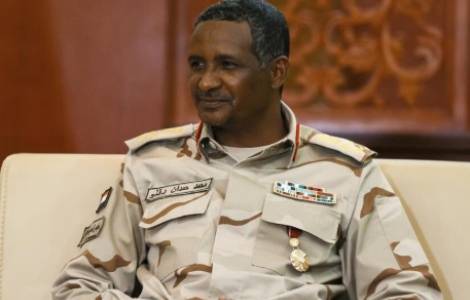
Khartoum (Agenzia Fides) – The creation of an opposition government in the regions controlled by the RSF (Rapid Support Forces) risks realizing the possibility of a new partition of Sudan, following the secession in 2011 of the southern regions that gave rise to South Sudan.
On August 31, in Nyala, capital of South Darfur State, the leader of the Rapid Support Forces, Mohamed Hamdan Dagalo, was sworn in as head of a parallel government in Sudan. The ceremony took place a few days after the first meeting of the Transitional Sovereign Council in Khartoum, the internationally recognized executive chaired by al-Burhan, the commander of the SAF (Sudan's Armed Forces), rivals of the RRF (see Fides, 29/8/2025).
In addition to Dagalo, his deputy, Abdelaziz Adam al-Hilu, and the 13 members of the presidential council were also sworn in.
In February, the RSF and several allied groups signed a political charter in Kenya to establish a parallel government in Sudan, sparking protests from the Khartoum government (see Fides, 19/2/2025).
Today, with two rival governments claiming legitimacy, regional observers believe that Sudan's territorial polarization is now evident and that the country's division risks becoming de jure and no longer just de facto. The creation of a parallel administration, which the military-led Sovereign Council has called a "ghost government," also highlights the effects of the stalemate in the war, with neither side close to victory. Both the African Union and the United Nations have rejected the authority of the parallel government in Sudan, calling it a threat to the unity and territorial integrity of the country.
The RSF controls all five of Darfur's regional capitals, except one, in an area rich in gold reserves. Dagalo's men also control the border points with Libya, Chad, and the Central African Republic. The RSF therefore has the ability to access international markets to sell gold extracted from areas under its control and, at the same time, to obtain weapons and ammunition from abroad. In this regard, the government in Khartoum has filed a formal complaint with the Somali federal government, requesting that it take steps to halt the airlifting of foreign weapons and mercenaries from the northeastern region of Puntland into Darfur. (on the presence of Colombian mercenaries, see Fides, 18/8/2025)
The only capital they do not control is El Fasher, the capital of North Darfur, besieged for over a year by RSF militiamen, whose tragedy was recalled yesterday, September 3, by Pope Leo XIV during the Wednesday general audience (see Fides, 3/9/2025). (L.M.) (Agenzia Fides, 4/9/2025)



 POPE IN FRANCE/XI - Leo XIV in Metz: Europe seeks peace in the "Lantern of the Good Lord"
 ASIA/UNITED ARAB EMIRATES - “The Lion's Roar”: Bishop Martinelli invites everyone to pray the Rosary every day for the gift of peace
 Pope Leo XIV: Let us celebrate the 100th anniversary of World Mission Sunday with gratitude and generosity