
Information service of the Pontifical Mission Societies since 1927
Archdiocese of hanoi
by Andrew Doan Thanh Phong
Hanoi (Agenzia Fides) – "It is better to be a citizen of a free country than a king of a slave country," was a famous saying of King Bao Dai, the last king of the Vietnamese Nguyen Dynasty, during the historic abdication ceremony on the afternoon of August 30, 1945, in the former capital of Hue, in central Vietnam, when he handed over the royal seal and sword (symbol of royal power) to the representative of the Provisional Government of the Democratic Republic of Vietnam. This event officially marked the end of the monarchy and is considered a milestone in Vietnamese society, as it ended the role of the Nguyen Dynasty's court and paved the way for a new democratic regime.
Immediately thereafter, on September 2, 1945, President Ho Chi Minh solemnly proclaimed the founding of the Democratic Republic of Vietnam on behalf of the provisional government in Ba Dinh Square in the capital, Hanoi.
In the Declaration of Independence, Ho Chi Minh emphasized: "All human beings are created equal. They are endowed by the Creator with certain inalienable rights; among these are the right to life, the right to the pursuit of liberty and happiness..." For a nation that endured so much suffering and loss during a long war, exploited under Vietnam's feudal dynasties and even under foreign rule, the right to life, the right to the pursuit of happiness and freedom are significant rights that reflect not only the aspirations of the entire Vietnamese people, but also the aspirations of contemporary people for progress and prosperity.
Vietnam is currently experiencing strong annual economic growth, particularly in 2024, reaching 7.09%, and the number of Vietnamese traveling abroad is also increasing significantly, reaching approximately 11 million in 2024.
Furthermore, Vietnam is considered a safe destination for many international tourists, with approximately 17.5 million foreign tourists in 2024.
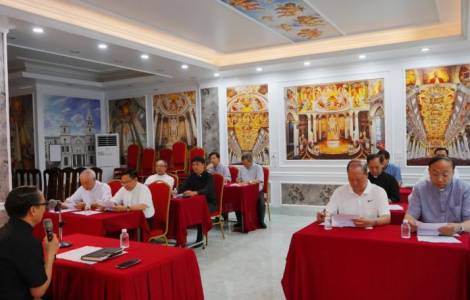
As part of this development, Catholics are contributing in many areas, including the economy, security, and social affairs. All state-run newspapers credit Vietnamese Catholics with "many useful activities for the good of the country," citing their commitment to building houses and bridges for the poor in remote areas, providing clean water to rural communities, direct participation on the front lines in the fight against the coronavirus pandemic, and providing disaster relief. "These activities," they say, "have demonstrated the patriotism and social responsibility of the Vietnamese Catholic community." It continues: "Vietnamese Catholics are actively involved in building safe residential areas and ensuring security and order in their hometowns. Many parishes have become shining examples of security and order, free from social injustices, where people live in friendship and harmony with non-Catholics."
Before 1945, the number of Catholic believers was very small, less than 2 million in 12 dioceses throughout Vietnam. Currently, the number has grown to over 7 million believers in 27 dioceses across the country, with approximately 30,000 priests, men and women religious. The ecclesial community has contributed to the country's development and made the image of Catholics more vibrant in Vietnamese social life.
Regarding Binh Duong Province, which belongs to the Phu Cuong Diocese in southern Vietnam and has a large Catholic population, the Vietnam People's Army newspaper wrote: "Local Catholics have joined forces with the community to transform Binh Duong from an agricultural province into a rich and beautiful province with an industrially specialized economic structure. As part of this service, local Catholics have actively participated in patriotic initiatives with numerous practical and effective activities, true to the motto 'Living a good social life and a fervent religious life' or 'Living the Gospel in the heart of the nation'."
As emphasized in a letter from the Vietnamese Bishops' Council in 1980, the Vietnamese Church wishes to contribute actively with the people throughout the country to the construction and protection of the Fatherland, along with the building of the ecclesial community, according to a lifestyle and a way of practicing the Catholic faith that are in harmony with national traditions: "Our Church is deeply rooted in the nation; we are determined to remain attached to the destiny of our Fatherland, to follow national tradition, and to integrate ourselves into the current life of the country, for this Fatherland is the place where God has called us to live as his children. Moreover, this country is also the womb that carries us in the process of realizing our vocation as children of God".
In economic terms, government reports also make it clear that in Catholic regions, traditional professions are geared toward effective investment and development, which helps create jobs for many local workers, maintains and preserves traditional professions, and contributes to local economic development.
In recent days, on the occasion of the celebrations of the 80th anniversary of Vietnamese independence, despite the bad weather, heavy rains, and other difficulties in social life caused by Typhoon Kajiki on August 25 and 26, 2025, many Vietnamese from various parts of the world traveled to the capital, Hanoi, to attend rehearsals for a grand military parade. An estimated 30,000 guests and delegates attended the magnificent ceremony today, September 2, 2025, along with more than 16,000 soldiers. Soldiers marched through the streets with modern military equipment. At the same time, hundreds of thousands of people watched this important event on the streets of Hanoi. Millions followed the event through the media. (Agenzia Fides, 2/9/2025)



 Leo XIV to the John Paul I Vatican Foundation Conference: peace is a daily Mission
 In Malawi, a whole stadium celebrates 100 years of World Mission Sunday: “United in Christ, united in mission”
 AFRICA/NIGERIA - Bishop Kukah: "The democratization of development leads to the development of democracy"
 EUROPE/ROMANIA - Romania: Cultural Invasion, Vast Military Expenses, Democracy Cancelled
 Brazil - October 4 elections could shape the Country’s future
 POPE IN FRANCE/XI - Leo XIV in Metz: Europe seeks peace in the "Lantern of the Good Lord"
 AMERICA/UNITED STATES - At the "G20 Interfaith Forum" Apostolic Nuncio Caccia points out that technologies and innovations "do not tell us what the good is”
 “Wecare” missionary experiences/II - When mission becomes a journey of faith