
Information service of the Pontifical Mission Societies since 1927
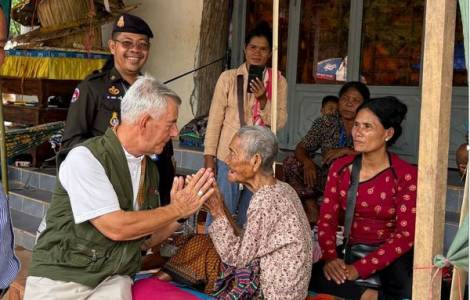
Prefettura Apostolica di Battambang
Battambang (Agenzia Fides) - "There is currently a ceasefire between Thailand and Cambodia, but civilians housed in refugee camps cannot return to their homes and villages due to the numerous unexploded ordnance and cluster bombs that make returning dangerous. The evacuation process will take months. In some areas, the Thai military has built new fences and barriers to enclose land and expand the border. Even if there are no firefights, tension remains high," Father Enrique Figaredo, Apostolic Prefect of Battambang, a Cambodian province bordering Thailand, told Fides about the situation in the border regions.
The ceasefire agreement signed between the two countries on August 7 remains very fragile: according to the Cambodian Foreign Ministry, the Thai side has violated the ceasefire agreement by erecting barbed wire fences enclosing residential areas and citizens' properties in Banteay Meanchey Province.
"According to a peace-oriented perspective, borders should not be battlefields, but places of friendship and cooperation," the Apostolic Prefect continued. "This requires legal clarity, consistent political will, mutual trust, and a shared commitment to peace and regional stability."
The Prefect, along with a Caritas Cambodia mission, spent four days in the refugee camps along the border and visited the four provinces of Banteay Mienchey, Oddar Mienchey, Preah Vihear, and Siem Reap. "There are many different camps," he reports, "in which poor people from rural areas, farmers and ranchers live who are caught against their will in a conflict they don't understand and who have to endure unnecessary suffering. People have no means of subsistence and are therefore dependent on food and humanitarian aid." Among them are many children and families whose lives have been turned upside down. Nevertheless, he continues, "amidst this uncertainty and suffering, I see a deep sense of solidarity, thanks to the help of the government, NGOs, and Caritas." "The displaced people," he notes, "are being welcomed in the compounds of Buddhist monasteries and temple gardens: This is a wonderful testimony to the solidarity of the Buddhist monks I have met. Their green and well-kept gardens, normally places of meditation, have become a welcoming home for the refugees. There is a feeling of warm hospitality, deep empathy, and compassion that we all share."
Among them are also Catholic displaced persons, "whom I met and encouraged, urging them to maintain and cultivate an inner attitude of non-violence, to respect and care for the place where they are, and to take care of the children's school," he explains.
Caritas Cambodia is also committed to this cause: "UNICEF has provided books and notebooks, and thanks to teachers and volunteers who are themselves among the displaced, Caritas has organized school classes for children and young people." However, he notes, this situation is expected to last at least six months. Therefore, he says, "we need support and solidarity to care for these people."
In this delicate situation, "the Pope's message for World Day of Peace reaches us: 'Peace be with you all.' We feel called to create an unarmed and disarming peace," he explains. "Pope Leo's message touches us deeply: It inspires us to place our hearts in the heart of Christ, which is an unarmed heart. If we are in the heart of God, there will be no hatred, we will have room for others, we will have peace in Cambodia and Thailand."
"World peace," he continues, "is built in everyday life, in our lifestyle, in the family, in the community, in the region; peace begins in our relationships with our fellow human beings and therefore calls us to a change of heart in order to live peaceful relations with our neighbors or fellow human beings." He concludes: "In the context of relations between Cambodia and Thailand, peace must be restored through language: a non-violent language, marked by words of compassion and reconciliation; here, Buddhists say 'metta' and 'karuna'. Language is an important symbolic factor that accompanies and inspires vision and behavior. Let us choose a new paradigm by abandoning hate speech and using words of peace." (PA) (Agenzia Fides, 27/8/2025)



 ASIA/LEBANON - General Abagnara (UNIFIL): “The Pope’s visit confirms us in our peacekeeping mission”
 ASIA/SOUTH KOREA - WYD, an opportunity to keep the desire for peace on the Korean Peninsula alive in the hearts of young people
 ASIA/PHILIPPINES - The Church is ready to "Give Hope" to those affected by the earthquake. Archbishop Uy: "Buildings are collapsing, but faith endures"
 ASIA/PHILIPPINES - Archbishop of Cebu: "Material and spiritual aid to earthquake victims: this is how God's love is made tangible"