Information service of the Pontifical Mission Societies since 1927
Missionari Comboniani
by Paolo Affatato
Rome (Fides News Agency) — One night in 1988, several young people were killed in the Parque Santa Madalena neighborhood on the eastern outskirts of São Paulo, Brazil. Comboni missionary Father Luigi Codianni, who was living in the neighborhood at the time, found himself confronted with an act of violence that would leave a profound mark on his life. In that place, a vast favela scarred by drug trafficking and marked by the vulnerability of countless children and adolescents, mission took on an even more tangible meaning for him: standing alongside those at risk of being abandoned, sharing their lives and defending their dignity.
Today, Father Codianni, 62, is Superior General of the Comboni Missionaries. He recognizes in that experience one of the wounds that can transform into a calling.
“Faced with that violence and the deaths of those young people, I felt even more strongly the urgency of standing alongside the most vulnerable children and young people — those whom society often regards as a problem to be eliminated rather than as persons to be welcomed, protected and loved.”
That episode helped decisively to shape his commitment to young people living on the streets. It was not enough simply to denounce the violence: it was necessary to share those young people's lives, walk alongside them and listen to them.
“I felt that I had to try to restore their dignity, hope and future,” he tells Fides News Agency.
The conviction he developed at the time has remained at the heart of his missionary vision. Those young people, he says, “did not need to be judged or pushed away, but to find someone willing to stand by their side, recognize their humanity and believe in them, even when no one else seemed willing to do so”.
That night gave rise to a conviction that runs throughout his reflections on mission: “Before even speaking about God, we must make those young people feel that their lives have value, that they are not ‘invisible’, and that someone believes in them.”
The Christian message, he explains, finds expression in concrete closeness and relationships of love. “Charity does not replace proclamation, but gives it credibility; proclamation does not replace charity, but gives it its foundation.”
From the “geography” of mission to a “culture” of mission
His experience in Brazil also helps explain how Father Codianni views the Church's mission in today's world. World Mission Day, which marks its centenary in 2026, offers an opportunity to reflect on a century of change without losing sight of the essential core of the missionary vocation.
“Over the past hundred years, the heart of mission has certainly not changed: the Church continues to be called to proclaim Jesus Christ and bear witness to his love. What has changed, however, is the way we understand and live out mission.”
“For a long time,” he recalls, “mission was understood above all as a movement that began in Europe and reached out to other continents. The Second Vatican Council brought a decisive change of perspective, affirming a vision in which all Churches are called both to give and to receive. This journey was further developed through the teaching of Pope St Paul VI, in Evangelii Nuntiandi; Pope St John Paul II, in Redemptoris Missio; and Pope Francis, in Evangelii Gaudium and his call for a ‘Church that goes forth’.”
“We could say that we have moved from the ‘geography of mission’ to a ‘culture of mission’,” observes the Comboni Superior General. “Mission is no longer ‘something that happens in distant places’; it is the very reason for the Church's existence, wherever in the world it may be.”
The missio ad gentes — the Church's mission to peoples and communities who have not yet received the Gospel — remains fully relevant, but is taking on new forms. Distance from the Gospel cannot be measured in kilometres alone: it can be found in the same city, the same diocese, the same parish or even within a family.
“For me, ad gentes above all means going towards those who do not yet know the Gospel, those who are far away, those who are excluded, those who cannot find a place in society, and even those who believe they have nothing left to hope for,” he says.
Mission, therefore, “means going out towards others, especially wherever wars, migration, poverty, loneliness, exclusion and a loss of meaning undermine human dignity”.
Among the most painful situations, Father Codianni points that of children and young people growing up in deprived and violent contexts, deprived of opportunities until they become convinced that they are destined to fail.
“Today, I believe that one of the greatest and most serious ‘existential peripheries’ is precisely that of young people whose hope has been stolen from them,” he says.
The missionary response is not an occasional intervention. Rather, it becomes “a presence that communicates, even without many words, that no one has been abandoned”.
“The missionary,” Father Codianni says, “tells them: ‘You matter to me; you are close to my heart! Your life possesses an inherent dignity. God has not forgotten you.’”
A Church that goes forth and allows herself to be evangelized
This perspective speaks directly to Christian communities.
“World Mission Day cannot simply be an annual occasion for collecting offerings to support the missions. It is an opportunity to examine how genuinely open our parishes are to those left on the margins, to young people, the poor, migrants and all those in need of a word of consolation,” he observes.
“I believe we need to move beyond the idea of a Church that ‘has missionaries’ and recognize the Church as ‘missionary by its very nature’,” the Comboni missionary says.
“A community becomes missionary,” he continues, “when it does not simply wait for others to reach it, but chooses to go out, meet people, listen to them and accompany them. Mission is no longer a commitment undertaken by a few on behalf of the many who live far away; it is something the entire community is called to live out, always and everywhere.”
“Going forth” also means allowing oneself to be encountered by people and cultures that are different from one's own, recognizing that mission does not proceed in only one direction.
“For a long time,” the Superior General recalls, “a model prevailed in which some Churches gave while others received. That distinction no longer works. All Churches are called both to give and to receive.”
African, Asian and Latin American missionaries arriving in Europe bring with them not only their skills and willingness to serve, “but also their own faith, spirituality, culture and way of living in community”.
The Comboni charism itself has become increasingly universal, multinational and multicultural, in keeping with St Daniel Comboni's desire for an authentically Catholic — that is, universal — institute, not tied to a single nation, he notes.
“Here, fraternity does not mean eliminating differences, but learning to live with and appreciate them without allowing them to become divisions,” he adds. “Unity does not mean that we must all be the same, but that we must learn to love one another in our diversity.”
The same principle applies to interreligious dialogue. Dialogue does not mean renouncing one's own faith, but rather “recognizing the other as a person with whom we can build relationships based on respect, mutual understanding and collaboration”.
Peace, service to the poor, the promotion of young people and the defence of human dignity are all areas in which believers from different religious traditions can work together, he points out.
“The other person, the one who is different from me, is not an obstacle to mission, but someone to be encountered. And when you truly encounter that person, you discover that they have something to teach you.”
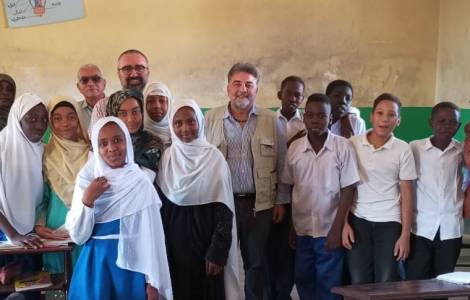
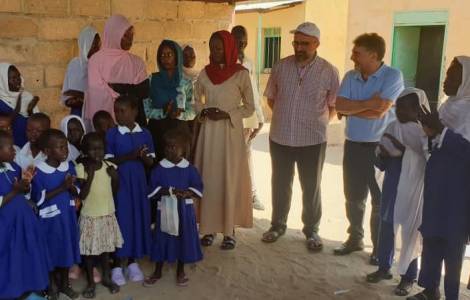
Father Codianni will celebrate World Mission Day on 18 October in Italy, taking part in meetings aimed at raising missionary awareness and proclaiming the Gospel. He does so with the experiences and faces of the people he has encountered over the years through his service as head of the Institute and his visits to its various missionary communities.
The celebration, he says, is “an opportunity to remember that mission does not belong to the past, nor is it confined to distant lands: it continues wherever a Christian community knows how to foster encounter, fraternity and hope”.
Today, the Comboni Missionaries number approximately 1,450 priests and brothers worldwide and are present in more than 40 countries across four continents: Africa, the Americas, Asia and Europe.
Their work ranges from first evangelization and formation to education and healthcare, as well as human development, justice and peace, integral ecology and communication. Following in the footsteps of St Daniel Comboni and remaining faithful to his charism, they combine the proclamation of the Gospel with a tangible commitment to stand alongside local communities, particularly the most vulnerable and forgotten.
(Fides News Agency, 15/10/2026)