
Information service of the Pontifical Mission Societies since 1927
Wecare
by Laura Gómez Ruiz
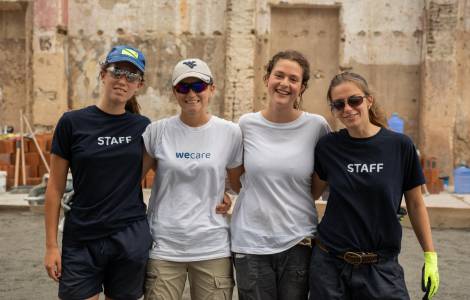
Rome (Fides News Agency) – Leaving home and one’s “comfort zones” for several weeks, venturing to another country and sharing time and work with people whose lives are very different. For some young people, holidays can become an experience of encounter and closeness with distant realities, where everything can become an opportunity to question themselves, others and the desires of their own hearts.
This is what often happens during the missionary experiences promoted by “Wecare”, an Italian initiative whose roots go back twenty years and which every year involves many young people in projects in Italy and other countries.
A Peruvian beginning
The story began in 2005, when Fernando Lozada Baldoceda, who initiated the volunteer experiences abroad and is now director of Wecare, organized a first trip to Peru with three university students. “It was the first attempt at a volunteering trip,” he recalls. In 2006, the experience began to take shape as a group and, over the following years, it grew to involve dozens of young people. In 2011, a legal framework was established to support the project and, after several stages of development and the expansion of its activities in Italy, Wecare was founded in its present form in 2023.
Camilla and Benedetta’s discoveries
For Fernando, these twenty years represent more than just the evolution of an organization; they tell the story of young people who discovered that they had a treasure to share and chose to get involved.
“There is much more joy in giving than in receiving,” says Camilla, from Rome, who, after taking part in an experience in Argentina in 2025, decided to set out again this year, this time for Brazil. “I chose to take part a second time because this experience does not only help others; it also helps me,” she explains. Meeting others, she says, allows one to “touch parts of yourself that you do not touch in everyday life” and to get to know oneself in a different way.
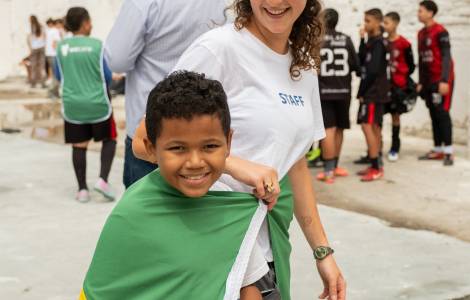
In Brazil, one of the encounters that left the deepest impression on her was with the community of Milan dos Coelhos. “What struck me most was the love that surrounded the community,” she recalls. In particular, she was moved by the way people cared for Evinho, an elderly member of the community. This made her realize that, although they had very little, they did not lack what, for her, is the most important value: “love for one's neighbor, closeness and selfless help.”
When she returned home, that experience had also changed the way she looked at her own life. “I came back with greater awareness and a greater desire to help others,” she says. The experience, she adds, “put my priorities into perspective” and helped her understand more clearly what is worth striving for. She also feels “more grateful for what I have and for what surrounds me.”
Benedetta, too, chose to set out again. After Peru in 2022 and Cameroon in 2025, this year she returned to Brazil. The phrase “There is more joy in giving than in receiving” has accompanied her experiences. “I feel lucky; I receive so much every day, and I wanted to understand what it really means to give,” she explains.
During the weeks of the experience, she says, “we strip ourselves of material things and live in order to give energy, love and smiles” to a community that has received far less. Yet the experience of gratuitous giving also has an impact on the group of volunteers themselves, involving them in the sense that they have become one family with the people they have come to meet and serve.
One of the moments she remembers most clearly is not tied to a specific activity, but to a scene that suddenly narrowed the distance she had perceived when she arrived.
While walking through a community in Recife, she saw houses built on stilts, barely supported above a river filled with rubbish. “I felt an enormous distance,” she recalls. Then she saw two barefoot girls and a small boy reaching for his sister’s hand. The gesture reminded her of her own childhood, when she would seek the attention of her older brother. In that moment, she recognized a part of herself in that child. “It made me realize that I could have been that child,” she says. “That is what Wecare does: it shortens the distance we perceive,” she explains.
After these experiences, Benedetta also learned to view vulnerability differently. “These people and children show their vulnerability with a smile,” she says. This helped her share her own weaknesses, joys and fears “without shame”, building a relationship of trust both with the community and with the other volunteers.
Nothing can be taken for granted or is “automatic”
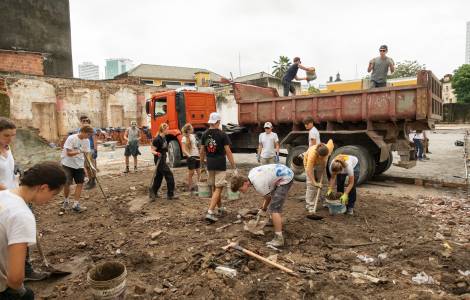
For Fernando Lozada Baldoceda, this is precisely where one of the possibilities offered by these experiences lies. By leaving home and their usual comforts, young people find themselves in a different setting, alongside other young people and in direct contact with situations of poverty and hardship. This is accompanied by a process of reflection inspired by the Gospel. “Young people take part in projects that have a real and meaningful impact,” he observes. It is not simply a matter of carrying out a small activity in order to have the feeling of having contributed, but of being able to take part directly in concrete projects and “experience at first hand the help” that is given and received.
The good seed and clichés
Wecare describes this journey as an experience of “pre-evangelization”: it is not catechesis, but rather an invitation to raise challenging questions about one’s identity, love, friendship, suffering, happiness, mission and vocation.
Lozada Baldoceda stresses that none of this happens automatically. Each young person remains free in the way he or she lives the experience, in how far they allow themselves to be challenged by it and in what they subsequently choose to do with what they have discovered. In his words, the journey is a “favourable context” in which to look within oneself. But “nothing is automatic; everything depends on each person’s freedom, on whether they wish to make good use of their time, be generous and look deep within themselves.”
The experience, moreover, does not claim to produce an immediate transformation. Two weeks cannot change overnight a way of thinking and living that has taken shape over many years. What Fernando sees is something more intimate and discreet: “a greater awareness of who each young person is, deeper sense of gratitude and a new possibility of looking at one’s own life with mercy and recognizing its value.”
It is like a seed, he explains. “Something is sown” and will then bear fruit “in each young person’s own time and according to the way they care for that seed”. What remains does not necessarily have to translate immediately into a new activity or a visible decision. “The hope is that an awareness of the precious value of one’s own life, and of the beautiful things that can be done with it, will remain in the heart,” he says.
After so many years spent accompanying these experiences, his view of young people is also free from prejudice and clichés about the “generation incapable of commitment”. Fernando does not believe that among the younger generations the desire to be happy, to do good and to live life to the full has died out. “If young people are criticized, it is not because their hearts do not desire to live to the full, to do good things and to do beautiful things,” he says.
“If adults do everything for them,” he explains, “they may end up not trusting young people’s ability to face difficulties, take responsibility and grow independently.” The role of adults, instead, should be to accompany them and create the conditions in which they can freely choose a life given in service to others.
Camilla returned from Brazil with different priorities, while Benedetta discovered that an apparently simple scene could make the distance between two worlds disappear. Through two different stories, their experiences illustrate what Fernando has seen repeated over the years: when young people are given a real opportunity to serve, encounter others and face difficulties, a capacity for self-giving also emerges that is not always visible in everyday life.
The experience, then, does not necessarily end when the journey comes to an end. What may remain is a question, a sense of gratitude, a new way of looking at things—or simply a seed that still needs time to grow.
(Fides News Agency, 23/9/2026)
Wecare
Wecare
Wecare



 Growing social alarm across Africa over the damage caused by illegal mining
 Working together for the good of the peoples: renewal of the memorandum of cooperation between the African Union and the Symposium of Bishops' Conferences of Africa and Madagascar
 ASIA/SOUTH KOREA - Second International Preparatory Conference for “WYD Seoul 2027” underway
 EUROPE/ROMANIA - Pontifical Society of the Holy Childhood: Jesus’ “torch” at the heart of missionary summer Camps
 EUROPE/POLAND - Mission seeks new paths: the message that emerged from the autumn meeting of the Pontifical Mission Societies
 VATICAN - World Mission Day: Third on line study session for the French-speaking world reflects on Pope Leo XIV's message
 ASIA/CHINA - Pushanghui Catholics restore their parish church with their own hands