
Information service of the Pontifical Mission Societies since 1927
by Peter Zhao Jianmin*
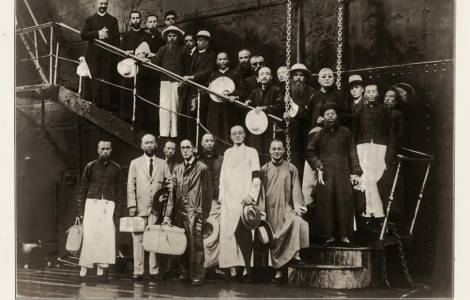
Shanghai (Fides News Agency) – Exactly one hundred years ago today, on September 10, 1926, the long blast of the ship’s sirens in the port of Shanghai announced the departure of the ship carrying six Chinese Apostolic Vicars. They were accompanied by Archbishop Celso Costantini, the first Apostolic Delegate to China, who two years earlier had prepared and led, on behalf of Pope Pius XI, the “Primum Concilium Sinense”, the Council of the Church in China held precisely in Shanghai in 1924. The Apostolic Delegate was accompanying the six Apostolic Vicars to Rome, where they were expected to receive episcopal ordination from the hands of the Pope himself.
The solemn ceremony of consecration, celebrated on October 28, 1926, in St Peter’s Basilica, attracted worldwide attention and interest. After their consecration, the Chinese bishops left Rome for a journey through four European countries, where they were welcomed with great enthusiasm. In Leuven, Belgium, crowds greeted them with cries of “Vive la Chine!” (“Long live China!”).
That journey stirred a sense of dignity and pride not only among the Catholic community in China, but throughout the Chinese nation—a nation which, just fourteen years earlier, had succeeded in breaking free from a semi-feudal and semi-colonial condition.
This is a page of history that deserves to be explored and studied with renewed interest. It therefore seems both useful and evocative to retrace that long journey, rich in fascinating and memorable details.
The following detailed account and travel diary is based principally on the information contained in the memoirs of Cardinal Celso Costantini (With the missionaries in China, 1922–1933), and in the work entitled Ricordi di due anni (二年的回忆, Memories of two years) by Venantius Zhao Huaixin.
He was the fifth brother of Bishop Philip Zhao Huaiyi. A priest, he had graduated from the Seminary of Beijing, where he taught advanced Latin. He accompanied his brother Philip Zhao, together with the other Chinese Vicars, on their journey to Rome. During the journey for their episcopal consecration, he served as secretary.
He subsequently worked at the Office of the Apostolic Delegate, within the Education Association. In 1927 he became the bishop’s secretary and, in the same year, was also appointed rector of the Minor Seminary of Xuanhua. In 1932, he became a professor at the Major Seminary; in 1937 he was also appointed vicar of Xuanhua. In 1948 he joined the diocesan advisory council of the Diocese of Xuanhua. He died in July 1949.
The sea voyage to Europe
On September 10, 1926, the six Apostolic Vicars set sail from Shanghai. We boarded an American ship in Shanghai; to avoid any possible misunderstanding, we chose neither a French nor an Italian ship. A large crowd of the faithful came to see us off, and emotion was evident on everyone’s face.” (Celso Costantini)
They arrived in Hong Kong on September 13. Church authorities and the faithful welcomed them at the port. They visited the “Nazareth Printing Press” and the Bethany Home. On September 14 they resumed their voyage by sea.
They arrived in Manila on September 16. They were exempted from all immigration and customs formalities. There they were welcomed by the Apostolic Delegate to the Philippines, religious men and women, and numerous faithful. They visited the Dominican convent and church, as well as the University of Santo Tomás. The welcome ceremony was attended by the Archbishop of Manila and the Chinese consul in the Philippines. They also visited St Francis Church and St Ignatius Church. The welcoming ceremony organized by the Catholic Youth Association was attended by the Archbishop of Manila, the Apostolic Delegate and the Chinese consul in the Philippines. On September 17 they resumed their voyage.
They reached Singapore on September 21. Priests and faithful welcomed them at the port and accompanied them to the bishop’s residence. They visited a church attended by the Chinese community, the museum and St Joseph’s Church of the Congregation of St Paul. The faithful gave them a warm welcome and collected offerings for them. On September 22 they resumed their voyage by sea.
Penang (Malaysia)
They arrived in Malacca, Malaysia, on September 24. The local bishop and priests welcomed them at the port. They visited the church and the major seminary. On September 25 they resumed their voyage.
They then arrived in Colombo, Sri Lanka, on September 29 and went to the bishop’s residence. In the evening they resumed their journey by sea.
On October 4 they passed the island of Socotra.
They entered the Red Sea on October 7. On October 11, the ship entered the Suez Canal, and on October 12 it reached the northern entrance of the canal.
They disembarked in Alexandria, Egypt, on October 13. They visited St Catherine’s Church and resumed their voyage in the evening. The ship docked at the port of Naples on October 16. There they were welcomed by representatives of the Sacred Congregation de Propaganda Fide and about fifty other people.
Episcopal ordination and the journey through Europe
On October 17, the six Apostolic Vicars and their companions left Naples by train. The Italian government exempted them from baggage inspection and, as a gesture of welcome, provided three first-class compartments free of charge. It also assigned personnel to accompany and assist them throughout the journey.
Upon their arrival by train in Rome, they were welcomed on the platform by representatives of the Sacred Congregation de Propaganda Fide, the Cardinal Vicar of Rome, Chinese students and others who had come to greet them. At the station exit, the passage normally reserved for the King of Italy was opened especially for them.
“The day after our arrival in Rome, the Pope was to receive us. I said that we didn't yet have Roman vestments; the Pope replied: ‘Chinese clothing is fine too.’” (Celso Costantini). Pius XI warmly embraced each of the six future bishops.
On October 28, the feast of the Holy Apostles Holy Apostles Simon and Thaddeus, the solemn liturgy of episcopal consecration took place in St Peter’s Basilica.
On October 29, the newly consecrated bishops visited the Catacombs of Domitilla.
On October 30, the Prefect of Propaganda Fide provided them with a car so that they could visit Castel Gandolfo, the Pope’s summer residence. They subsequently visited numerous religious and cultural sites and institutions in Rome, including the House of the Congregation of the Mission of St Vincent de Paul; the Colosseum; the Basilica of St John Lateran; the Basilica of Holy Cross in Jerusalem; the Church of Our Lady of Consolation, where a meeting was held; the Sistine Chapel; the Gregorian University, where a welcome ceremony was organized; the Roman Seminary, where they were received by six cardinals, about forty bishops, numerous priests and many other people; the tomb of St Peter; the Trappist monastery; the Franciscan convent; the Basilica of St Lawrence Outside the Walls; and the Basilica of St Cecilia in Trastevere.
On November 10, during another audience with the Pope, Pius XI said:“I hope that you will be able to come to Rome more often. Today, transportation is still developing, and therefore it takes a lot of time; in the future, transportation will certainly improve, and if one travels by plane, one will be able to get from China to Rome and back in just a few days.” (Father Venantius Zhao Huaixin)
The Chinese bishops then also visited the Church of Trinità dei Monti, the Pontifical Urbaniana University of Propaganda Fide, the Dominican church, the Jesuit church, and the headquarters of the Knights of Columbus.
On November 15, as they began their journey through Italy and other European countries, the Chinese bishops departed from Foligno railway station. The local bishop, priests, Chinese students and faithful accompanied them to the station to bid them farewell. Once again, the Italian government assigned personnel to accompany and assist them during the journey.
They subsequently visited Assisi, (the Basilica of St Francis and the Basilica of St Clare); Loreto, (the Basilica of the Holy House); Padua (the Basilica of St Anthony); and Udine, the city linked to Blessed Odoric of Pordenone and the birthplace of Celso Costantini.
On November 30, they arrived in Milan, where they were welcomed at the train station by numerous priests and faithful. They visited the Pontifical Institute for Foreign Missions (PIME), the Archdiocese of Milan, the Basilica of St Ambrose, and the Cathedral (Duomo), dedicated to the Nativity of the Blessed Virgin Mary.
On December 6 they arrived in Turin, where they visited the offices of the Archbishop’s Curia. Then their journey through France began.
On December 8, the new Chinese bishops arrived in Lyon, where they visited the bishop’s residence and places associated with the Curé of Ars, St John Mary Vianney.
On December 9 they reached Paris. During their stay, they attended a reception offered by the Cardinal Archbishop and visited the Congregation of the Mission (Vincentians), the Congregation of the Daughters of Charity and the Basilica of the Sacred Heart. The Chinese Ambassador to France hosted a banquet for them at the embassy. They also visited the Association of Far Eastern Students in Paris and Notre-Dame Cathedral. In addition, they attended a reception organized by the Missionary Friendship Association, which was attended by more than two hundred people.
They then travelled to Paray-le-Monial, where they visited the famous Basilica of the Sacred Heart, and then continued on to Lisieux, where they visited the Shrine of St Thérèse of the Child Jesus.
On their way to Belgium, they arrived in Brussels on December 20. Priests and faithful gave them a warm welcome at the station. They then went to the residence of the Chinese Ambassador to Belgium, visited St Louis College, the Curia and the church of the Archdiocese of Mechelen, and were received by the Queen of Belgium. Afterwards they visited the Cathedral of Brussels.
Upon their arrival at Leuven railway station, they were welcomed by university professors, priests and faithful. Along the route, French-Chinese and five-colour flags were displayed. The Association of Chinese Catholic Youth in Belgium and numerous members of the Chinese community greeted them with cries of “Long live China!” (Vive la Chine!).
They then attended a welcome dinner organized by the American College, where they were also accommodated. The American College was regarded as one of the colleges of the Catholic University of Leuven offering the best standards of food and accommodation.
During their stay, they also attended a reception organized by Chinese students, during which Bishop Philip Zhao Huaiyi delivered a speech in French. They visited St Michael’s Church, the Jesuit church and the Franciscan convent; attended a reception offered by the rector of the Catholic University of Leuven; took part in a reception hosted by the Chinese students of Leuven; and attended a social gathering at the Sacred Heart girls’ school. They also visited a Benedictine convent.
In Malines (Mechelen), they visited the parents of Father Vincent Lebbe and the Congregation of the Scheut Fathers (Congregatio Immaculati Cordis Mariae).
They reached the Netherlands on December 27. During their train journey, they changed trains at Breda, where they were welcomed at the station by the local vicar and other ecclesiastical authorities.
In Utrecht, while making another train change, they were welcomed by the Episcopal Vicar, who accompanied them to the bishop’s residence, where they were invited to lunch.
They then continued by train to Amsterdam. Upon their arrival at the station, they were welcomed by a large crowd. Bicolor and five-colour flags were displayed on the front of the cars transporting them.
During the welcome dinner, they visited the Pontifical Society of St Peter the Apostle, as well as four important churches. They also visited the cities of Haarlem, Rotterdam, Breda and Nijmegen.
On January 1, 1927, they returned to Belgium and travelled to Ans, where they visited the Jesuit commercial School and the Basilica of Our Lady. During the welcome ceremony, the Chinese consul in Ans also delivered an address.
They then continued to Liège, where they visited the Congregation of the Mission of St Vincent de Paul and its church.
They then reached Namur. A large crowd welcomed them at the station, while the flags of various associations and organizations were displayed along the route. A welcome ceremony was held at the bishop’s residence and cathedral, during which Bishop Philip Zhao Huaiyi delivered a thank you speech in French.
On January 6, they travelled by train to the border between Belgium and France. The Chinese bishops were exempted from customs and border controls. At the station they were welcomed by priests of the Paris Foreign Missions (MEP).
They had lunch at the Apostolic Nunciature in France in the presence of two cardinals, two auxiliary bishops and other bishops, for a total of more than twenty people.
On January 9, they left Paris, accompanied to the station by a large crowd.
They then visited Bordeaux and Dax, where they were welcomed at the station by numerous people and by Vincentian priests. They then travelled to the birthplace of St Vincent de Paul before continuing to Lourdes.
On January 12 they arrived in Marseille, where numerous priests belonging to different religious orders and congregations welcomed them at the station. They visited the bishop’s residence and the Basilica of Notre-Dame de la Garde.
The return journey to China by sea
On January 14, the Chinese bishops sailed from Marseille. They had purchased second-class tickets, but the shipping company, as a gesture of courtesy, upgraded them to first class free of charge.
On January 18 they passed near the island of Crete.
On January 19 they reached the northern entrance of the Suez Canal.
On January 25 they passed through Djibouti.
(Meanwhile, Bishop Simon Zhu Kai-min of Haimen, who had separated from the group and travelled through the United States before continuing to Canada, arrived in Ottawa on January 28).
On February 1, 1927, the bishops returning to China stopped in Colombo, Sri Lanka.
On February 5, they crossed the Strait of Malacca.
On February 7, they arrived in Singapore. Bishops, priests and faithful came aboard to welcome them. They visited the bishop’s residence and again a church attended by the local Chinese community; they took part in a welcome ceremony and visited a boys’ school and a girls’ school.
On February 10, still on their return journey, they arrived in Saigon, where they were welcomed by priests of the Paris Foreign Missions Society and other religious. They visited the bishop’s residence, the Carmelite Congregation and the Congregation of the Sisters of St Paul.
On February 16 they arrived in Hong Kong. Bishops, priests and faithful came aboard to welcome them. A reception in their honour was held at the bishop’s residence.
On February 20 they finally landed in Shanghai. At the port they were welcomed amid the sound of firecrackers and fireworks. They then went to the bishop’s residence and took part in a solemn Mass of thanksgiving at Yangjiabang Church (洋泾浜).
Historical context
In order to appreciate the significance of the first episcopal consecrations of Chinese bishops, it is useful to bear in mind the turbulent historical events that marked the decades before and after this important ecclesial event.
On October 10, 1911, the Wuchang Uprising broke out, triggering the Xinhai Revolution, which led to the overthrow of the imperial dynasty and the end of the monarchical order.
On January 1, 1912, Sun Yat-sen assumed office in Nanjing as provisional President of the Republic of China.
On May 14, 1912, the provisional Senate of the Republic adopted the five-colour flag as the national flag. It consisted of five horizontal stripes—red, yellow, blue, white and black, from top to bottom—symbolizing the ideal of a “Republic of Five Races” (五族共和).
On December 12, 1915, Yuan Shikai proclaimed an Empire and assumed the title of Emperor. On March 23, 1916, compelled by circumstances, he abolished the monarchy once again. This was followed by a period of turmoil and clashes among the “warlords,” together with political division between North and South.
On December 29, 1922, the first Apostolic Delegate to China, Celso Costantini, arrived in Beijing, then the capital of the government of the Republic of China.
From May 15 to June 12, 1924, the Primum Concilium Sinense was held in Shanghai.
It was against this backdrop that, on September 10, 1926, the journey recounted in this article began, bringing six Chinese Apostolic Vicars to Rome to receive episcopal consecration from the hands of Pope Pius XI.
On December 17, 1928, the Nationalist government in Nanjing formally adopted by law the Blue Sky, White Sun and Red Earth flag as the national flag.
On December 29, 1928, in what became known as the “Northeast Flag Replacement,” the five-color flag was replaced by the Blue Sky and White Sun flag (青天白日), marking the formal reunification of North and South China under the Nationalist government.
On May 14, 1934, Apostolic Delegate to China, Mario Zanin arrived in Nanjing, then the capital of the government of the Republic of China.
In July 1942, the Republic of China and the Holy See established formal diplomatic relations.
In 1943, the government of the Republic of China established a legation in Rome; its first Prime Minister Plenipotentiary was Xie Shoukang.
In 1946, the ordinary ecclesiastical hierarchy was established in China. The Holy See established the Apostolic Nunciature in China (Nuntiatura Apostolica in Sinis) in the capital, Nanjing.
(Fides News Agency, 10/9/2026)
* Priest, Director of the Institute for Catholic Studies and Culture in Beijing.



 VATICAN - Course for new Bishops: Bishop García Macías: Inculturation can become one of the most beautiful forms of Evangelization, “when it enables a people to recognize that Christ is no stranger to them”
 Cardinal Tagle to the new Bishops of the new Churches: let us walk together in this time of “missionary conversion”
 VENEZUELA/COLOMBIA - When the earthquake has passed, brothers and sisters remain by the side of those who continue to suffer
 At the Course for Newly Appointed Bishops, practical tools for missionary communion with the Successor of Peter were presented
 The Pontificate of Leo XIV and Global Politics: A lecture by Massimo Faggioli at the Gregorian University
 EUROPE/ROMANIA - Faith that unites peoples: The memory of Pope Luciani celebrated in the church of Italian migrants
 Pope in France/III - Metz, at the roots of European peace in the “city of three borders”
 “Research on the History of Catholicism in China”: A new “road map” tracing six centuries of Catholicism in China