
Information service of the Pontifical Mission Societies since 1927
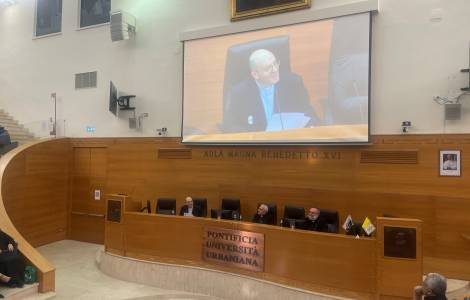
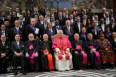
Rome (Fides News Agency) – Newly appointed bishops who have gathered in Rome to take part in formation courses organized for them by the Dicasteries of the Holy See have had the opportunity to receive detailed information on a range of initiatives and resources available to them to fully live out and express their episcopal concern for the mission of the universal Church, within the bond of communion that unites each Successor of the Apostles with the Successor of Peter, the Bishop of Rome.
The afternoon session yesterday, Tuesday, 8 September, was held in the Aula Magna of the Pontifical Urbaniana University. It brought together bishops enrolled in the course organized by the Dicastery for Evangelization (Section for First Evangelization and New Particular Churches) and bishops attending the corresponding formation course organized by the Dicastery for Bishops.
In their presentations, the speakers stressed that the institutions and initiatives being presented are rooted in the Church’s millennial history.
Peter’s Pence and the widow in the Gospel
Archbishop Filippo Iannone, Prefect of the Dicastery for Bishops, opened the session by tracing the history of Peter’s Pence, “a voluntary offering made by the faithful directly to the Pope”. Its name, he explained, recalls the “small gift” of the widow in the Gospel (Mk 12:41-44), an act of generosity made from the heart, not based on abundance.
Officially established under King Offa of Mercia in the seventh century as the “Denarius Sancti Petri”, it became in the Middle Ages a “regular tax tribute ... often contested because of abuses”, before coming to an end with the Protestant Reformation. Pope Pius IX revived the practice after 1870 through the encyclical Saepe Venerabilis, presenting it as a “voluntary offering of the faithful throughout the world”. Archbishop Iannone quoted St John Paul II, who said that “Peter’s Pence constitutes a genuine participation in the Church’s evangelizing action” and Benedict XVI, who described it as “the most typical expression of the participation of all the faithful in the good initiatives of the Bishop of Rome”. Following Pope Francis’ Motu Proprio of 26 December 2020, Peter’s Pence remains administered under the direction of the Secretariat of State, but is administered by APSA, under the supervision of the Secretariat for the Economy, “in order to ensure greater transparency”.
Regarding Canon 1271, which was “new to canon law” in the 1983 Code of Canon Law, Archbishop Iannone clarified that “the norm is not intended to impose a tax. It simply reminds bishops of an obligation inherent to their office”. He quoted the text: “By reason of the bond of unity and charity and according to the resources of their dioceses, bishops are to assist in procuring those means which the Apostolic See needs, according to the conditions of the times, so that it is able to offer service properly to the universal Church.”
Funds and Colleges in Rome in the long history of Propaganda Fide
Archbishop Samuele Sangalli, Adjunct Secretary for the Administration of the missionary Dicastery, followed up on the presentation of the significance of Peter’s Pence and Canon 1271 by introducing “three other areas which belong to the same horizon”: the Pontifical Mission Societies (which were subsequently presented by Fr Tadeusz Nowak); the Ecclesiae Sanctae Fund, together with the Pro Afris Collection; and support for the Roman Colleges that provide formation.
The Ecclesiae Sanctae Fund, Archbishop Sangalli explained, “is the result of a process of reflection and analysis that lasted approximately seventeen years. Its origins can be traced back to the Second Vatican Council and to the Motu Proprio of the same name issued by His Holiness Pope Paul VI” on 6 August 1966. It was intended to involve “the world’s Bishops... by inviting them to make an annual contribution specifically to the Dicastery in support of its missionary service”.
The Fund provides scholarships for the Pontifical Urbaniana University and its five Colleges, as well as the provision of books to Major seminaries.
As regards the Pontifical Pro Afris Collection, “it was established by Leo XIII in 1890 to support those working for the liberation of slaves in Africa”. It was subsequently confirmed by Paul VI in 1976, “extending its purpose to the liberation of people from all forms of slavery”. Today, the Dicastery draws on the Collection to support courses organized by I.C.O.F. (an inter-congregational group for ongoing formation) for pastoral workers who have suffered “physical, psychological, and spiritual trauma” in war zones or in contexts of human trafficking.
Archbishop Sangalli focused particularly on the Colleges of formation in Rome, heirs to the Congregation de Propaganda Fide (1622): The Pontifical Urban College (1627) which will celebrate its fourth centenary next year, welcomes “approximately 170 seminarians” each year from Africa, Asia, Oceania and the Apostolic Vicariates of Latin America. The Colleges of San Pietro (1946) and San Paolo (1965) each accommodate “between 150 and 200 priests”. The Mater Ecclesiae College (1979), in Castel Gandolfo, welcomes “approximately 130 young religious women”. The Collegio San Giuseppe, located on the Janiculum since 2006, welcomes each year rectors and formators from “425 minor seminaries, 135 propaedeutic seminaries and 270 major seminaries” for formation courses.
The Pontifical Urbaniana University has 97 affiliated institutes in 40 countries. The Adjunct Secretary of the missionary Dicastery concluded: “We need the support of all the local Churches, so that these Colleges may continue to provide the service for which they were established.”
The “Secret” of the Pontifical Mission Societies
As Coordinator ad interim of the Presidency of the Pontifical Mission Societies (PMS), Fr Nowak opened his presentation with a humorous observation, noting that “the Pontifical Mission Societies are the best-kept secret in the Catholic Church”, since even many bishops and priests “do not really know who we are”.
Fr Nowak briefly outlined the origins and profiles of the four Pontifical Mission Societies: the Pontifical Missionary Union, described by Paul VI as the “soul” of the four PMS; the Society of St Peter the Apostle, which supports seminaries and novitiates; the Pontifical Society of the Holy Childhood, whose motto is “Children helping children”; and the Pontifical Society for the Propagation of the Faith (POPF), founded by Blessed Pauline Jaricot in Lyon in 1822.
Fr Nowak, Secretary General of the POPF, described the Society as “a partner and not patron or funder” of the local Churches. He also highlighted the wide range of ordinary and extraordinary subsidies distributed each year by the POPF to support the mission of the particular Churches, while stressing the principles of transparency and sustainability ensured by the procedures governing the allocation of resources.
(MLK) (Fides News Agency, 9/9/2026)



 VATICAN - “September courses” in Rome for 147 newly appointed Bishops
 Archbishop Nwachukwu’s “compass” for Catholic communicators: “You are disciples before being influencers”
 ASIA/PHILIPPINES - "A truly missionary Church does not impose political choices, but it helps the faithful discern wisely"
 AMERICA/COLOMBIA - The commitment of the Pontifical Mission Societies after the earthquake: Amid destruction and suffering, mission becomes closeness, comfort and fraternal service
 ASIA/MONGOLIA - Farewell to Father Robert Goessens, pioneer of the Catholic mission in Mongolia
 LATIN AMERICA - "Care unites us": CELAM, CLAR and Caritas promote a culture of "caring for others"
 EUROPE/ROMANIA - Faith that unites peoples: The memory of Pope Luciani celebrated in the church of Italian migrants
 Pope Leo: a united and missionary Church which becomes a 'leaven' for a reconciled world
 The Pontificate of Leo XIV and Global Politics: A lecture by Massimo Faggioli at the Gregorian University
 Leo XIV, Saint Augustine, and the two Cities