
Information service of the Pontifical Mission Societies since 1927
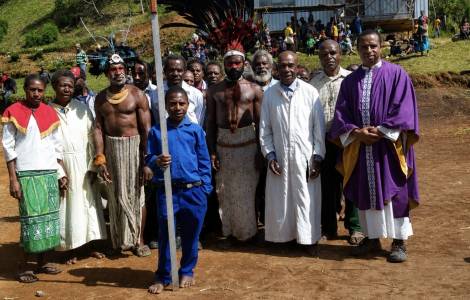
Cristian Sieland (personal collection)
by Marie-Lucile Kubacki
Port Moresby (Fides News Agency) - As the Diocese of Bougainville marks a historic 125 years of the arrival of the first Catholic missionaries, the three-week jubilee celebrations will culminate in a grand finale in the North Region from August 14 to 17, 2026.
Rooted in the early Marist arrivals at Pokpok (1901) and Buin (1903), the local Church has grown from a fledgling mission sustained by lay catechists through WWII and the Bougainville crisis into a vibrant diocese of over 200,000 believers across 35 parishes.
The highlight of this final leg will coincide with the pastoral visit of His Eminence Luis Antonio Cardinal Tagle, who will preside over the solemn Jubilee Mass on August 16 at Our Lady of the Assumption Cathedral in Hahela. His four-day itinerary in Buka also includes local parish visits, hospital ministry, meeting regional leaders, and blessing a new diocesan building.
On the occasion of these celebrations, Father Christian Sieland, National Director of the Pontifical Mission Societies, reflects for Fides on the history of evangelization in Papua New Guinea.
Can you first tell us more about your personal story?
I speak as someone who had the distinct privilege of growing up in PNG during an era when our local Church was almost 90% staffed by foreign missionaries. My own father was a lay missionary recruited by Misereor in Germany, and he worked side by side with priests and religious brothers and sisters for over 20 years. Today, I am part of a local clergy that finds itself in a critical period of transition—moving from a missionary church to a fully local church.
Personally, I believe the most vital values I have inherited are respect and appreciation. Our modern generation has lost some of its connection to the past; many young people today struggle to speak their local vernacular languages, communicating only in Tok Pisin and English. By fostering deep respect and appreciation, local values can be preserved, and the virtues of the Gospel can be meaningfully integrated into people's lives. In that sense, inculturation is an ongoing journey.
In our formation programs, we constantly remind our local catechists, lay leaders, and priests never to forget their cultural heritage, and to truly make the Gospel message their own. The faith has successfully taken root, but it needs to grow even deeper to bring about the radical social transformations required to completely heal wounds like sorcery-related accusations, polygamy, and tribal fighting.
Your own family story is closely linked to the history of evangelization in Papua New Guinea. How did the testimony of both your Papuan relatives and the missionaries influence your vocation as a priest?
After finishing high school in Germany, I was drafted for military service. However, following my Christian conscience, I chose to object to the draft. Instead, I joined the SVD as a youth missionary volunteer through a program called "Missionar auf Zeit" (Missionary for a Time). This program allowed young people from German-speaking countries to gain hands-on missionary experience for 9 to 15 months in a mission territory.
Because I wanted to serve in Papua New Guinea, I did my volunteer service there from September 1999 to December 2000. My direct encounter with the international community of SVD missionaries, and particularly my close friendships with some of them, sparked my own calling to the priesthood. Without that encounter, I would not be a priest today.
I also come from a deeply committed Catholic family. Without the hard work of my parents, who raised us intentionally with Christian values, I would not have answered this call. So, my vocation was shaped first by the witness of my family, and secondly by the dedicated missionaries who have tirelessly evangelized our people.
Looking back over more than 120 years of Catholic presence, what major stages do you identify in the journey from the first mission stations to a Church that is now led largely by local clergy?
Based on my own knowledge, pastoral experience, and historical reflection, I would say we are currently looking at the fourth or fifth generation of people who have accepted the Gospel since it was first preached by the pioneers. The first missionaries to enter our region set foot on our lands in the early 1930s. My home parish of Denglagu was the very first Catholic mission station established in the entire Highlands region of Papua New Guinea, founded in 1934. From that base, the missionaries ventured further into other territories across the Highlands.
Before the 1930s, our people had no contact with the outside world, making that a monumental historical moment—it was our very own "1492." In 2034, we will celebrate 100 years of evangelization in the Highlands.
The presence of the Church also brought essential social services and structural development to our country. Following the Second World War—which was utterly disastrous for our local Church and various missionary congregations—a second wave of missionaries arrived to rebuild the infrastructure that had been destroyed. The third and fourth generations of missionaries arrived in the 1970s and 1980s.
The 1990s marked a major turning point with a significant increase in indigenous vocations, a number that expanded even further in the 2000s. This is where our current generation of Christian leadership comes in. We are now a local Church in transition. This means we must learn how to be self-reliant, sustainable, and confident in our unique Christian identity as a Melanesian Church. This is the great challenge we face in the coming years: as the number of foreign missionaries declines, the expectations on us, the local clergy, to take full ownership and lead will continue to rise.
In a country marked by strong cultural and tribal diversity, what do you see as the main challenges for building unity within the Church, and what positive developments give you hope?
Our country is rightly described as one of the most culturally diverse nations on Earth. We are a tribal society boasting over 800 distinct languages and ethnic groups. It is a beautiful miracle that, as a young country, we have successfully celebrated 50 years of independence (1975–2025) as a unified, democratic, and predominantly Christian nation—despite significant social, tribal, economic, and political challenges.
I firmly believe that the most powerful unifying factor in our country is our Christian identity. This unity is most vibrant within the Church, where people from all backgrounds, regions, and tribes gather together as one family. It is powerful to witness moments where individuals from historically rival tribes sit down and collaborate as a team on a parish pastoral council.
Since the very beginning of evangelization, the churches have played a monumental role in uniting the thousand tribes of New Guinea. While national unity is still a work in progress, the Church has done an exceptional job laying the groundwork and fostering a shared national identity by providing schools and health centers open to everyone, regardless of tribal lines.
The primary challenges to this unity stem from political divisions and the lingering grip of ancestral customs, such as the "eye-for-an-eye" payback system, which can trigger endless cycles of conflict and tribal warfare.
Traditional beliefs, including fears linked to sorcery and the spirit world, remain very present in some areas. How does the Church seek to accompany people with respect, while helping them to deepen their understanding of the Gospel?
Traditional beliefs, sorcery-related accusations, violence, and a fear-based relationship with the spirit world remain prevalent in many parts of the country, even among practicing Catholics. The Church is one of the few institutions that approaches traditional belief systems with pastoral sensitivity while remaining firmly truthful about the cultural practices that are entirely incompatible with Christian faith.
The Catholic position is uncompromising: we cannot genuinely live as Catholics while continuing to harbor beliefs in sorcery and witchcraft. The Church also firmly opposes polygamy, which remains common, particularly among wealthy men.
To address this, my own diocese, along with many others, operates pastoral centers. These centers run courses and workshops in close partnership with NGOs and government departments to train church leaders and community volunteers. Participants are equipped to become advocates and counselors for victims of domestic violence, sorcery-related accusations, and other structural social issues. Furthermore, some are trained specifically in conflict resolution and peace mediation, and are actively deployed into active tribal warfare zones.
Through these initiatives, the ecclesial community actively accompanies victims of violence while simultaneously raising community awareness to eradicate harmful traditional practices. We are working to help people embrace the transformative power of Gospel truth, love, and forgiveness. The situation is not yet perfect, but the Church is leading the way in advocacy, protection, and human formation.
In Papua New Guinea, there is a rich diversity of tribes and cultures. From your experience, what opportunities and what challenges does this diversity create for building communion within the Church?
I can speak to this reality deeply from my pastoral experience as a former parish priest. The challenges are ever-present. Our reality is quite different from the multicultural societies of Europe, where people from completely different countries migrate to live and work together. In Papua New Guinea, our diversity is internal—we are made up of different tribes and ethnic groups who share a common Melanesian heritage. Therefore, our first unifying building block should naturally be our shared Melanesian identity. However, in practice, it is rarely that simple because we are still deeply bound to a complex, localized tribal system.
This immense diversity should be viewed as a profound blessing. It can be utilized by the Church to demonstrate that just as different parts of a body make up a whole, our distinct tribal identities can contribute uniquely to the unity of both the Church and the independent nation.
A beautiful example of this unity is our national blessed, St. Peter ToRot. Even though he was from Rabaul (New Britain), every Catholic across Papua New Guinea proudly claims him, saying, "He is one of us." His specific tribal and regional background fades into the background because he died as a catechist, a martyr, and a Catholic. This shows the incredible opportunities we have to build true communion.
Where tribal fights continue to devastate certain regions, the churches are consistently at the forefront of mediation, leading peace talks and reconciliation efforts. Because the local population frequently trusts the integrity of the Church far more than they trust their political leaders, our training workshops for community peace mediators are incredibly impactful.
We still have a long way to travel to realize a flawless sense of national and spiritual unity. However, the Church has successfully blazed the trail. With continued patience and perseverance, I am confident that this steadfast commitment will ultimately bear fruit in lasting reconciliation and unity.
(Fides News Agency, 12/8/2026)



 The seed of the Gospel and mission: Archbishop Sangalli concludes the formation Course for bishops in Nemi with a meditation on St Charles de Foucauld
 AFRICA/MALAWI - Archbishop Nwachukwu at the Jubilee marking 125 years of the Gospel in Malawi. Two new priests for a Church called to set out anew on mission
 The Church of the Sheaves: a missionary perspective presented to Newly Ordained Bishops
 ASIA/CHINA - Andrew Ding Yang ordained Archbishop of Chongqing
 LEO XIV IN AFRICA - The Pope to the Angolans: The Risen Jesus can also heal the wounds of your people
 LEO XIV IN AFRICA - Eastern Angola: plundered riches, calls for autonomy, and witchcraft
 The Centenary of the consecration of Six Chinese Bishops and the Provisional Agreement between the Holy See and the People’s Republic of China