
Information service of the Pontifical Mission Societies since 1927
by Marta Zhao
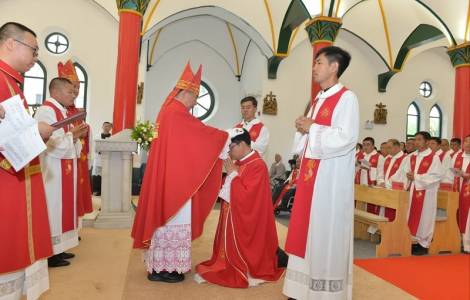
Chifeng (Fides News Agency) – More than 400 bishops, priests, women religious and lay faithful attended the episcopal ordination of Father Joseph Chang Yanfeng as Bishop of Chifeng, a diocese located in the Chinese province of Inner Mongolia, on the morning of Wednesday, July 22.
According to the statement released by the Holy See Press Office, Pope Leo XIV appointed Joseph Chang Yanfeng Bishop of Chifeng on Monday, June 15, "having approved his candidature within the framework of the Provisional Agreement between the Holy See and the People’s Republic of China."
The ordination liturgy was presided over by Bishop Meng Qing Lu of the diocese of Hohhot. The co-consecrating bishops were Bishop Yao Shun of Wumeng (Inner Mongolia) and Bishop Pei Jun Min, Bishop of the Diocese of Liaoning.
During the celebration, Father Joseph Yang Yu, Secretary of the so-called Chinese Catholic Bishops' Conference, referred to the Pope's appointment of the new Bishop and read the decree of approval issued by the Conference.
Formation in South Korea
Born on April 4, 1984, the new Bishop studied at Shenyang Theological Seminary from 2000 to 2006, and then completed a pastoral internship at the parish of Lindong. From 2007 to 2010, he continued his studies at the Catholic University of Daejeon, South Korea, earning a Licentiate in Biblical Theology.
He was ordained a priest for the Diocese of Chifeng on November 18, 2010. From 2010 to 2013, he served in the diocesan curia, while also carrying out pastoral ministry in several parishes. From October 2013 to September 2019, he served as parish priest of Chifeng Cathedral, and subsequently, from 2019 to 2021, as parish priest of Lindong.
Since October 15, 2021, he has served as Diocesan Administrator of Chifeng.
Throughout these five years he devoted himself to proclaiming the Gospel and fostering the spiritual and communal life of the local Church. He led retreats for the diocesan clergy and promoted works of mercy and charity, particularly for the poor, the vulnerable, the sick and the elderly. Familiar with digital communications, he has also used social media as part of his pastoral ministry, warning the faithful against online scams by fraudsters posing as fundraisers for church construction projects or for sick priests.
A journey that continues
With Pope Leo XIV's appointment and today's episcopal consecration, the number of Chinese Catholic bishops ordained within the framework of the Provisional Agreement on the Appointment of Bishops between the Holy See and the People's Republic of China has risen to fifteen. The Agreement, first signed on September 22, 2018, was renewed in 2020 and 2022 before being extended for four years in October 2024.
The process leading to Bishop Chang Yanfeng's appointment and consecration was carried out under the pontificate of Pope Leo XIV. The current Successor of Peter continues to follow the appointment and ordination of Chinese bishops with the solicitude of the universal Pastor. Having himself gained extensive missionary experience, Pope Leo desires that Chinese Catholics may continue to live their faith peacefully and joyfully in the faith of the Apostles, proclaim the Gospel, heal divisions within the ecclesial community, and remain firmly rooted in the communion and unity guaranteed by the communion between the bishops and the Successor of Peter.
Since the beginning of his pontificate, Pope Leo XIV has appointed several new bishops in China and has also entrusted bishops already ordained with new pastoral responsibilities.
On June 11, 2025, the Vatican Press Office announced "the recognition of the civil effects and the taking of possession of the office of Msgr. Joseph Lin Yuntuan, whom the Holy Father, in the framework of the dialogue regarding the application of the Provisional Agreement between the Holy See and the People’s Republic of China, appointed on 5 June 2025 as auxiliary bishop of Fuzhou (Fujian Province, China), took place." Bishop Lin welcomed the appointment and declared himself "ready to cooperate."
Subsequently, on July 8, Pope Leo XIV suppressed the two dioceses of Xuanhua and Xiwanzi, which were erected on 11 April 1946 by Pope Pius XII, and at the same time to erect the new diocese of Zhangjiakou, suffragan of Beijing. On September 10, 2025, Fr. Joseph Wang Zhengui, appointed Bishop of Zhangjiakou by Pope Leo XIV, received episcopal consecration.
On October 15, 2025, Ignatius Wu Jianlin was ordained Auxiliary Bishop of Shanghai. Pope Leo XIV had appointed him bishop on August 11, 2025. On December 5, 2025, Francis Li Jianlin, appointed Bishop of the Apostolic Prefecture of Xinxiang (Henan Province), also received episcopal ordination following his papal appointment on August 11.
As Cardinal Luis Antonio Tagle, Pro-Prefect of the Dicastery for Evangelization, observed on October 10 during the presentation of the proceedings marking the centenary of the ‘Primum Concilium Sinense,’ "When Catholic communities in China are discussed today, attention is usually focused on issues of episcopal appointments, local incidents, relations between the Chinese political authorities and the Holy See, or problems related to the state's religious policy."
Such "selective attention," however, often ignores "the real daily life and ordinary journey of Chinese Catholic communities. It ignores the vast network of prayers, liturgies, processions, catechesis, pastoral initiatives and charitable works, frequently inspired directly by the ordinary Magisterium of the Successor of Peter."
This observation also applies to the Diocese of Chifeng in the Autonomous Region of Inner Mongolia, which includes faithful of Han and Mongolian ethnic groups.
Pastoral ministry is carried out through urban and rural parishes, with particular emphasis on catechesis, the liturgy, lay formation and charitable outreach.
In modern times, Catholicism reached the Chifeng area around 1835, thanks to missionaries of the Paris Foreign Missions Society (MEP). From 1840 the mission was entrusted to the Vincentians. In 1865, the Holy See officially entrusted the Mongolian mission to the Congregation of the Missionaries of the Immaculate Heart of Mary (CICM), commonly known as the Scheut Fathers. Their founder, Fr. Théophile Verbist, arrived in Xiwanzi on December 6 of that year with other confreres, marking the beginning of the Congregation's missionary presence in Mongolia.
To provide more effective pastoral care across the vast territory, the Apostolic Prefecture was established in 1932 under the leadership of its first Apostolic Prefect, the Chinese Lucas Zhao Qinghua. In 1946, with the Apostolic Constitution Quotidie Nos, Pope Pius XII established the ecclesiastical hierarchy in China, elevating the Apostolic Vicariate of Chifeng to the rank of Diocese within the ecclesiastical province of Suiyuan (today Hohhot).
As the Gospel took deeper root and missionary work flourished, the Pacific War, the Chinese Civil War and the subsequent deterioration of the international situation brought immense suffering to both the local population and the Catholic community. Apostolic and missionary activity encountered increasingly severe obstacles.
Many priests, religious and lay faithful bore witness to Christ even to the point of shedding their blood. Their witness strengthened the foundations of the Church in Chifeng.
Following the reopening of China in the 1980s, six elderly priests who had survived years of re-education through labor returned to the diocese in 1981 under the leadership of Fr. Qiao Zhanying. Despite enormous difficulties, they courageously began rebuilding the local Church from the ruins left by previous years. They visited Catholic families one by one, sought to recover churches and ecclesiastical properties that had been confiscated or damaged, and gradually restored pastoral life.
The first seminarians were admitted in 1983 and sent to the Major Seminary in Beijing; a second group followed in 1985, studying at the Major Seminary of Inner Mongolia. At the same time, churches were repaired and parish life progressively resumed.
Today the Diocese of Chifeng numbers more than 50,000 faithful, organized in 16 parishes and 37 churches, served by around 30 priests and some 20 women religious.
The diocese has always placed great importance to formation through catechetical programs, spiritual retreats, priestly ordinations, courses for lay faithful on the liturgy and the documents of the Second Vatican Council, and ceremonies to confer the missionary mandate on the catechists.
During retreats, meditations were also entrusted to foreign missionaries such as the Dutch priest J. Kuepersoltre, as well as bishops and priests from other dioceses.
The community has lived in constant communion with the Universal Church by following the indications and messages of the Bishop of Rome, particularly on occasions such as World Youth Day, World Mission Sunday, and those dedicated to the poor and families. The ecclesial community is also deeply engaged in charitable outreach through its Social Service Center, which provides assistance to elderly people and scholarships for students from disadvantaged families.
(Fides News Agency, 22/7/2026)



 AMERICA/COLOMBIA - Earthquake in Chocó: Church community comes to the aid of displaced people. Bishops: “Recognize ourselves as one family”
 AMERICA/PERU - Edgard Rimaycuna, secretary to Pope Leo XIV, brings the Pope's blessing to Chiclayo
 "You will see greater things": FABC opens its 12th Plenary Assembly in Jakarta
 Keeping the threshold of the Mystery open. Leo XIV reveals to the new priests the "secrets" of their mission
 ASIA/CHINA - Coadjutor Bishop Anthony Li Hui succeeds Nicholas Han Jide at the helm of the Diocese of Pingliang
 VATICAN - Vietnamese-language online missionary formation course on Pope’s Message for World Mission Sunday begins on Saturday, August 8