Information service of the Pontifical Mission Societies since 1927
RVA
by Paolo Affatato
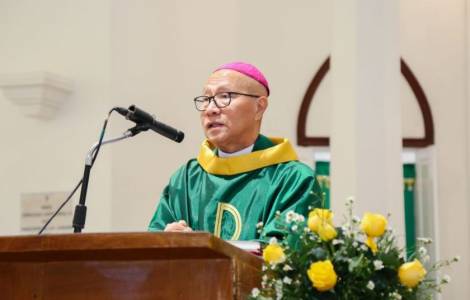
Mandalay (Fides News Agency) – “The word ‘hope’ always belongs to Christians. We do not place our hope in this world, nor in any person on earth. Our hope comes from God.” With these words, Archbishop Marco Tin Win of Mandalay describes to Fides the spirit with which the local Catholic community is facing one of the most difficult periods in its history, marked by civil conflict, the devastating earthquake of March 2025, and floods that have hit central Myanmar for two consecutive years.
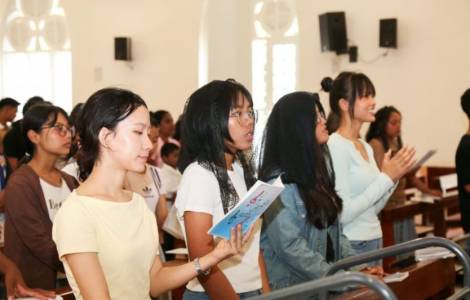
“The dramatic experience of the pandemic, war, floods and the earthquake has not driven people away from faith and the Church,” the Archbishop says. “On the contrary, the faithful have found greater comfort and consolation in God. They pray, celebrate the Eucharist, take part in spiritual retreats and pastoral activities. I myself practice and promote Christian meditation among the faithful, who attend these meetings with perseverance. In our hearts there is one certainty: hope comes from God.”
The Archdiocese of Mandalay is one of the most important ecclesiastical circumscriptions of the Catholic Church in Myanmar. It covers a vast territory where, among a population of about 10 million, baptized Catholics number approximately 21,000—just 0.2% of the overwhelmingly Buddhist population.
The archdiocese encompasses the regions of Mandalay, Sagaing and Magwe, now among the areas hardest hit by the social and humanitarian crisis caused by the Burmese civil conflict. Following the 2021 military coup, this part of the country became a major center of civil disobedience and later armed resistance, turning it into an area of intense fighting with severe consequences for civilians. Natural disasters—including the violent 2025 earthquake and flooding—have further deepened the population’s suffering.
“Seventeen churches in the archdiocese were severely damaged by the earthquake, including the cathedral and the pastoral center,” the Archbishop explains. “We are still working on restoration projects, especially the cathedral’s bell tower.” Among the buildings most seriously affected is the historic Church of St. Michael, also known as the “Lafon Church,” named after the missionary Father Jean Lafon of the Paris Foreign Missions Society (MEP), who lived and evangelized in the area. “Many homes were destroyed, and numerous families are still living in temporary shelters, struggling to meet their daily needs,” he adds.
The conflict and the earthquake have triggered a large-scale displacement of people. The local Church has converted many of its facilities into reception centers. “More than 700 displaced persons are currently taking refuge at the Marian Shrine of Our Lady of Lourdes in Chanthagon, in the Mandalay area, while parishes, monasteries and Catholic schools that remain usable continue to serve as temporary reception centers,” he reports.
“Priests, religious sisters and volunteers from Karuna—the local Caritas—provide hospitality, protection, and human and psychological support to families, the elderly, children and the most vulnerable,” the Archbishop says.
Archbishop Tin Win expresses particular gratitude to the clergy and religious, whom he describes as points of reference in a time of hardship and trial. “I am truly proud of my priests. When villages are burned or abandoned because of the conflict, priests and religious remain with the people. They continue to instill courage and hope. Their presence is truly precious.”
He also highlights the remarkable solidarity emerging among communities of different faiths. “When Catholic villages are destroyed, people find refuge in Buddhist villages. And vice versa, when Buddhist villages are burned, their inhabitants are welcomed into our Catholic villages. Interreligious solidarity grows stronger through shared suffering.”
Mandalay, a land rich in pagodas, stupas and Buddhist temples. Immersed in the heart of this culture, the local Church has developed over the years a particular vocation for interreligious dialogue and cooperation.
“Mandalay is the center of Burmese culture and Buddhist culture,” the Archbishop recalls. “That is why our presence here has a special meaning, conveying a message of coexistence and harmony.”
Although Catholics are a small numerical minority, the community is recognized for its contribution to education, human development and humanitarian assistance. Amid a social crisis that has lasted nearly five years, “parishes run informal schools, orphanages and vocational training centers, offering educational opportunities to children and young people in a context marked by poverty, lack of education and instability,” Archbishop Tin Win says.
The city also occupies a central place in the history of evangelization in Myanmar. “The roots of the Burmese Church are here,” he explains. “The first Catholic missionaries arrived in Mandalay, and from here the mission spread to the rest of the country.”
Archbishop Tin Win recalls with particular gratitude the work of the Barnabites, the first missionaries to arrive in Myanmar in 1722. They studied the Burmese language in depth, translated Catholic texts, compiled the first dictionaries and contributed to the birth of Christian literature in the local language. Among them, Monsignor Gian Maria Percoto, a scholar of Burmese history and culture, stands out.
He also remembers the sacrifice of the first Barnabite Apostolic Vicar, Monsignor Giovanni Battista Galizia, who was killed in the 18th century together with other confreres, as well as the contribution of the missionaries who arrived later, including the Oblates of the Virgin Mary, priests of the Paris Foreign Missions Society, missionaries of the Pontifical Institute for Foreign Missions (PIME), and others.
“We carry in our hearts the sacrifice of the missionaries, the gift of their lives and their blood: thanks to them we came to know Jesus Christ and the Gospel,” Archbishop Tin Win says. “I often tell the faithful that we are called to preserve and continue their legacy. Our prayers, songs and liturgical hymns in the Burmese language are the fruit of their dedication and tireless mission. Today, that legacy lives on in our daily witness of faith, hope and service, even in times of tribulation. The missionaries taught us to always trust in God and never to lose hope. In this way, we will be able to build an authentic peace.” (Fides News Agency, 3/7/2026)
RVA