Information service of the Pontifical Mission Societies since 1927
RVA
Vatican City (Fides News Agency) – Due to the civil war that has ravaged Myanmar since 2021, five bishops from the country's 17 dioceses have been forced to abandon their episcopal sees and cathedrals and have taken up residence in parishes located in safer areas, far from the clashes between the army and rebel groups.
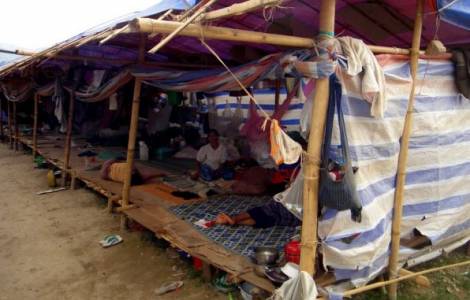
“They are the bishops of the dioceses of Pekhon, Loikaw, Banmaw, Mindat, and Lashio,” Bishop Felice Ba Htoo of Pekhon, in Shan State, explained to Fides. The prelate described the suffering endured by the country's pastors, who for the past five years have witnessed their nation being scarred by the conflict and its severe consequences for the population. “We bishops have not been immune to this reality either. Many of our parishes have been closed because they have been damaged, attacked, or because they have lost their faithful,” he noted. The bishops of Myanmar are currently in the Vatican for their ad limina Apostulorum visit. Today, they met with Pope Leo XIV, with whom they discussed the situation in the country and prayed for peace and reconciliation. Bishop Felice Ba Htoo described his current mission to Fides: “We don’t know what the future holds. We live in the present, trusting in God. Our task is to be close to the people, to the internally displaced scattered throughout the country: some in the jungle, others in refugee camps, others in villages less affected by the violence. We try to meet them, console them, and offer them a word of hope.” “With the Catholics, we celebrate the sacraments. We encourage them to live in a spirit of fraternity, cooperation, and mutual support, so that they can overcome this time of hardship. People are weary and traumatized by a conflict that has continued for five years. In this context of trial and suffering, we live our pilgrimage of hope,” he affirmed. Priests, religious, and catechists remain close to the population, he explained, preaching peace and reconciliation to prevent hatred from prevailing. “We trust in God and pray for a time of light for our future.” The Bishop also described the serious humanitarian situation in the diocese, which has received at least 40,000 newly displaced people from various faiths, seeking safe areas, especially in the western part of the diocesan territory. Access to water has become a determining factor in the displacements. “People are looking for places where there is water, because it is scarce in our area,” he said. In the early years of the conflict, local communities generously shared land and resources, but after five years of war, the situation has deteriorated: “Now, residents must support their own families and no longer have resources to share. The humanitarian situation has worsened.” Currently, thousands of displaced people live in more than 30 camps in the region, while others survive in makeshift settlements that allows them to survive. Church life has also been profoundly affected. “I had to leave the pastoral center in Pekhon and move to a parish in a village, dedicated to the Blessed Virgin Mary. We have had to close about seven of the 16 existing parishes,” the bishop noted. “Of the approximately 60,000 Catholics in the diocese, many have left their communities and moved to rural areas with their families.” Destruction of churches and convents has also been reported, especially in the central area of the diocese, where the largest Catholic population and main infrastructure were previously concentrated. The diocesan priests, he added, are living alongside the displaced in the camps, sharing their daily lives. “People trust them and feel protected.” Religious men and women and catechists continue to sustain community life, ensuring, as far as possible, the celebration of Sunday Mass, the education of children, and support for displaced families. “For us, priests and nuns, it is essential to accompany traumatized people. That is our main concern: to show them that the Lord continues to love them,” Msgr. Ba Htoo stated. With a touch of bitterness, the bishop concluded: “The situation is critical. Violence has plagued us for five years. People are exhausted, but they pray with tears in their eyes, with deep and sincere words. They pray the rosary, go to churches or makeshift chapels, and participate in Eucharistic adoration. This is no small thing: it means they maintain their faith in God and do not lose hope for a better future.”
Pekhon, in southern Shan State, is part of the southeastern front of the civil war, where episodic but persistent violence has been occurring. This is a territory of great strategic importance due to its communication routes, where the forces of the military junta and the local People's Defense Forces are clashing. In this complex and fragmented scenario, ethnic militias aligned with the government, such as the Pa-O National Organisation, have also been present. The area remains contested and highly unstable, with clashes between the army—which maintains control of some bases and the main roads—and the resistance groups, concentrated in rural areas and the surrounding hills. (PA) (Fides News Agency, 5/6/2026)