
Information service of the Pontifical Mission Societies since 1927
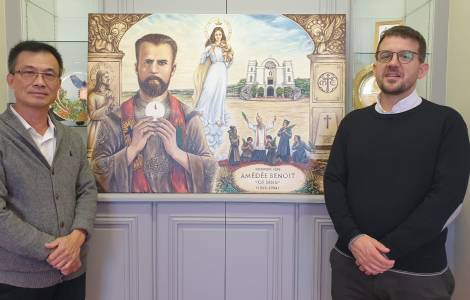
by Marie-Lucile Kubacki
Lyon (Fides News Agency) - "He died with the rosary in his hand, just as he had lived: a missionary totally given to others." With this evocative image, Father Benoît Campion summarizes for Fides the life of Father Amédée Benoît, a priest of the Paris Foreign Missions, born in Lyon in 1913 and died in Vietnam in 1954, among the people to whom he had been sent.
For many years, Father Campion served the Lyon parish from which Father Amédée came. Behind the image he chose, a life silently shaped by prayer, a sense of the Church, and a passion for the mission emerges.
Amédée Charles Benoît was born on the eve of the First World War, into a large family deeply marked by faith and parish life. During childhood and youth, they prayed together, attended Mass, and practiced concrete acts of charity. Even today, his family refers to him as a "contemporary": not a distant figure from an old album of yellowed photographs, but a surprisingly close uncle.
After completing his secondary education at the Saint-Joseph College, Amédée entered the major seminary of Issy-les-Moulineaux. Here, he gradually received orders until his priestly ordination in 1937, before being sent as vicar to Saint-Didier-au-Mont-d'Or, in the diocese of Lyon.
For eight years, he dedicated himself to this parish ministry of proximity. Those who gathered the testimonies of the elderly, like Father Campion, retain the image of a priest immersed in prayer, attentive to people, available, and discreet. Yet little by little another calling matured within him: that of the mission "ad gentes."
In the aftermath of World War II, while so many lives had been disrupted and he himself was deported and imprisoned, he joined the Paris Foreign Missions, the spiritual family that will send hundreds of priests to Asia. "He was not seeking adventure, but fidelity to a very clear inner calling," Father Benoît Campion confides today, emphasizing how this decision also fits into a family history marked by generosity and dedication.
Assigned to the mission of Quy Nhon, in central Vietnam, Father Amédée left France in 1946. His missionary journey took him through several stages: Nha Trang, Binh-Cang to learn the language and culture, then Tourane, Tra Kiêu, and finally a small seminary near Phan Rang, where he worked as a teacher and bursar. He accepted the challenge of being a student among others, of learning a new language, customs, and allowed himself to be transformed.
His family remembers him living with great simplicity. "There were not many possessions, because as a religious man, he had little," observes his godson Bruno Benoît, recalling the suitcase that returned from Vietnam, almost empty of material possessions but rich in history.
But the political and military context became increasingly tense. In 1952, Father Amédée became responsible for the district of Tra Kiêu, which the war transformed into a fortified camp. The risks were real, attacks were possible, and travel was dangerous. Yet he never considered abandoning his post. His decision to remain among the Vietnamese people he loved and served became a spiritual reference point for his family. "One could say that he unites the family, raises its spiritual level, helps overcome trials, and communicates a joy for life," summarize Bruno and his cousin Marie-Ange, seeing in his pastoral attitude a lasting source of inspiration.
The memory of this missionary took root very early. Another niece, Dominique, recalls: "As a child, at the time of my First Communion, my mother had me write to Uncle Amédée, who had been in Vietnam for several years. I received his reply, handwritten on airmail paper, which I have always treasured. He died a year later. Since then, his memory has always been honored, more or less regularly." In these few lines from Asia, a bond was formed that the passing years never broke.
Over the decades, the family chose not to let this memory fade, to the point of recently considering founding an association dedicated to Father Amédée Benoît. Gatherings are organized, initially modest, then increasingly structured, starting with the great celebration of the Witnesses of the Faith, organized by Pope John Paul II for the Jubilee of the Year 2000, during which Father Amédée was remembered.
These meetings often take the form of large family reunions involving several generations and sometimes hundreds of participants. "These family gatherings are moments full of joy, a human joy certainly because we meet again as a very large family, but also a supernatural joy that surpasses us," Dominique confides. For Isabelle, the spiritual dimension is at the heart of these days: "We could not gather without starting with a Mass. Continuing with the spiritual dimension is simply evident."
At the heart of these gatherings are always the Eucharist, common prayer, the transmission of family history, and an atmosphere of simplicity. Bruno Benoît and Marie-Ange are happy to see that these gatherings, far from being reduced to nostalgia, "encourage participation in prayer groups and a connection to the Eucharist."
For them, the figure of Father Amédée "unites the family, raises the spiritual level, helps overcome trials, and communicates a joy for life." This joy, they say, is one of the most visible fruits of the discreet presence of this missionary uncle.
The chest preserved by the family, which is passed on to encourage prayer, bears tangible witness to this story. It contains, in particular, the breviary he carried at the moment of his death, brought back by the Lovers of the Holy Cross.
"It is the most important object for me," Dominique confides. "Out of respect, the sisters removed the blood-stained cover before giving it to the missionary's parents, so as not to further shock them."
"This breviary was a great support for my mother at the time of her death," she adds, demonstrating how this object became a means of communion between generations.
Isabelle confirms this: "The breviary is the object that touches us the most... It is a relic that we pass on to our family and friends." Around this core memory other signs have appeared: a missal preserved in the MEP museum, photographs, a booklet recounting his life, a theatrical play, a song, the beginnings of a children’s comic book, and even a small statue of his likeness placed in family nativity scenes.
Commemorative plaques recall his passage in several parishes, such as Saint-Didier.
All of this contributes, in Dominique's words, to a "spiritual and intangible heritage that is important to pass on." The final moments of Father Amédée’s life unfolded within a few hours amid turmoil. In July 1954, learning that a soldier from a nearby post had been seriously wounded, he immediately rode to his bedside to assist him. The next day, he decided to accompany the soldier’s body to Tra Kiêu to provide Christian burial.
As he followed the stretcher, he prayed the rosary. The small procession was suddenly targeted. An armed group opened fire, and the missionary was shot at close range. Hit in the chest, he died shortly thereafter, his rosary still clutched in his hand.
The Lovers of the Holy Cross and several parishioners recovered his body and buried him near the church among the people who had welcomed him and preserved his memory through commemorations and a beautiful painting created by a Vietnamese artist in Tra Kiêu, now an important Marian shrine. For his family, Father Amédée's death marked the fulfillment of a life completely given. "We are heirs to a spiritual and intangible heritage that is important to pass on," says Dominique. She adds: "In times of difficulty, I often invoke him: 'Uncle Amédée, come and help me!' And it works!"
Florence, a great-niece, recounts that when she spoke of "Uncle Amédée" to Vietnamese nuns, one of them replied that she already knew him and had prayed at his tomb: a discreet sign that his memory lives on in the country where he served and gave his life.
This fruitfulness extends beyond the family itself. Isabelle notes that there are “two nephews who are already priests and a great-nephew in the seminary." Father Amédée’s example prompts reflection on vocation in a context where it can no longer be taken for granted.
One visitor to Fourvière, Father Alexandre Rogala, whom Marie-Ange had introduced to Father Amédée, became a priest of the Paris Foreign Missions. He then left on a mission to Japan, as if the grace of the mission continued to discreetly nourish his spiritual family. "Many would like to be witnesses of the faith like him," Isabelle summarizes, aware that many spiritual fruits remain hidden "in the secret of hearts" and that "the future does not belong to us."
Another nephew, Father Étienne Frécon, Vicar General of the MEPs, received the chalice and paten.
Today, the memory of Father Amédée Benoît is expressed through prayer, gatherings, in the objects, but also places.
His icon, placed in the chapel of the House of Lorette in Lyon, where Pauline Jaricot lived, accompanied by a meditation booklet, recalls the major stages of his life: baptism, pilgrimages to Le Puy-en-Velay with the young Cœurs Vaillants, his departure for Asia, his parish life in Vietnam, and his violent death for remaining faithful to his mission.
This presence, alongside a great figure of mission and charity like Pauline, emphasizes the continuity of the same intuition, the response to Christ's call.
"It helps and guides the family, but above all protects it in a good spirit, the spirit of joy in living,” Isabelle confides. Between the hill of Fourvière in Lyon and the sanctuary of Tra Kiêu, between the family home and the Paris Foreign Missions Society, the life given by Father Amédée Benoît traces a luminous thread. His death in 1954, far from putting an end to his story, illuminates a life characterized by spiritual fruitfulness that spans generations and continues even today to encourage missionary vocations.
A life in the image of that open family chest, whose most precious treasure is that of a living faith. (Fides News Agency, 23/6/2026)



 Father Camerlengo: The gift of Osório, killed by evildoers, becomes a seed
 Cardinal Tagle at the memorial Mass for Bishop Osorio Afonso Citora: "Freely you have received, freely give"
 Fulton J. Sheen proclaimed Blessed. Cardinal Tagle: “Blessed is the earthen vessel that draws power from Jesus”
 BEATIFICATION OF FULTON SHEEN/IV - Sons and Daughters of the same Father. Fulton Sheen and racial segregation
 The Heaven opened, the Bishop’s Mission, and the Grace of being a little flock
 The Gospel bears fruit among mountainous ethnic minorities in Northern Vietnam
 ASIA/SOUTH KOREA - Catholic Culture Fair in Seoul serves as a “trial run” ahead of World Youth Day 2027
 Cardinals Vesco and Marengo: "At the school of the Acts of the Apostles, in the deserts of the world"