
Information service of the Pontifical Mission Societies since 1927
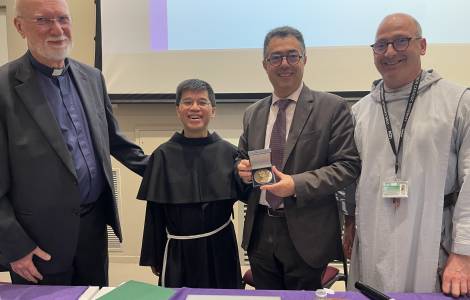
Lyon (Fides News Agency) – “The Sacred Heart reminds us precisely this: God is not primarily an idea to be understood, but a love to be embraced. This truth is particularly important today, as we celebrate the bicentenary of the Living Rosary, founded by Blessed Pauline Jaricot.” These are some of the words taken from the homily delivered by Father Dinh Anh Nhue Nguyen OFM Conv, Secretary General of the Pontifical Missionary Union (PMU), on Friday, June 12, in the Saint Irenaeus Chapel at the Catholic University of Lyon (UCLY).
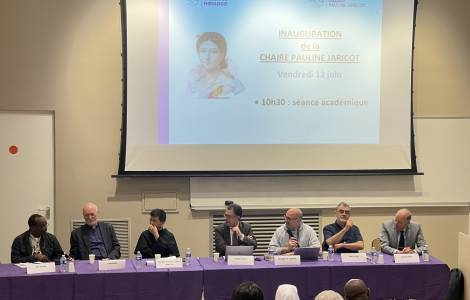
In the university chapel, Father Anh Nhue presided over the Eucharistic celebration for the Solemnity of the Sacred Heart that morning. The occasion: the inauguration of the "Blessed Pauline Jaricot" chair at the Faculty of Theology of UCLY, on the very day that, with the evening vigil at Saint John's Cathedral, the celebrations for the 200th anniversary of the Living Rosary, a movement founded by the French Blessed Pauline Jaricot, began in Lyon (see Fides, 12/6/2026).
"Paoline," recalled Father Anh Nhue, "was a young laywoman from Lyon who discovered that Christ can transform an entire life when one opens one's heart to Him. Her genius lay in understanding that mission belongs to all of God's people. One does not become a missionary through one's own resources, knowledge, or power. One becomes a missionary when one encounters the love of Christ and that love overflows to others. The entire Christian life begins there. Before being an activity, mission is an encounter. Before being a commitment, it is communion. Before being a responsibility, it is a gift."
In his homily, the Secretary General of PUM also emphasized the importance of formation in effectively and appropriately supporting missionary work. Formation, which constitutes the PUM's specific area of focus, "is neither a technique nor a strategy," Father Anh Nhue stressed. "It is not primarily a skill either," he continued. "Initial missionary formation consists of remaining close to Christ."
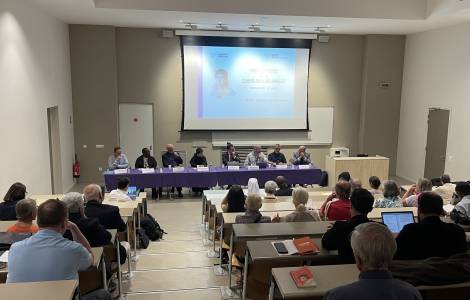
Shortly afterward, during the inauguration ceremony for the chair dedicated to Blessed Jaricot, which took place in the Aristotle Amphitheater at UCLY, Father Dinh Anh Nhue Nguyen gave a lecture on the theme "Uniting the actors of mission: The PUM's intuition yesterday and today."
“Today, the PUM is called not only to continue its work of evangelization and missionary formation for priests and consecrated persons, but also to accompany a Church where missionary responsibility is more broadly shared and where the lay faithful occupy an essential place,” explained the Secretary General of the PUM, which is celebrating its 110th anniversary this year. It is precisely from this perspective that university missiology is entrusted with a particular responsibility today: not only to study mission, but also to contribute to the formation of those who will carry it out tomorrow. This is why the intuition of Blessed Paolo Manna (considered the founder of the PUM) remains extraordinarily relevant: to unite those engaged in mission, by forming them together, so that the whole Church can continue to proclaim the Gospel to the entire world,” concluded Father Anh Nhue Nguyen.
The inaugural session, which drew a large audience and was opened by Michele Younès, Dean of the Faculty of Theology at UCLY, continued with a series of presentations, including one by Father Florent Guyot, head of pastoral care for foreign priests in the Diocese of Lyon. This was followed by personal testimonies and a welcome message from Georges Delrieu, Secretary General of the French Pontifical Mission Societies, one of the institutional partners of the newly established chair.
Father Gonzague de Longchamp, who shares the chair dedicated to Blessed Jaricot with Father Cesare Baldi, presented the organization of the study and training activities that will be centered around this new academic institution.
The creation of this chair stems primarily from the observation that the face of the local Church is also characterized by an increasingly significant presence of religious men and women, as well as lay people of foreign origin. This implies the need to clarify the forms of intercultural and interpastoral dialogue in order to intervene in an increasingly de-Christianized European context, drawing on the contributions and experiences developed in the ecclesial contexts of sub-Saharan Africa, Latin America, and Southeast Asia. Providing the necessary means and skills to intervene in the current French cultural and pastoral situation is the objective of this training cycle dedicated to the founder of the Living Rosary movement, as well as providing training in the cultural and pastoral context. This is useful for establishing a fruitful dialogue with sister churches in the Global South.
The Chair offers a program lasting one to three years, depending on the participants' availability, and is structured around three main areas. First, there are courses, including a course in pastoral theology, a course chosen by the student, and a specialization course offered by the chair, which this year focuses on the sociology of Christianity.
Second, study days are offered, addressing themes such as migration, popular religiosity, ministry, and community. Finally, workshops are planned, with the aim of providing targeted training in light of a reflection on practical work in the missionary field. (EG) (Fides News Agency, 13/6/2026)



 “Research on the History of Catholicism in China”: A new “road map” tracing six centuries of Catholicism in China
 Leone XIV at the Rimini Meeting: Jesus keeps his treasure in earthen vessels
 ASIA/PHILIPPINES - "A truly missionary Church does not impose political choices, but it helps the faithful discern wisely"
 AMERICA/COLOMBIA - The commitment of the Pontifical Mission Societies after the earthquake: Amid destruction and suffering, mission becomes closeness, comfort and fraternal service