Information service of the Pontifical Mission Societies since 1927
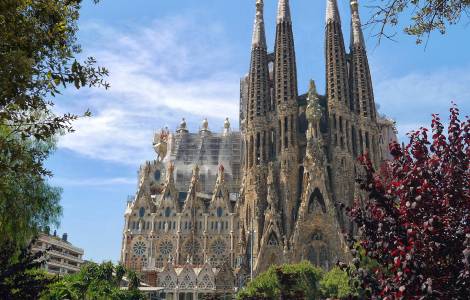
by Marie-Lucile Kubacki
Barcelona (Fides News Agency) – “The new tower realizes the project of its architect, Gaudí, who was deeply inspired by faith. He was the first to understand art as a form of proclaiming the Gospel and as the preferred language of Christian mission,” said Cardinal Secretary of State Pietro Parolin in an interview with Vatican media ahead of Pope Leo VI’s Apostolic Journey to Spain, from June 6 to 12, 2026.
In the Sagrada Família Basilica, the Pope will preside over a Holy Mass on June 10 and participate in the inauguration of the Tower of Jesus Christ.
By presenting the tower as a “beacon of redemption and hope” and as a “work of evangelization,” the Secretary of State goes beyond the mere artistic and cultural significance of the Sagrada Família: For the Holy See, the church building is “a construction site of living stones, constantly growing throughout history” and is called to direct humanity’s gaze to God.
This approach sheds a unique light on the personality of the architect Antoni Gaudí and his contribution to a missionary architecture that is not only the fruit of his aesthetic genius but also the result of a profound journey of conversion.
Born in 1852 into a Catholic family, the Catalan architect was initially a rather ‘lukewarm’ Christian. But the blows of fate in life—illness, loss—gradually created a space within him in which his relationship with God grew. When he accepted the Sagrada Família project, he was also attracted by the career opportunities it offered. But the young dandy gradually transformed into an “architect-monk,” to use Patrick Sbalchiero’s famous phrase from his biography, “Antoni Gaudí: The Architect of God.” This referred to the poverty and asceticism that would characterize the final years of his life.
The Sagrada Família shapes the human heart as the human being works on its stone structure. The work shapes the artist, to the extent that he entrusts it to God. This “expiatory basilica”—its full name is “Temple Expiatori de la Sagrada Família,” or “Expiatory Temple of the Holy Family”—was financed entirely by alms, that is, by the donations of the faithful and visitors. Its construction was repeatedly interrupted, particularly due to financial difficulties, and it remains a construction site to this day. Precisely because of this unique history, it is a church of living stones, built from faith and prayer, and in this sense, profoundly “inspired.”
At the consecration of the church and altar in 2010, Benedict XVI recalled that Gaudí, faced with the countless difficulties he had to overcome, one day “exclaimed with complete confidence in divine Providence: ‘Saint Joseph will complete the church.’”
Thus, Pope Leo XIV’s presence comes to honor not only a “great architect” but also a unique understanding of art and the vocation of the missionary artist. “Through his work, Gaudí shows us that God is the true measure of humanity, that the secret of true originality, as he said, lies in returning to the origin, which is God. By opening his own mind to God in this way, he was able to create in this city a space of beauty, faith, and hope that leads people to an encounter with the One who is truth and beauty itself,” Benedict XVI declared in 2010.
A century after the architect’s death, the basilica continues to captivate some 4.8 million visitors annually with its unique beauty. (Fides News Agency, 9/6/2026)