
Information service of the Pontifical Mission Societies since 1927
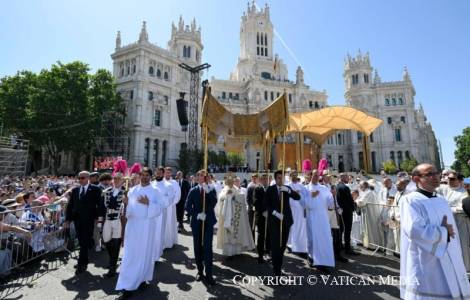
VaticanMedia
Madrid (Fides News Agency) – In Madrid, during the Solemnity of Corpus Christi celebrated on Sunday, June 7, one of the most significant moments of his trip to Spain, Pope Leo XIV, in his homily delivered during the Eucharistic celebration in Plaza de Cibeles, offered a profound reflection on popular piety. In it, he warned against nostalgia and recalled that, in the ecclesial experience, “remembering” is always a living and transformative act.
In Spain, the Pope noted, Corpus Christi “is more than just another celebration on the liturgical calendar. It is a way of returning to the heart of the faith to renew our love and fidelity to God”: the solemn processions, he pointed out, have “for centuries shaped the piety, art, music, architecture and life of the Spanish people.” This is not, “an exhibition, a remnant of folklore or a simple display of beauty: it is a profession of faith in the presence of the risen Lord, who is alive and continues to walk among us.” The procession is also a missionary gesture, because “just as Christ gives himself as food in the Eucharistic celebration, the procession shows that he is not confined to the church, but comes out to meet us.” Jesus “travels the streets, crosses the squares and visits our neighborhoods, dwelling in the settings of our daily lives,” and the Christ who processes through the streets in the monstrance “is the same one who identifies with the poor, the downtrodden, those who are alone and forsaken.” Therefore, “it is not merely a matter of bringing out the monstrance, but of allowing ourselves to be brought out of our selfishness and indifference, of a comfortable, private faith, so as to respond to his invitation to conversion, to change our perspective, and to welcome his presence which transforms us and makes us builders of a new world.”
The distinction between mere nostalgia and living memory is fundamental to understanding popular spirituality, an area of great importance for mission throughout the world and, especially, in secularized countries, where participation in Mass often declines more rapidly than devotional practices. “The historical memory of the Corpus Christi processions is not confined to wistful nostalgia. Instead, it stands as an invitation in the present moment, in our daily lives, in our relationships, in society, and in the building of the future.” This is also how we understand the biblical invitation to “remember” the journey in the desert: to remember so as “not to forget who the Lord is” and not to fall into the temptation of trusting in other idols and feeding on bread that does not satisfy.”
Herein lies the task of Spain today and in the future: “to ensure that the religiosity which has shaped and defined this country for centuries is not a museum of the past to be visited, but a school of faith from which to draw even today.” “A school that teaches us to kneel before God and before our neighbor, because no one can kneel before the Lord and despise their brother; A school that teaches us of the gratitude of love that becomes a gift, so that it may flow among us and break the chains of all selfishness; A school from which we learn that God is a real presence and that we too are called to be present in the realities and challenges of society, not shying away, but personally committing ourselves to the building of the common good.”
Recalling Saint Manuel González García, the “the bishop of the abandoned tabernacle” and great apostle of the Eucharist in early 20th-century Spain, as well as the verses of Saint John of the Cross—“For I know well the spring that flows and runs, although it is night”—the Pope pointed to Jesus in the Eucharist as “that eternal spring that is hidden” that quenches thirst “yet without blinding, without imposing itself through outward power, without presenting itself in a spectacular way.” From that source, he concluded, we must drink again, because Eucharistic grace “does not enclose us in private devotion, but sends us out to refresh our brothers and sisters, our families, the poor, the suffering, and those who have lost hope.” Furthermore, “it makes us protagonists of the transformation of history, a sign of hope for those we meet.” (MLK) (Fides News Agency, 7/6/2026)



 POPE IN FRANCE/I - Bishop Guillet: This is how the “Acts of the Apostles” is coming alive in Saint-Denis
 AMERICA/PERU - Edgard Rimaycuna, secretary to Pope Leo XIV, brings the Pope's blessing to Chiclayo
 President-elect Keiko Fujimori visits the Presidency of the Peruvian Bishops’ Conference
 APOSTOLIC JOURNEY - Pope Francis in Ajaccio: Popular piety is a gift for all
 Pope Francis in Ajaccio: The missionary soul of popular spirituality
 ANGELUS - Pope Leo XIV: When we are with Christ, “our needs are abundantly met”
 Leo XIV to the FABC Assembly: Continue to promote a “Eucharistic spirituality” within the Churches of Asia
 ASIA/CHINA - New Church in the Diocese of Wenzhou dedicated to Saint Thérèse of Lisieux