Information service of the Pontifical Mission Societies since 1927
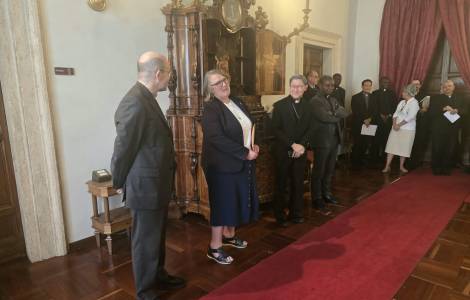
photo Natale Scarpitta
Vatican City (Fides News Agency) – Pope Leo XIV has appointed the Reverend Sr. Mary Teresa Barron, N.S.A., superior general of the Missionary Sisters of Our Lady of the Apostles, as adjunct secretary of the Dicastery for Evangelization in the Section for First Evangelization and the New Particular Churches, with the office of president of the Pontifical Mission Societies, with effect from 4 January 2027.
Today, at around noon, before the recitation of the Angelus, Sr Mary Teresa Barron was presented to the staff of the Missionary Dicastery at the Palazzo di Propaganda Fide.
Reverend Sr. Barron was born in Donegal, Ireland, on 7 November 1968. She was awarded a master’s degree in “Public Healthcare Administration from the Institute for Public Administration in Dublin, and in “International Development” from the Kimmage Institute in Dublin, Ireland. Since 2018 she has served as superior general of the Missionary Sisters of Our Lady of the Apostles, from 2022 to 2025 she was president of the Service of Documentation and Study on Global Mission (SEDOS), and from 2023 to 2025, president of the International Union of Superiors General (UISG) in Rome, Italy, as stated in the official curriculum vitae accompanying the appointment.
Her public statements are characterized by her missionary experience, intercultural dialogue and the link between synodality and the proclamation of the Gospel.
In an interview with the Spanish weekly Vida Nueva, published on 10 January 2025, she stressed the importance of having lived and worked in different ecclesial contexts and of being in contact with “the Church and peoples from different continents”.
She described this experience as “extremely important for any role in the Church that has a global reach”.
When asked on that occasion what belonging to a missionary congregation might have in common in her own journey and that of Sister Simona Brambilla, who had recently been appointed Prefect of the Dicastery for Institutes of Consecrated Life and Societies of Apostolic Life, she explained: “I believe that a missionary perspective and understanding are very important in a synodal Church, because experience teaches us to appreciate and cherish diversity as a source of richness.” She added that “the missionary spirit is often inclusive and readily encourages dialogue”, qualities that are important in relations with people from all over the world.
The link between mission and synodality was already at the heart of her words at the conclusion of the Assembly of the Synod on Synodality in October 2024. In an interview with iCatholic, Sister Barron recalled with emotion a process in which she had been involved from the very beginning, three years earlier. She expressed satisfaction with the final document, which she regarded as a source of support to continue “as a Church on this synodal path”.
When asked about the prospects for the Irish synodal journey, she identified the “missionary orientation” as one of the document’s strengths. The challenge, she explained, was to form missionary disciples and to help people live their faith in everyday life: “Faith is not a Sunday event; it is something we live every day.” It meant bringing Christ’s love into ordinary life and sharing it. She also highlighted the emphasis placed on the family as the domestic Church, seeing this as a call to a more missionary presence in society.
On 19 March 2026, in a joint interview with Vatican News together with Father François Marie Hervé du Penhoat, Superior General of the Society of African Missions, Sister Barron reflected on new forms of missionary presence. The two congregations were celebrating, among other anniversaries, the 150th anniversary of the foundation of the Sisters of Our Lady of the Apostles and the 170th anniversary of the Society of African Missions.
“The Church is becoming more synodal. This missionary spirit is fundamental,” she said.
“Today, our response could include accompanying migrants, women who are victims of trafficking for the purpose of exploitation, and a greater commitment to social pastoral ministry, even though our traditional apostolates in healthcare and education remain essential.”
She also recalled the international dimension of the congregation, which brings together sisters from 21 countries, and the importance of nurturing a family spirit among them.
Her concern for people wounded by exploitation is one of the causes particularly close to her heart, as shown by a message she addressed to participants in a prayer marathon against human trafficking, organized in 2025 by the UISG and the Union of Superiors General. “Our prayers today are not just words. They are also a call to action,” she stressed, inviting participants to walk in solidarity with victims and to draw inspiration from the courage of survivors.
During the nine-day novena following the death of Pope Francis, on 3 May 2025 in St Peter’s Basilica, she expressed, on behalf of consecrated women, a commitment to continue a mission of closeness: “To be the caress of our loving God the Creator towards those who suffer, to be the fire that kindles other fires.” She linked this mission to the Gospel’s call to go out to meet people, to serve, heal and accompany those most in need.
(Fides News Agency, 8/10/2026)