
Information service of the Pontifical Mission Societies since 1927
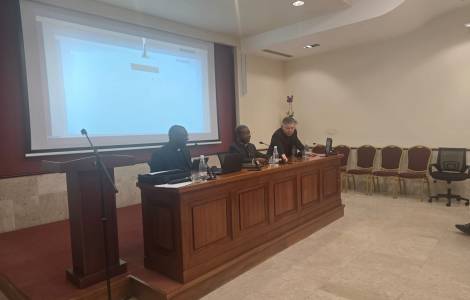
Photo Natale Scarpitta
Rome (Fides News Agency) – “He is not bishop of one group or another; he is bishop of all.” Archbishop Fortunatus Nwachukwu, Secretary of the Dicastery for Evangelization, addressed newly ordained bishops taking part in a formation course in Rome (see Fides, 2/9/2026).
In his reflection on “Ministers of Communion in the Church: Tribalism, Casteism, Racism and Exclusive Regionalism in the Contemporary Church,” he urged them to make communion a criterion of their ministry and governance.
“Communion is the First Name of Our Ministry,” Archbishop Nwachukwu said. Recalling Pope Leo XIV’s Meditation for the Jubilee of Bishops, he said that the Bishop is the “visible principle of unity” in the particular Church, called to build communion within the diocesan community and with the universal Church while fostering the variety of gifts and ministries entrusted to the Church. “The bishop does not create unity by making everyone alike; he guards the unity that allows different persons and different gifts to serve one Gospel,” the Secretary of the Dicastery said. Communion, therefore, “cannot remain a beautiful word in the Bishop’s pastoral letters. It is to be a criterion of government.”
According to Archbishop Nwachukwu, this criterion must shape the discernment of candidates, the appointment of priests, the formation of seminarians, the distribution of responsibilities, the use of resources, the handling of conflicts and the welcome extended to those who come from elsewhere. Every episcopal decision, he added, should be able to answer a fundamental question: whether it strengthens “the communion and mission of the Church” or merely protects “an existing circle of familiarity and influence.”
Diversity and inculturation
Addressing the relationship between communion and culture, Archbishop Nwachukwu stressed that diversity itself is a gift, whereas exclusion distorts that gift. Recalling Saint Paul’s teaching that “You are all one in Christ Jesus,” and that those who were once “strangers and aliens” have become “members of the household of God” (Ephesians 2:19), he warned against a mistaken understanding and application of inculturation.
While the Incarnation gives Christians confidence to honour culture, he said, inculturation reaches maturity only when culture “allows itself to be purified, transformed, and opened by the Gospel.” “A culture evangelized by Christ becomes capable of giving and receiving,” Archbishop Nwachukwu affirmed. “It does not need to raise walls in order to remain itself.”
Four forms of exclusion
The Archbishop described tribalism, casteism, racism and exclusive regionalism as distinct forms of exclusion stemming from the same temptation: making a particular identity — tribe, caste, race, region, language, family or social standing — more decisive than the common Christian identity rooted in belonging to Christ.
Speaking of tribalism, Archbishop Nwachukwu said attachment to one’s own community is not itself the problem. The distortion begins when solidarity becomes systematic preference and “‘one of ours’ is presumed trustworthy simply because he or she is ‘one of ours.’” The problem arises “when ‘ours’ becomes synonymous with ‘better,’ and ‘others’ becomes synonymous with ‘foreign’ and ‘unacceptable.’”
Casteism, he continued, introduces inherited social hierarchies into ecclesial life. Whenever access to formation, ministry, responsibility or opportunity is determined by caste or comparable categories, “the dignity received in baptism is contradicted.” Such discrimination may be open, but can also be more subtle: in who is heard, promoted, invited into decision-making, entrusted with responsibility or quietly kept at the margins.
Racism, he said, may appear not only through overt contempt, but also through stereotypes, suspicion, humiliating language, exclusion or assumptions that some cultures are more suited to leadership, theology, administration or holiness. Recalling Pope Francis’ warning in Fratelli Tutti that doubts and fears can make people “intolerant, closed and perhaps even — without realizing it — racist” (n. 41), he stressed that a Bishop must become “an educator of communion.” “In the house of God, dignity does not depend on blood, colour, passport, or language,” Archbishop Nwachukwu said. “It is grounded in the dignity of the human person and elevated by the grace of baptism.”
The Archbishop also warned against exclusive regionalism, which can be presented as pastoral prudence when geographical origin becomes a decisive criterion for responsibility. A particular Church possesses a real culture and history, he observed, but “it is never a cultural fiefdom.” Although a priest may need particular pastoral competencies to serve effectively in a certain place, “birthplace can never become a condition of ecclesial dignity or a permanent barrier to responsibility.”
Discernment and appointments
In this context, Archbishop Nwachukwu referred to the “Son of the Soil” syndrome: the assumption that those born in a certain territory have a natural priority for leadership there. Recalling Pope Leo XIV’s call to the Bishops of Spain to offer “a witness to unity in diversity” in a time marked by polarization and division, he said that local origin must not override genuine discernment. “The decisive question should not be, ‘Where does he come from?’ It should be, ‘Who is he?’” Archbishop Nwachukwu said. He indicated faith, prayer, maturity, the capacity to listen and collaborate, freedom from personal ambition, love for the poor and the capacity to serve people outside one’s own group as criteria for discernment. Referring to the selection of the Seven in the early Church, he recalled that the Apostles sought men “‘of good reputation, full of the Spirit and of wisdom.’”
At the root of these forms of exclusion, Archbishop Nwachukwu identified “the temptation to confuse responsibility with possession.” A Bishop may come to think, “‘This is my diocese.’ But in truth, it is not ‘mine.’ It is Christ’s.” “We are administrators, not owners; servants, not masters,” he added. This freedom, he continued, enables a Bishop to resist pressure from his own region or group, the temptation to protect a circle of influence, fear of losing popularity and the desire always to be understood or applauded. His first loyalty, he said, is to Christ and to the good of souls.
Appointments are a particular test of communion. “A nomination is never merely administrative. It communicates an ecclesial message,” Archbishop Nwachukwu said. It can say, “This Church is a home for all.” Or, without anyone intending it, it can say, “This Church belongs to them.” He also cautioned against reducing representation to a form of entitlement. Diversity in the People of God should be visible, he said, but “representation must never become a new form of tribal entitlement.” The decisive criterion remains a person’s ability to serve the Church; his presence can then become a sign that the Church belongs to everyone.
Babel, Pentecost and mission
Drawing on the biblical movement from Babel to Pentecost, Archbishop Nwachukwu recalled that Pentecost does not eliminate languages or impose uniformity. Peoples remain different, but hear and understand the one Gospel.“We are not called to create uniformity. We are called to prevent plurality from becoming Babel,” he said.
For the first years of episcopal ministry, the Archbishop proposed four commitments: examining one’s own heart and preferences; making discernment in appointments freer through consultation, verification and consideration of candidates beyond customary circles; educating the presbyterate for fraternity; and defending concretely those exposed to exclusion.“Silence from the pastor can be interpreted as consent,” Archbishop Nwachukwu warned, noting that circumstances may require a Bishop to speak clearly against tribalism, casteism, racism or regionalism.
The issue is inseparable from evangelization, he added. “The credibility of mission therefore depends, in part, on the quality of our communion.” Referring to Pope Leo XIV’s episcopal motto, “In Illo Uno Unum — in the One, we are one,” Archbishop Nwachukwu said that the Church’s unity is received in Christ and must become visible “in the way we govern, form, appoint and welcome.” “Our deepest identity is baptismal: children of God, members of the Body of Christ, brothers and sisters within one household,” Archbishop Nwachukwu said. “That is Catholicity. Not uniformity, but unity. Not the isolation of cultures, but their encounter. Not competition among groups, but shared responsibility for the mission.”
Concluding his address, the Secretary of the Dicastery for Evangelization urged the new Bishops not to create personal systems of influence. “You do not need to leave behind a personal system. You should desire to leave behind a more united and faithful Church,” he said. “You do not need to be remembered because you increased your influence. You should desire that, after your ministry, people will recognize more clearly the face of Christ.”
(MLK) (Fides News Agency, 3/9/2026)



 100 YEARS SINCE THE ORDINATIONS OF THE FIRST SIX CHINESE BISHOPS - Bishop Joseph Hu Ruoshan and the Diocese of Taizhou
 New episcopal ordination in China: Ignatius Ding Zuyao ordained Bishop of Haimen
 AFRICA/MALAWI - Archbishop Nwachukwu at the Jubilee marking 125 years of the Gospel in Malawi. Two new priests for a Church called to set out anew on mission
 South Sudan's post-independence ordeal: fifteen years of conflict, political instability and humanitarian crises
 BEATIFICATION OF FULTON SHEEN/IV - Sons and Daughters of the same Father. Fulton Sheen and racial segregation
 AMERICA/BRAZIL - Justice for the murder of Moïse Kabagambe: "barbarism becomes normal when it involves the poor"
 VATICAN - Cardinal Luis Antonio Tagle is the new Dean of the Sacred College of Cardinals
 VATICAN - Sister Mary Teresa Barron appointed adjunct secretary of the Dicastery for Evangelization and president of the Pontifical Mission Societies