
Information service of the Pontifical Mission Societies since 1927
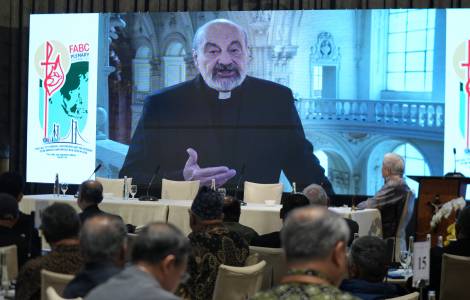
Jakarta (Fides News Agency) - As the global order undergoes an unprecedented period of fragmentation and uncertainty, in what ways can the Church discern the signs of the times? Czech priest and theologian Tomáš Halík, tackled this question in his address to the bishops of Asia gathered in Jakarta for the FABC Assembly.Through a lucid analysis of globalization and the crisis facing post-war institutions, he called on ecclesial communities to renew its mission through contemplation and by fostering a culture of relationship and connection, in order to respond to the moral and spiritual crisis of our contemporary world. We are publishing an excerpt of his address with his kind permission.
«The deepest lesson of our present moment is perhaps that the crisis of international institutions is not primarily an institutional crisis.
It is a crisis of trust. A crisis of responsibility. A crisis of solidarity. Ultimately, it is a crisis of the human spirit. The crisis facing today’s international institutions is not merely a matter of their organizational effectiveness, bureaucracy, or lack of authority. The deeper problem lies in the erosion of the cultural, moral, and anthropological foundations upon which these institutions were built. It is therefore not enough to reform procedures; we must rethink the very spiritual and ethical foundations of the international order.The crisis of international institutions thus reveals a deeper spiritual crisis of civilization.The current geopolitical crisis is therefore also a spiritual and anthropological crisis: a crisis of the image of humanity, the meaning of society, and the ability to understand humanity as sharing a common destiny. And it is precisely here that the Church and theology has something distinctive to contribute.
How, then, should the Church (and theology) respond to this historical transition? Certainly not by offering technical solutions to political problems.That is neither her competence nor her vocation. Nor should she withdraw from public life into the apparent safety of private spirituality. The Church is called to offer something that neither politics nor economics nor technology can provide. She is called to cultivate wisdom. Synodality should not primarily a reform of ecclesiastical structures. Its deepest goal is conversion - spiritual transformation. Transformation of the culture of relations, not only in Church, but also in the entire human family. Synodal renewal can be a significant contribution also to the political culture of the civil society. Just as the democratization of the Church during the Reformation contributed, indirectly and often unintentionally, to the emergence of modern democracy, so the synodal renewal of the Church may become a source of inspiration for life together in the pluralistic world of the twenty-first century. This does not mean that synodality should imitate the political mechanisms of majority rule, nor should it simply reproduce the strengths and weaknesses of contemporary democratic systems. On the contrary, the principle of synodality may itself become a source of renewal for democracy b addressing precisely those dimensions that contemporary democracies often lack and that make them vulnerable to populism and authoritarian temptation.
Populism thrives upon superficial perceptions of reality. The Church is called to offer a deeper vision—a different way of seeing and a different way of relating. The crises of our time invite us to recover what our civilization perhaps needs most urgently: the capacity to pause and to contemplate. We need a conversion in the very way we perceive reality and understand ourselves. We need to recognize that what is happening around us and what is taking place within us both belong to a reality infinitely greater than ourselves—a reality that embraces us even as it infinitely transcends us. Human existence is always being-with. We become ourselves through the network of relationships that binds us to one another, to the natural world, and to the all-embracing Mystery that we call God. Our churches must become schools of a culture of relationships. They must continually teach—and themselves continually learn—the deepest of all relationships: the inseparable unity of love for God and love for our neighbors.
For many centuries, at least in large parts of the world, Christianity fulfilled the role of religion (religio) in the sense of the Latin the verb re-ligare—to bind together once again. Christian religion served as a force of social integration. Wherever Christianity exercised a dominant, or even a privileged, cultural position, it offered society a common language, a shared moral imagination, a broadly accepted system of values, and a common symbolic and ritual framework. Throughout the modern era, however, Christianity gradually lost this integrating function. In today's radically pluralistic and culturally interconnected world, it continues to lose that role even within societies once regarded as traditionally Christian. Our world will remain irreversibly pluralistic. Within such a world, Christianity is perceived as one voice among many. Yet that voice must remain clear, credible, and unmistakably authentic. I am convinced that today Christianity can offer our world a different role of religion -in the sense of the verb re-legere — to read again. It means to read more carefully. To read reality anew. Christianity can offer humanity a new hermeneutics: a renewed way of perceiving and interpreting God's voice within the unfolding drama of history. Amid all historical change, the deepest source of the Church's identity is the living presence of the Risen Christ. That presence—within the faith and witness of the Church, but also beyond her visible boundaries—is dynamic. It continues to grow and unfold throughout history.
This growth cannot simply be identified with an increase in Church membership, with geographical expansion, or with greater cultural or political influence. The presence of the Risen Lord often reveals itself in paradoxical and kenotic ways. More important than growth in breadth is growth in depth. When we reflect upon the condition of the Church in different parts of the world, we should not be satisfied merely with statistical indicators such as the number of baptized Christians or the percentage of Mass attendance. We must ask a deeper question: To what extent does the spirit of the Gospel shape people's way of thinking and their way of living? Evangelization bears fruit only when it takes the form of inculturation. Here, too, the principle of synodality applies. Mission itself must become a shared journey, journey of dialogue. Dialogical evangelization creates a hermeneutical circle between the questions and experiences of women and men today and the experience of faith, the questions, and the responses that we encounter in Scripture and in the entire depositum fidei.
We therefore need to ask ourselves two fundamental questions. First, does the way we proclaim the Gospel help people to understand more deeply their own lives and the age in which they live? Second, can their culture—their questions, their experience, and their way of understanding reality—contribute something genuinely new to our own understanding of the treasure of faith? The Second Vatican Council offers a deeper and more dynamic understanding of Tradition. In the Dogmatic Constitution Dei Verbum we read: "This tradition which comes from the Apostles develops in the Church with the help of the Holy Spirit; for there is a growth in the understanding of the realities and the words which have been handed down." (II, 8) The work of evangelization—and therefore also the inculturation of the Gospel—is never complete. It must continue to develop, critically reflecting upon new historical experiences and cultural inspirations. It is one of the reasons why I have always regarded the theological creativity of the Churches of Asia with such admiration.
Asian Christianity has shown the universal Church that dialogue with ancient religious traditions need not weaken Christian identity. On the contrary, when rooted firmly in Christ, such dialogue can deepen our understanding of the mystery of Christ himself. Personally, I remain grateful to the Japanese Jesuits who first taught me to approach certain passages of the Gospel as one approaches a Zen koan. Not because Christianity should become Zen. But because they helped me to discover that the Gospel often invites us, before it offers answers, to undergo a transformation in the very way we perceive reality. It is not simply teaching people to think differently. It is helping them to see differently. The Church's first responsibility is not simply to speak. It is to learn how to see. Dear brothers and sisters, The future of Christianity will depend upon whether our communities become places where people truly learn to see. To see one another more deeply. To see the world more truthfully. To see the signs of the times more wisely. And, through all of them, to recognize the living presence of the Risen Christ, who continues to make all things new. Then the words of Jesus will become true for us as well: "You will see greater things than these."» (Fides News Agency, 24/7/2026)



 BEATIFICATION OF FULTON SHEEN/VI — At the Vespers for Fulton Sheen, “made holy through his friendship with Christ”
 The seed of the Gospel and mission: Archbishop Sangalli concludes the formation Course for bishops in Nemi with a meditation on St Charles de Foucauld
 BEATIFICATION OF FULTON SHEEN/IV - Sons and Daughters of the same Father. Fulton Sheen and racial segregation
 The BRICS between “global governance” challenges and the growing role of African countries
 U.S. Secretary of State Rubio’s South American tour: the fight against drug trafficking and the implementation of the “Donroe Doctrine”
 ASIA/SOUTH KOREA - The journey toward WYD 2027 crosses paths with the Church’s social doctrine
 AFRICA/ALGERIA - Record of abstention in Algeria's legislative elections
 Pope to Latin Catholic Bishops in the Arab Regions: “Do not be afraid of your smallness”
 Cardinal Vesco: in Algeria, Augustine is also a “universal brother”