
Information service of the Pontifical Mission Societies since 1927
VaticanMedia
by Pascale Rizk
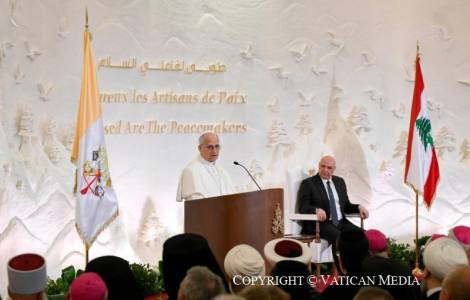
Beirut (Agenzia Fides) – “Blessed are the peacemakers! It is a great joy for me to meet with you, and to visit this land where “peace” is much more than just a word.” With these words, Pope Leo addressed the political and religious leaders gathered at the Presidential Palace, the first major stop on his apostolic journey to Lebanon, on Sunday, November 30. “Here, peace is a desire and a vocation; it is a gift and a work in progress,” continued the Pope, who was greeted at the Palace entrance by a light and sound choreography in which Lebanese symbols blended with those of peace, and dancers performed the dabke, a Lebanese folk dance, in pouring rain.
The day had initially been rainy, but shortly before the papal plane from Istanbul landed on Lebanese soil at 3:34 p.m., the skies over Beirut cleared.
Two children, Celine and Tony – former patients of the Children's Cancer Center –were the first to greet the expected guest: Celine with a bouquet of flowers and Tony with bread in his hands. A little further along the boulevard named after Imad Mughnieh, a key figure in the Hezbollah party who was killed in Syria in 2008, thousands of scouts from the Muslim association "Imam Mahdi" welcomed Pope Leo. They had organized clean-up operations along the avenue and prepared welcome banners in response to the Catholic Church's invitation to greet the Pope.
Along the streets from Rafik Hariri International Airport to the Presidential Palace in Baabda, Lebanese people gathered to welcome the one they call "the messenger of peace." A much-desired peace in a climate marked by omens that, following the departure of the Bishop of Rome, foreshadow and threaten a new war. Just as after the brief visit of Pope Paul VI in Lebanon and the apostolic visit of Pope John Paul II.
In the Land of the Canaanite
As the Popemobile reached the presidential palace, heavy rain began again, which in Lebanese culture is considered a lucky sign and a harbinger of abundance.
In his address to the Pope, before an audience of civil and religious dignitaries, representatives of civil society, and members of the diplomatic corps, Lebanese President Joseph Aoun described Lebanon as the land of the Canaanite woman whose daughter Jesus healed because of her great faith. "If the Christians were to disappear from Lebanon," the Head of State said, among other things, "the balance would collapse, as would justice. If the Muslims were to disappear, the balance would collapse, as would moderation." Aoun also asked the Pope to bear witness that Lebanon “will remain the only place of encounter in our region—and I dare say, in the whole world—where an assembly like this can gather around the successor of Saint Peter to represent all the children of Abraham in the diversity of their faith and affiliation.”
The “always open construction site” of peace
In his address, delivered in English, Pope Leo described peace in Lebanon as “always an open construction site” and offered reflections on “what it means to be peacemakers” in the Land of the Cedars “in circumstances that are highly complex, conflictual and uncertain.”
The Pope invited everyone to focus on a quality that distinguishes the Lebanese people: “You are a people who do not give up, but in the face of trials, always know how to rise again with courage. Your resilience is an essential characteristic of authentic peacemakers, for the work of peace is indeed a continuous starting anew,” he emphasized. And “the commitment and love for peace know no fear in the face of apparent defeat, are not daunted by disappointment, but look ahead, welcoming and embracing all situations with hope.”
Wounds to heal and the flight of young people
Pope Leo XIV urged the Lebanese people to look to their history for ways to emerge from the new crises plaguing the Land of the Cedars: “Ask yourselves: from where comes that formidable energy that has never left your people downtrodden or without hope.” An energy, the Pope added, that must be channeled into the search for paths of reconciliation, because there are “personal and collective wounds that take many years, sometimes entire generations, to heal,” so that one does not remain stuck, “each imprisoned by our own pain and our own way of thinking.”
Furthermore, the Bishop of Rome highlighted a “third characteristic of those who strive for peace. Even when it requires sacrifice, peacemakers dare to persevere.” There are moments – according to Pope Leo, referring specifically to the emigration of young Lebanese people from their homeland – “when it is easier to flee, or simply more convenient to move elsewhere. It takes real courage and foresight to stay or return to one’s own country, and to consider even somewhat difficult situations worthy of love and dedication.” “Nevertheless,” he emphasized in this context, “we must not forget that remaining in our homeland and working day by day to develop a civilization of love and peace remains something very valuable.”
At the end of his address, the Pope recalled “another precious characteristic” of Lebanon’s millennia-old tradition: “You are a people who love music. On feast days, this becomes a dance, a language of joy and communion. This aspect of your culture helps us to understand that peace is not only the result of human effort, however necessary. Indeed, peace is a gift that comes from God and which, above all, dwells in our hearts. It is like an interior motion pushing outwards, enabling us to let ourselves be guided by a melody greater than ourselves, namely that of divine love. Those who dance move lightly, without trampling on the earth, harmonizing their steps with those of others. So it is with peace, which is a journey inspired by the Spirit, and causes our hearts to listen, making them more attentive and respectful towards others.” (Agenzia Fides, 30/11/2025)

 ASIA/LEBANON - General Abagnara (UNIFIL): “The Pope’s visit confirms us in our peacekeeping mission”


 The 2026 General Assembly of the Pontifical Mission Societies begins
 ENCYCLICAL - “Magnifica humanitas” and the risk of the digital age becoming “colonial in another form”
 ASIA/SYRIA - Ministry of Justice report on the attack on Mar Elias Church
 AMERICA/COLOMBIA - The results of the legislative elections reveal new trends ahead of the presidential elections
 Bishop Martinelli: The "Church of immigrant workers" put to the test by war
 "As one Body in Christ": Churches in the Emirates pray together for peace in Dubai
 LEO XIV IN AFRICA - The Pope to the Angolans: The Risen Jesus can also heal the wounds of your people