
Information service of the Pontifical Mission Societies since 1927
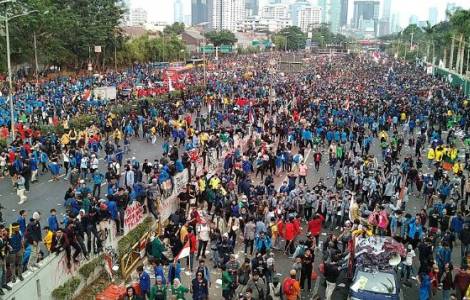
Wiki Commons - JahlilMA
Jakarta (Agenzia Fides) - Representatives of student movements, workers, and civil society groups gathered today in front of the Parliament building in the capital, Jakarta, for a protest. A coalition of student associations known as "Bem Si" declared that the focus of the protest was "corruption and the politicization of the law." After a week of protests in various cities – first over subsidies for parliamentarians and then against police violence (ten dead, over a thousand injured, three thousand arrested throughout the archipelago), President Prabowo Subianto declared that the army and police had resisted the violence of the masses, behind whom "traitors and terrorists" hide.
An open letter from the rectors and presidents of Indonesian Catholic universities, all members of the Association of Catholic Universities (APTIK), analyzes the political and social situation and warns of the danger of a serious split between politics and civil society.
In the letter, sent to Fides, 28 rectors of Catholic academic institutions write: "We are aware that Indonesia is currently experiencing a wave of uncertainty due to global geopolitical and economic turmoil. This situation has impacted the national economy, leading to an increase in the number of vulnerable workers and unemployment. Likewise, the population has faced increasing difficulties due to rising prices for essential goods."
"In this situation," the letter states, "instead of showing empathy and visionary leadership alongside the people, the political elites of the executive and legislative branches have displayed arrogance and indifference, far removed from empathy and compassion. Officials have also resorted to corruption, in the context of measures intended to ensure public safety and greater access to citizens' needs. All of this further undermines citizens' sense of justice."
The Catholic academics believe that "national development programs, which were supposed to be instruments for achieving social justice and public welfare, have instead become projects that favor the interests of oligarchs and elites." Many policies, they say, "are actually harmful to the population, such as the increase in property and building taxes in various regions, the extremely high remuneration of members of the House of Representatives, the simultaneous exercise of ministerial and deputy ministerial offices, the persistent difficulties in accessing health care, and the use of law enforcement agencies for political purposes."
Another sore spot is the education system: "Education policy, which should be a fundamental right of citizens, has been largely left to market mechanisms, leading to the neoliberalization and commercialization of education," the text states, which also addresses investments in the security forces: "The government clearly favors the Indonesian National Armed Forces (TNI) and the Indonesian National Police (Polri), which receive the largest share of the state budget among all ministries and institutions."
Regarding the causes of the protest, the rectors emphasize: "In addition to the arrogance of officials and the violent actions of the police, which have led to the loss of life, we believe that today's public anger is also fueled by injustice, social inequality, and the heavy economic burden on the community. Injustice always leads to deep hurt and anger among the population, which explodes when the limits of humanity are exceeded by arrogance, lack of empathy of officials, and repression by the forces of law and order."
Against this backdrop, the Catholic Academic Association calls on "all those who hold power in the executive, legislative, and law enforcement branches" to "always respect the nation's morals and constitutional mandate." It also demands: "The government and the House of Representatives must side with the people and improve their policies to defend the people's interests, for the benefit of social justice for the entire Indonesian people, in accordance with the Pancasila and the mandate of the preamble to the 1945 Constitution." "The executive and legislative branches must also serve the people and human dignity, not party elites or oligarchies." Only "authentic, honest leadership focused on the good of the present and future can restore public confidence and order of coexistence," they add.
It is urgently necessary to "protect democracy from violent practices and intimidation." APTIK demands that "freedom of opinion, association, and expression be respected as the cornerstone of democracy." "Any attempt to silence critical voices through authoritarian measures, media censorship, intimidation, or other forms of violence is an affront and a betrayal of democracy. Conflict resolution should always take place within democratic boundaries and with respect for popular sovereignty," the letter states.
"The police and the Indonesian armed forces must end the repression and prioritize a more humane approach," the letter's signatories demand, "by understanding the will and emotional state of citizens who are outraged by the injustice and violence that has claimed victims. Repression and incitement will only exacerbate the anger and suffering of people who already bear the heavy burden of economic and structural injustice on a daily basis."
The letter therefore also calls for dialogue: "The House of Representatives and the government, including the President, must immediately engage in a transparent and effective dialogue with the representatives of civil society demonstrating." APTIK supports the demonstrations "as a form of expression and participation in a healthy and dignified democracy, provided they do not become anarchic, destructive, or illegal."
Finally, it calls on "all intellectuals, students, and civil society to unite and raise their voices to proclaim authentic truth." "The truth must be expressed with intellectual integrity and moral courage for social justice and the common good. As citizens, we all have an ethical and historical responsibility to ensure that this country always upholds the values of humanity and justice," it emphasizes.
"Peace," it concludes, "is the result of justice, as Pope Francis affirmed in his speech at the State House. We should always remember that peace and prosperity are achieved when we work not only for our own interests and visions, but for the common good, by embracing one another, strengthening agreements and synergies, and joining forces to overcome every form of moral, economic, and social suffering and promote peace and harmony." (PA) (Agenzia Fides, 4/9/2025)



 ASIA/PHILIPPINES - Bishop Bagaforo: "Protests concern moral issues"
 ASIA/NEPAL - Apostolic Administrator: "Young people demonstrate for good governance and for their future"
 ASIA/INDIA - Association of Lay Catholics: "In the new year, the commitment to free society from hatred and discrimination"
 ASIA/PHILIPPINES - The Silsilah movement: the spirit of Advent helps to break free from the “culture of corruption”
 ASIA/ISRAEL - No permits for teachers residing in the West Bank: next academic year at Christian schools in Jerusalem is at risk
 AFRICA/NIGERIA - Several schoolgirls kidnapped in attack on school in northeastern Nigeria
 AFRICA/KENYA - Bishops concerned over amendments to cybercrime law: "Freedom of expression at risk"
 ASIA/PAKISTAN - Between Kashmir and Baluchistan: “Now is the time for unity and peace”
 ASIA/SOUTH KOREA - The journey toward WYD 2027 crosses paths with the Church’s social doctrine
 Tomáš Halík at the FABC Assembly: «The future of Christianity will depend upon whether our communities become places where people truly learn to see»