
Information service of the Pontifical Mission Societies since 1927
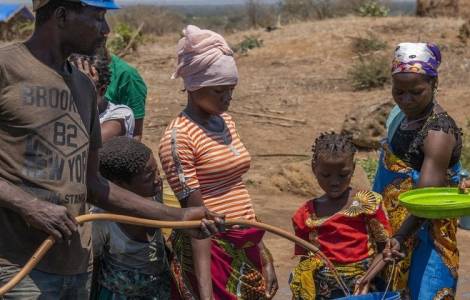
Maputo (Agenzia Fides) – Not only jihadism, but also economic and social demands of the local population, as well as interests related to the exploitation of the region's natural resources (primarily gas, but also precious stones), and the involvement of foreign armed forces are causing the severe instability affecting the province of Cabo Delgado in northern Mozambique. Pope Leo XIV also addressed this in his message after the Angelus prayer on Sunday, August 24, expressing his "closeness to the people of Cabo Delgado in Mozambique, who live in a situation of insecurity and suffer violence that continues to claim lives and displace people."
In recent weeks, jihadists from the Islamic State's Mozambican province have attacked villages in eight districts of Cabo Delgado province, engaged in skirmishes with Mozambican and Rwandan soldiers, and set up roadblocks along provincial roads.
The districts of Chiúre and Macomia are the most affected, followed by Ancuabe and Muidumbe. The jihadists have set up checkpoints along the N380 and N14 roads, hindering the delivery of humanitarian aid to over 85,000 people in Macomia and Muidumbe. Drivers and passengers of stopped vehicles, if they are Christian, must pay a "toll" of $150 to $460 to pass and avoid being captured.
Since 2017, more than 6,000 people have lost their lives in clashes in the province. The escalation of violence has forced some 60,000 people to flee, while the resumption of construction of the liquefied natural gas (LNG) terminal in Afungi, planned for September, remains uncertain. The project, worth at least $20 billion, was suspended in March 2021 following the attack by radical Islamist groups on Palma, the region's most important city (see Fides, March 27, 2021).
To counter the Islamists' actions, the Mozambican government has requested assistance from the Southern African Development Community (SADC) states and Rwanda. The former deployed soldiers in 2021 as part of the Southern African Development Community Mission in Mozambique (SAMIM), which was withdrawn in July 2024. This has increased the importance of the military contingent deployed by Rwanda, which, together with the Mozambican military and the military of neighboring Tanzania, is fighting the activities of the Islamic State.
However, military measures must be accompanied by a development policy that benefits the local population, which is among the poorest in Mozambique (see Fides, 14/9/2022). Without such a policy, the temptation to join the armed groups in the province remains strong, not only the Islamic State, but also the various "self-defense militias" that have emerged in recent years (see Fides, 19/12/2022). (L.M.) (Agenzia Fides, 26/8/2025)



 ASIA/SYRIA - Ministry of Justice report on the attack on Mar Elias Church
 AFRICA/MALI - Annual marian pilgrimage cancelled for security reasons
 LEO XIV IN AFRICA - The “Anglophone crisis” in Cameroon
 Rebirth in Chiclayo