Information service of the Pontifical Mission Societies since 1927
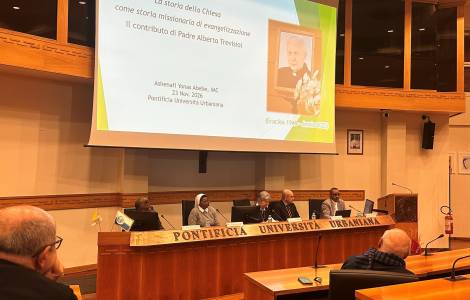
photo Fides (MLK)
Rome (Fides News Agency) – “Missiology is not just an addition to theology; it is itself a theological reading of the missionary experience.” With these words, Vincenzo Buonomo, Rector of the Pontifical Urbaniana University, summed up the vision that shaped the life and work of Father Alberto Trevisiol, a Consolata missionary and Church historian who taught at the university and later served as dean and rector.”
For him, studying the mission and living it were two inseparable aspects of the same reality.
On 23 November, former students and confreres gathered at the Urbaniana for a study day entitled “The History of the Church as Missionary History of Evangelization: The Contribution of Alberto Trevisiol”. They shared personal memories and reflections on his thought. “Their contributions focused on what moderator Gaetano Sabetta described as the ‘missionary vocation’ that guided Trevisiol’s intellectual and personal journey.”
Lessons at the heart of the “missionary experience”
“In her message, Sister Simona Brambilla, a Consolata missionary and Prefect of the Dicastery for Institutes of Consecrated Life and Societies of Apostolic Life, recalled her university days with the professor.”
Unable to attend the meeting, she entrusted her contribution to Sister Ivana Cavallo, who read it on her behalf.
The Prefect had first met Trevisiol when she was a novice and later attended his lectures at the Institute of Missionary Catechesis. “The two-hour classes went by far too quickly,” she recalled. This was not simply because of his lively teaching style. Trevisiol connected different periods, places and events, helping students recognize the deeper dynamics of the Church’s history. “History was no longer a sequence of dates and events, but revealed itself as a living process.” Behind his direct approach and sometimes sharp language, Brambilla recognized not only a critical mind but also “an extremely sensitive, kind, understanding and loyal heart”.
Their relationship grew closer through their shared commitment to the mission and the shared charism of the Consolata. After her experience in Maúa, in northern Mozambique, she found in him someone who could understand its significance. During her years of service in the leadership of the Consolata Missionary Sisters, Brambilla invited him several times to share his reflections on the mission and the congregation’s founder. “You are me,” Trevisiol would tell the sisters. In these words, the Prefect recognized his sense of brotherhood rooted in their shared missionary charism.
One memory remains particularly vivid: a day they spent together during the 2014 extraordinary general chapter, dedicated to the revision of the Constitutions. The discussion focused on missionary identity and the specific nature of the ad gentes mission, the proclamation of the Gospel to non-Christians. “I do not think I am exaggerating when I say that this day marked a turning point in the work of the chapter and in the life of the institute,” Brambilla wrote. Their reflection helped guide not only the work of an assembly, but also the choices that followed.
In his final years, the professor was also a source of fraternal support. “How important and precious it is to have someone you can count on, someone who knows how to listen, understand, respect, safeguard, remain silent and pray,” Sister Brambilla concluded.
Scientific rigour as a form of respect
Attention to people also emerged in the other testimonies. Tiziana Longhitano, who moderated the second part of the meeting, described Trevisiol as “a man of relationships”, able to build trust without limiting the other person’s freedom.
Nzasule Jofrida Simon, a Consolata missionary and former student, remembered him as “a father figure, a brother and a friend”. The Superior General, James Bhola Lengarin, recalled the affectionate nickname “the prince”, a tribute to his dignified conduct and the care with which he approached every responsibility.
His academic rigour, too, was a form of respect. Roberto Catalano, whom Trevisiol supervised during his doctoral studies, still remembers one piece of advice: ‘Remember that this is your thesis.’ The professor insisted on accuracy, he corrected language and challenged self-referential interpretations, while respecting the freedom of research. Dean Mario Grignani praised his ‘ability to summarise’: his skill in identifying the key facts while maintaining a thorough analysis.”
Father Ashenafi Yonas Abebe drew attention to the “silent witnesses” of Trevisiol’s life: his books, icons and personal objects in his study, as well as the care he devoted to the chapel and the liturgy. They offered a glimpse of a curiosity that embraced different Christian traditions and mission lands.
Finally, Benedict Kanakappally summed up Trevisiol’s vision of mission as “not a matter of giving, but of sharing”. This was where the historian, priest and educator came together: in the desire to know others, listen to them and walk alongside them under the gaze of God.
At a time when the Church is called to rethink how she carries out her missionary presence in new contexts, the journey retraced at the Urbaniana on 23 November offered a valuable point of reference. It showed a way forward that brings together knowledge of history, listening to cultures and encounters with people. For reflection on mission is never an abstract exercise: it is deeply connected to the lives of those to whom the Gospel is proclaimed and with whom it is shared.
(MLK) (Fides News Agency, 24/11/2026)