Information service of the Pontifical Mission Societies since 1927
Vatican Media
Buenos Aires/Luján (Fides News Agency) – The final day in Argentina of the apostolic journey to Uruguay, Argentina and Peru (November 6–17) brought together two places that bear witness to the same mystery: the Buenos Aires Federal Penitentiary Complex, known as Devoto Prison, and the National Shrine of Luján.
The common thread running through both encounters was grace and reconciliation: the call of Jesus, which reaches people in the most difficult moments of their lives, precisely through their limitations and wounds.
In the prison gymnasium, Pope Leo XIV met around seventy inmates, together with their family members, prison officers and members of the prison chaplaincy. He was welcomed by the Archbishop of Buenos Aires, Jorge Ignacio García Cuerva, who recalled that Pope Francis came to visit the prison every Holy Thursday to celebrate the Eucharist and wash the inmates’ feet.
Two prisoners and a former inmate then shared their personal testimonies.
Cristian, 29, who has been deprived of his freedom since 2025, recounted how addiction had driven him away from everything: “I lost my job; I lost everything.” In the prison chapel, however, “I felt that I was not alone, that Jesus was accompanying me and inviting me to encounter Him again.” Today, he asks forgiveness “from everyone I have hurt in some way.” He offered a message to those trapped in addiction: “There is always a way out, and God listens. There is a new life to be lived, and that life is in Jesus.”
Maximiliano, 32, spoke of his regret over the time he had lost with his daughters, “time that will never come back”, and of his discovery of inner freedom while in prison: “I felt once again that I was a son loved by God... Only love will change the world, and God is love.”
Reinaldo, 44, a father of four, recalled the embrace he had received in the prison chapel: “A new life is possible. Regardless of our circumstances or the mistakes we have made, He loves us and is always waiting for us, with open arms.”
The Pope offered those present a reflection on the “experience of limitations”. While society tends to regard limitations as “a defect to be corrected”, the truth, he explained, is quite different: “Human beings do not flourish in spite of their limitations, but often through them.”
“Even when persons dehumanize themselves and bring about tragedy, a small light continues to shine […] one that can be rekindled, with God’s grace, along paths of conversion and reconciliation,” he said.
Prison, he continued, is also “a witness to profound changes and conversions”, where some have learned to “transform the desert of their own existence into a fruitful garden”.
Addressing the families, the Pope recalled that, when speaking of charity, Jesus “identified Himself with a prisoner”, and that He too, before giving his life to save us, “was deprived of his freedom despite being entirely without sin”.
During the exchange of gifts, the prison chaplain, Father Matías De Martini, thanked the Holy Father, his voice breaking with emotion: “Your visit to this prison reminds us once again that God never gives up on anyone—that He rejoices over the sheep that is found, over the son who returns home... We feel the embrace of the Father, an embrace that makes no distinctions on account of the past and reminds us of our dignity: we are beloved children.”
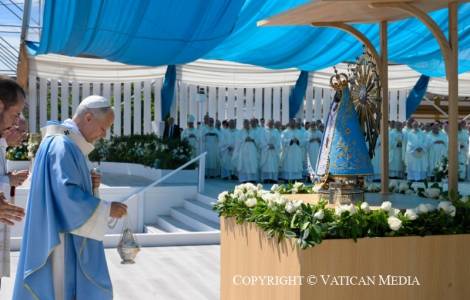
A few hours later, in the heart of the Pampas, the Pope presided over Mass in the square outside the Basilica of Luján, where the statue of the Virgin Mary, just 38 centimetres high is housed, which, according to tradition, arrived in 1630 on a cart that mysteriously came to a halt. Venerated as the Mother and Patroness of Argentina, Our Lady of Luján draws around seven million pilgrims every year.
Following the welcoming hymns, sung by the crowds under the sun, the Archbishop of Mercedes-Luján, Jorge Eduardo Scheinig, greeted the Pope on behalf of the Argentine episcopate.
“Here, in the house of our Mother of Luján, the home of all Argentinians, your Apostolic Journey comes to an end. The annual pilgrimage here helps us become aware that we share a common destiny and that we make this journey together,” he said.
He recalled that 2030 will mark the four hundredth anniversary of the Virgin’s presence in Argentina. Addressing the Pope, who was elected on May 8, the feast of Our Lady of Luján, the Archbishop added: “Whenever you need to feel the embrace of this people, remember that you also have a Mother here.”
In his homily, after recalling “our beloved Francis” – at whose tomb he had gone to pray on November 2 – and noting that he “always carried the little Patroness in his heart”, Pope Leo XIV outlined a four-stage spiritual journey: reconciliation, enlightenment, communion and being sent forth on mission. He then entrusted Argentina with a message of hope:
“Many of our brothers and sisters — or even we ourselves and our families — may currently be living through moments of Calvary, suffering from illness, poverty, unemployment, discrimination or family breakdown, among other problems,” he said.
“In those dark moments, we understand Mary’s experience at the foot of the Cross, with her mother’s heart torn with grief. In that most terrible moment of her life, Mary received a new mission from her Son, embracing all humanity in her mother’s heart. We are likewise called to receive God’s grace and to undergo processes of forgiveness and reconciliation that renew peace, hope and charity within us.”
“We also need to reconcile ourselves with our past and present, in order to build a new future where love has the final word,” he urged, and quoted an Argentine popular song 'La Zamba del Perdón': “Forgiveness for that beggar, for that tear I caused to fall; forgiveness for those eyes that, when they met mine, I refused to look at.”
Before presenting the Golden Rose to the Virgin Mary and entrusting the Argentine people to her protection, the Pope recalled that her white and sky-blue mantle bears the same colors as the Argentine flag.
(MLK) (Fides News Agency, 11/11/2026)