Information service of the Pontifical Mission Societies since 1927
RVA Myanmar
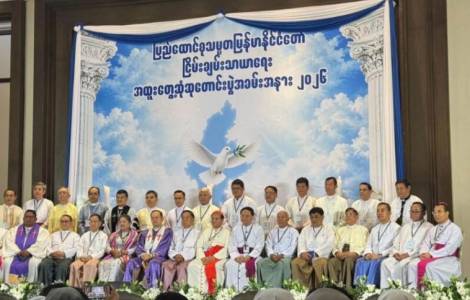
Naypyitaw (Fides News Agency) – “There is no other option: peace is the only way, and it is possible.” This was the message addressed to Myanmar and the world by the leaders of the country’s various religious communities and traditions, who gathered in Naypyitaw in early November for an interfaith prayer meeting for peace.
The meeting was organized by the local Interfaith Dialogue Group, in collaboration with several international non-governmental organizations, including the Japanese organization “Peace”, based in Tokyo, which in recent years has devoted much of its work to supporting Myanmar’s peace process by fostering cooperation among spiritual and religious leaders.
The central message was delivered on behalf of all the participants by Cardinal Charles Maung Bo, Archbishop of Yangon and President of the Catholic Bishops’ Conference of Myanmar (CBCM).
In his address, shared with Fides News Agency, the Cardinal made a heartfelt appeal to all the country’s leaders, political groups, armed organizations and other parties involved in the civil conflict that has been ravaging the country for five years: “Choose dialogue, reconciliation and negotiation instead of violence,” the Cardinal urged, giving voice to a shared desire and common will.
More than 700 people belonging to different religious traditions, including Christianity, Buddhism, Hinduism and indigenous religions, took part in the meeting, which focused on the theme: “There is no other option: peace is the only way, and it is possible.”
The time of prayer and listening sought to place at the centre the suffering of the people of Myanmar, exhausted by a prolonged conflict, while reaffirming the responsibility and commitment of religious communities to promote peace and protect human life.
“We are not here to accuse anyone, reopen old wounds or deepen the divisions that already separate us,” Cardinal Bo said. “We bring a simple message from the heart: a message of hope, a message of courage and a message of responsibility for the future of our country.”
In his address, the Cardinal highlighted Myanmar’s rich ethnic, cultural and religious diversity, urging people to regard it not as a source of division but as “an asset for the future of the nation”.
At the same time, he gave voice to the suffering of those who, in the five-year-old conflict, have lost family members, homes and property, and have been “forced into displacement and precarious living conditions”.
“Our people are tired of suffering. Our children deserve a future. Our young people deserve opportunities. Our elderly deserve dignity. Every citizen deserves the opportunity to live in peace,” the Archbishop declared.
He then appealed to the authorities and all parties involved to “keep the door to dialogue open and invite all sectors of society to the negotiating table”.
A genuine peace process, he stressed, must be inclusive, allowing ethnic communities, political groups, armed organizations, civil society and religious communities to express their concerns in a meaningful way.
“Dialogue,” he emphasized, “does not mean that everyone must immediately agree. It means that we commit ourselves to continuing to talk rather than continuing to destroy one another.”
A strong appeal was also made for the protection of civilians and the need to ensure access to humanitarian assistance. Even amid conflict, the parties must, he urged, “safeguard schools, hospitals, places of worship, homes and villages, and ensure support and security for displaced families”.
Indeed, he recalled, even in the face of political differences, “we must never forget that the life of every human being is of immeasurable value”.
In this context, the Cardinal clarified that “peace does not mean surrender or giving up on justice”.
“True reconciliation requires respect for human dignity, accountability and the protection of civilians,” he said. It also takes time for wounds to heal: “After years of suffering, rebuilding trust will only be possible through consistent and patient gestures.”
“The strongest leaders are not those who manage to prolong a conflict indefinitely, but those who find the courage to bring it to an end,” he observed.
Among the concrete steps identified by religious leaders as necessary to bring about a positive turning point in the ongoing conflict are: establishing ceasefires in the various regions where fighting is taking place; launching urgent humanitarian cooperation to assist displaced people; opening reliable channels of communication to resume dialogue; and signing agreements to protect civilians.
Even limited initiatives, beginning at the local level, are welcome, he noted, “and can help create favourable conditions for a broader process of reconciliation”.
Particular attention was devoted to children and young people. Their lives and future prospects, the Archbishop of Yangon observed, are being shaped by the protracted conflict, and today's generations have a responsibility towards those who will follow them.
“We owe our children more than speeches about patriotism. We owe them the conditions in which they can live, learn, work and grow in peace,” he said.
Religious communities have an important role to play in this journey towards restoring hope and a future to a troubled and devastated country.
Leaders of all faiths reaffirmed their commitment “to working together to protect life, accompany displaced families, support vulnerable children and promote peaceful coexistence”.
“Our religious differences do not prevent us from working together to protect human life and restore peace,” Cardinal Bo remarked.
Recalling Jesus’ words in the Gospel of Matthew – “Blessed are the peacemakers, for they will be called children of God” (Mt 5:9) – the Cardinal urged religious communities to become places of consolation, healing and hope, as they are already doing in war-torn Myanmar.
In today's deeply fragmented social context, this work means “helping to rebuild social bonds broken by violence and keeping open the possibility of reconciliation”.
The appeal of Myanmar’s religious leaders was also addressed to the international community and neighboring countries, urging them to “continue supporting humanitarian assistance, inclusive dialogue and efforts to find a peaceful political solution to the crisis in Myanmar”.
“Peace,” he warned, “is not the victory of one group over another. Peace is the victory of our shared humanity over hatred and destruction.”
The concluding hope, shared by all the religious leaders and faithful present, was for “a future in which displaced families can safely return home, children can attend school without fear, farmers can cultivate their fields, and communities can live together in dignity and mutual respect”.
The interfaith meeting concluded with a prayer “for wisdom for Myanmar’s leaders”, asking that every person to be inspired by “the compassion and courage to pursue justice, reconciliation and peace”.
The message entrusted to the country's various religious communities and, through them, to society as a whole and to the political sphere, was a call to become “peacemakers”:
“There is no other option: peace is the only way, and it is possible” – through everyone's contribution and goodwill, and with God's blessing, because, as the leaders agreed, “only peace is holy”.
(PA) (Fides News Agency, 9/11/2026)