
Information service of the Pontifical Mission Societies since 1927
by Domitia Caramazza
Lima (Fides News Agency) – For many Peruvians, this will be far more than the arrival of a Pope. It will be the return, as Successor of Peter, of the “Father Robert” who shared their hardships, travelled across their land and, in the light of the Gospel, learned to recognize and share the hopes and sufferings of his people. A bond that neither the passage of time nor the Petrine ministry to which he has been called in the universal Church has erased.
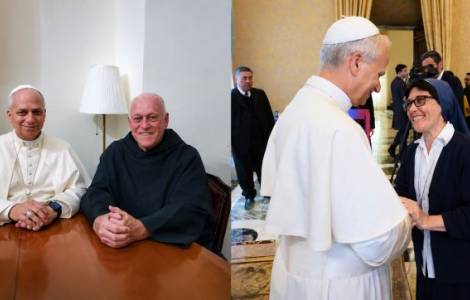
“Everyone feels that he belongs to them and that they belong to him. Honestly, I believe this feeling is mutual,” says Father Arthur Purcaro, an American Augustinian missionary in Peru and a friend of Robert Francis Prevost for more than forty years.
From 11 to 16 November, Leo XIV will return to the country that welcomed him as a young priest and where his missionary vocation found fertile ground for human, spiritual and pastoral growth. Peru is a country of “complex realities”, where deep wounds – poverty, inequality, violence, corruption and social divisions – coexist with extraordinary cultural and spiritual richness. It is a country yearning for reconciliation and peace, where faith is deeply rooted in the daily lives of communities and continues to nourish their hope.
“I have encountered so many people who have taught me to reshape my life and my choices as a person, a consecrated woman and a missionary,” says Sister Romina Guercio, an Italian missionary who has been serving in Peru since 2011. After working in the Diocese of Chiclayo, she is now based in Pimpingos, in the northern Andes. “Faces marked by hardship, suffering, inequality, insecurity, injustice, internal divisions and material poverty,” she recalls, yet all united by “a hope against all hope, and a strong, steadfast faith capable of believing in the disruptive power of the Word of God”.
This, too, is the Peru that helped shape the pastoral experience of “Father Robert”.
To retrace his journey, we must go back more than forty years, to a small village in the northern mountains, where the young Augustinian from the United States encountered an ecclesial community whose faith was expressed through an extraordinary experience of communion and sharing.
The mission in Pacaipampa and Chulucanas: “There was immense faith”. Memories of the Augustinian Arthur Purcaro
It was 1985. Father Robert Prevost, educated in the United States and Rome, with a background in canon law, arrived at the Augustinian mission in Chulucanas. He first met Father Arthur Purcaro in Pacaipampa, in the Andes, not far from the border with Ecuador.
“The group travelling to Pacaipampa from the desert region where Chulucanas is located spent more than eight hours on the road in a pick-up truck,” the missionary recalls. “They came to join our small Augustinian community, made up of three friars, to celebrate the liturgical memorial of Saint Augustine.”
Their destination was a village of just 120 families, with no electricity, running water or sewage system, and only the most basic healthcare and educational facilities. It was a world far removed from Chicago, Villanova and Rome. Yet it was there that the young Father Prevost encountered a witness of faith and community life that would leave a profound mark on his ministry.
“There was immense faith, complete trust in God in every circumstance: a real treasure. It was a community where people came together to build their homes, the chapel and the school,” Father Arthur says.
The precariousness of material conditions coexisted with a wealth of relationships, solidarity and trust in Divine Providence that the young missionary would come to understand through everyday life.
This was not simply a matter of confronting radically different living conditions. In Chulucanas, an ecclesial experience was taking shape that sought to translate the teaching of the Second Vatican Council into everyday life: organized communities, responsibilities entrusted to the laity, formation of the People of God, and a sense of belonging to the Church experienced as a communion of communities.
“Bob was a young priest trained in canon law, who had devoted his thesis to the role of authority in the Augustinian community. In Chulucanas, he could see and experience first-hand how that Augustinian ideal, rooted in the second chapter of the Acts of the Apostles, was taking shape in the local pastoral journey.”
The missionaries' task, Father Purcaro explains, was first and foremost “to build the Church there: above all, the People of God, rather than material buildings, which are also necessary but secondary”.
It was an experience that “opened our eyes and touched our hearts deeply”, showing how ecclesial communion could become a concrete witness to the Gospel, even in a world where meeting people's most basic needs was a daily struggle.
Do not do things “for the poor”, but “with the poor”
In the communities of Chulucanas, Father Robert deepened his understanding of an essential dimension of mission: proclaiming the Gospel means encountering others, sharing their lives and bearing witness, but it also requires a willingness to be evangelized by the faith and experience of those we meet.
Being close to the poor did not mean merely providing for their material needs. It meant recognizing their dignity, sharing in their lives and helping a community flourish in which everyone could feel welcomed and share responsibility.
“Every day, every meal was an entirely new experience, allowing Father Prevost, and all of us, to look at the world through different eyes: the eyes of those who had no access to services other than those their local communities were able to provide,” Father Purcaro recalls.
The missionary remembers families who, on religious feast days, would each bring something to contribute to a communal pot, so that after the liturgical celebration everyone could share a hot meal. It was a simple gesture through which the communion celebrated in faith found expression in the sharing of goods and fraternal solidarity.
From Chulucanas to Trujillo
That experience would remain with Father Prevost in the years that followed, in Trujillo, where he devoted himself to the formation of the Augustinians and to pastoral ministry in the poorest neighborhoods.
There, among other initiatives, he promoted community soup kitchens where families prepared and shared food. These initiatives are still operating today.
The difference, his confrere and friend emphasizes, lay in the very way assistance was understood:
“It was not about a form of generosity that risks turning into welfare dependency, doing good ‘for’ others – with the danger of humiliating them, adopting paternalistic attitudes and failing to address the root causes of their problems. Rather, it was about doing good ‘with’ others, listening to them with respect and seeking together solutions to poverty and marginalization.”
It was through this experience that Father Robert consolidated a pastoral style based on closeness, shared responsibility and the recognition of every baptized person as a “living stone” in the spiritual edifice that is the Church.
“He became a priest for the People of God and with the People of God, ready to welcome people where they are – rather than where we would like them to be – and to walk alongside them towards the goal indicated by the Gospel,” Father Purcaro observes.
It was a ministry that meant “always reaching out to everyone, without ever excluding anyone”.
In Chiclayo, a Church where no one is invisible. The memory of Sister Romina Guercio
Many years later, that same understanding of mission found a new expression in Robert Prevost's episcopal ministry in Chiclayo.
Sister Romina Guercio witnessed this first-hand. In 2017, she was invited by the then Bishop to join the diocesan pastoral animation team.
“The first steps of a synodal journey were being taken in a diocesan context where women were practically ‘invisible’ and their voices had no importance,” she recalls. “There were very few of us: all priests, one layman and me, the only woman.”
The presence of a woman in that body represented a significant development, but above all it was a sign of a growing awareness that all the baptized share responsibility for the life and mission of the Church.
“It was a new experience for all members of the team, because it highlighted the urgent need for change: a journey to be undertaken together, a Church that does not belong solely to the clergy but to everyone – laypeople, consecrated men and women – in which each person is recognized for their value.”
Sister Romina remembers the discretion and determination with which the Bishop accompanied that process.
“Bishop Robert did an extremely delicate job of bringing people together, showing great listening skills, balance and practical wisdom. He guided a new journey inspired by synodality, revealing the true face of the Church.”
This testimony seems to echo, decades later, that of Father Purcaro. In Trujillo, in fact, Prevost had already promoted neighborhood communities led by lay volunteers, both women and men, recognizing abilities and responsibilities that did not always find room for expression in Peruvian society at the time.
In Chiclayo, synodality was not confined to ecclesial structures. It translated into concrete closeness to people, especially those experiencing the greatest suffering.
“Bishop Robert's emphasis on the primacy of the Gospel and the centrality of the poor was very clear,” Sister Romina says. “On many occasions, we saw with our own eyes how he was the first to be present and to ‘get his hands dirty’ in the difficult situations Peru had to face, such as the El Niño phenomenon, Covid-19 and Cyclone Yaku.”
The religious sister cherishes the memory of a Bishop who placed himself at the service of even the most remote and inaccessible communities.
“His hands were always open, ready to work, and his boots were covered in mud. He was present in the most remote and difficult-to-reach places and, when necessary, he would even travel there on horseback.”
A pastor who, faced with emergencies, did not seek individual solutions, but built networks of cooperation involving laypeople, consecrated men and women, institutions and associations, engaging everyone according to their abilities.
“He was a presence that did not rely on many words, but knew how to ‘be there and share’ the joys and sorrows of his people.”
Awaiting the “Peruvian Pope”
The Peru that awaits Leo XIV today still bears wounds that Father Robert came to know during his missionary years.
Sister Romina, who lives alongside the communities of the northern Andes, speaks of a country marked by profound contradictions.
“The greatest emergency is poverty,” she observes, recalling the difficulties many families face in accessing essential goods and healthcare services.
Violence, abuses in remote areas, instability and corruption are added to these problems. The missionary describes corruption not merely as a political problem, but as “a significant scourge and a moral evil”.
“Peru still has so many wounds to heal. It needs to breathe deeply the things that allow it to live fully: freedom, truth, justice and stability. Without these, it will never achieve peace.”
Yet, in the religious sister's account, these wounds do not tell the whole story of the country.
“Peru shines through the richness of its humanity and its tremendous vitality, with everything bursting forth in a beauty that speaks to you through colors, hospitality, celebration, sharing and generosity.”
It is the same richness that Father Arthur encountered forty years earlier in Pacaipampa: communities ready to share what little they had, support one another, find in faith the strength to face adversity and preserve hope.
For Sister Romina Guercio, the Church's presence alongside this wounded humanity is called to bear witness to the dignity of every person and to promote a more just society, in which fundamental rights are recognized not as privileges, but as an expression of the justice owed to every human being.
This perspective is also reflected in Father Arthur Purcaro's testimony: “The Church is not self-referential: it exists to help build a better world for everyone. The Church's role is to promote unity, while respecting and valuing differences. It is not called to build a separate society, but to allow the leaven of the Gospel to act in the dough and bear fruit.”
When Bishop Prevost left Chiclayo in 2023, Sister Romina confided to her fellow religious sisters an intuition she had had about him: “You will see: sooner or later, this man will become Pope,” she recalls saying.
“It was a kind of intuition rooted in the consistency of his life and the balanced way he exercised his ministry as a pastorloved by his people,” she explains today.
“What struck me most was the importance given to the challenge of synodality: a Church that belongs to everyone! Not the prominence of a few, not the race for the highest positions, not power or privilege, but a journey shared together, in which the most vulnerable are accompanied by the strongest, and the voices of the weak and the invisible regain their value.”
On the day of the election, internet connection was poor at the mission in the Andes. When she finally managed to hear the name of the new Pontiff, Sister Romina was deeply moved.
“With a lump in my throat, I thought: through his election, the Lord is giving all humanity a tender embrace.”
Father Purcaro, too, has a special memory of those days. Shortly before the Conclave, he had dinner in Rome with his friend “Bob”. Later, he watched him appear on the balcony of St Peter's Basilica as Leo XIV.
“From the balcony, deeply moved, he spoke from the heart,” he recalls. “He addressed the Peruvian people explicitly in Spanish. He was telling them, and the whole world, that they hold a special place in his heart.”
Now Pope Leo returns to Peru as Successor of Peter, called to confirm his brothers and sisters in the faith and encourage the journey of a Church he knows from within, with all its riches and struggles.
For the communities that accompanied him during his missionary years, the apostolic visit thus carries a meaning that brings together the memory of a shared experience and the hope of renewed missionary impetus.
“For those who knew him, it is undoubtedly the homecoming of someone dear to them,” Sister Romina says. “There is a widespread joy that opens the hearts of those awaiting him with such emotion.”
It is a joy which, the religious sister hopes, may help heal the country's divisions and open up new paths of dialogue, communion and reconciliation.
Father Arthur, too, has sensed the enthusiasm of the communities. He knows that the Pope will not be able to meet personally with all the friends and people with whom he shared so many years of his life.
“Not being able to spend time with friends and people he has known for so many years will be very difficult for him on a personal level,” he observes.
But he is convinced that Leo XIV will carry that bond with him forever, together with the Gospel.
From the mountains of Chulucanas to the neighborhoods of Trujillo, from the Diocese of Chiclayo to the leadership of the universal Church, that missionary vocation has taken on different forms and responsibilities, while retaining its evangelical foundation and Augustinian roots.
“He is a man of prayer who wants everyone to know that they are loved by God,” Father Arthur says. And Sister Romina, giving voice to the expectations of Peru's communities, adds: “We are waiting for a Pope who was a brother to us, a father, an important point of reference, one of our own, an hermano del camino – a brother on the journey.”
(Fides News Agency, 9/11/2026)



 Pope Leo XIV at the Conference on the first Chinese Bishops: Communion blossoms from the faith of the Apostles
 VATICAN/MONGOLIA - Leo XIV receives Cardinal Marengo and the abbot of Gandan Monastery, the heart of Mongolian Buddhism
 POPE IN FRANCE/XI - Leo XIV in Metz: Europe seeks peace in the "Lantern of the Good Lord"
 THE POPE IN FRANCE/X - In Lourdes, where the vulnerable bring light
 VATICAN - "Church of Rome, Missionary Church": Cardinal Reina opens the Urbaniana's Academic Year
 Cardinal Chow at the Conference on the first Chinese bishops: an “intercultural” approach can support the journey of Catholics in today’s China
 Cardinal Tagle: Five "Thank You" on the occasion of the Conference on the first Chinese Bishops
 “Gifts to give and gifts to receive”: The Church of the Sheaves opens its first international conference in Rome
 Archbishop Nwachukwu presents the “Church of the Sheaves”, an initiative born out of gratitude
 EUROPE/SPAIN - Canary Islands, “a border that becomes a bridge”: the reflection of the Delegate of Caritas Tenerife after the visit of Leo XIV
 ASIA/CHINA - Chinese Catholic communities participate in Jubilee pilgrimages and Lenten retreats to ask for the gift of communion
 ASIA/INDONESIA - Waiting for Pope Francis, along with the Muslim brothers. An interview with Ignazio Suharyo, Cardinal of Jakarta (I/II)
 ASIA/PHILIPPINES - The synodal path in the Philippines enhances the Basic Ecclesial Communities