
Information service of the Pontifical Mission Societies since 1927
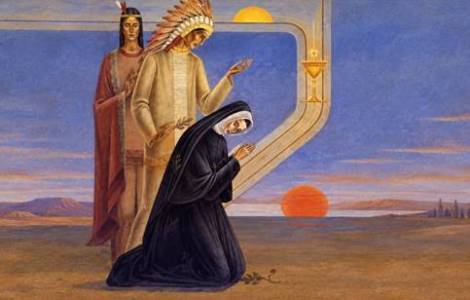
source: Conférence des évêques de France (CEF)
by Marie-Lucile Kubacki
Saint Louis (Fides News Agency) - A pioneer of Catholic education on the American frontier, Philippine Duchesne (1769–1852) established the Society of the Sacred Heart in the United States in 1818. Her journey forms part of the wider missionary history that shaped American Catholicism, marked at its origins by a strong French influence, a history reflected today in Pope Leo XIV’s own path from Chicago to Peru and Rome. Fides met Sister Carolyn Osiek, RSCJ, in Saint Louis to explore this legacy, its achievements and its painful chapters, including slavery. A New Testament scholar and former archivist of the Society of the Sacred Heart, United States-Canada Province, she taught Robert Francis Prevost at the Catholic Theological Union in Chicago. Her testimony connects the challenges faced by nineteenth-century missionaries with the cross-cultural formation of the first North American pope.
How did Philippine Duchesne contribute to the Church on the culturally diverse American frontier?
Sister Carolyn Osiek: First of all, she was part of a larger movement. By the end of the nineteenth century, a majority of the Catholic missionaries in the world were French. Then she had been inspired by the reports of priests coming back from North America, from China and other places. She originally wanted to go to China, and then Canada, and eventually got the opportunity to come to North America. She came in 1818, and Missouri became a state in 1821. Philippine didn't think she was coming to the United States. She thought she was coming to French colonial civilization in the Mississippi Valley. Her major interest was with the Native Americans, which was frustrated as she did not get much time with them. In terms of cultural diversity, she herself never felt comfortable in English, and that was a great obstacle to her. In her first years in Missouri, the language was changing fast from French to English. People from the eastern United States were moving into the Mississippi Valley, people she was not prepared to deal with. So instead of achieving her dream to come to the frontier, where there would be Native Americans, she landed in a growing frontier town, dealing with French and Anglo children. The cultural diversity was extremely difficult for her to deal with.
How did she respond?
Sister Carolyn Osiek: She followed the model of the newly established Society of the Sacred Heart in France, based on European boarding schools for girls. This included the distinction between choir religious and coadjutrix sisters. Despite the bishop's warning that it would not work in Missouri, she maintained the French practice, even though it proved unsuitable. Priests and religious were urgently needed in these colonial settings. Many communities became autonomous from their European foundations, but Philippine refused to do that. She would wait up to six months for an answer from Madeleine Sophie Barat, the Superior General in France, much to the bishop's frustration. Preserving those ties helped make us an international congregation, present today in forty-one countries.
What can her educational mission, begun in St. Charles, offer the Church in the United States today?
Sister Carolyn Osiek: Women religious participated in colonization and the development of new places chiefly through schools and hospitals. The Society of the Sacred Heart did not have hospitals as part of its mission; its mission was expressed through education. The European model distinguished between boarding schools for the upper classes and free schools for the poor. Philippine had grown up with that distinction, although her family was bourgeois. She established both, but an intermediate option was needed. Fee-paying day schools, also emerging in Europe, presented a new challenge. Her work belongs within the considerable, continuing legacy of Catholic education in the United States and Canada, which eventually produced great universities. I believe this remains a distinctive contribution. With a new pope and a new teaching voice, the emphasis on human dignity and Catholic social teaching is more important than ever. Philippine was part of its beginnings.
How should we read her desire to live with Indigenous peoples in light of the wounds inflicted by colonial history?
Sister Carolyn Osiek: She participated in that history without intending to inflict wounds. By the time she arrived in Missouri, Native Americans had largely been pushed west, away from St. Louis and St. Charles. This frustrated her hope of working among them. The removal of Native Americans is central to American history. They were driven from arable land into places where they could be contained and evangelized, always according to what white people wanted. Philippine reached the Potawatomi mission at Sugar Creek, Kansas, in 1841. By 1848, the Potawatomi had been pushed out again. The Religious of the Sacred Heart followed them to St. Mary's, before they eventually dispersed. Although we associate the Potawatomi with Kansas, they had come from Indiana and places much further east. The Jesuits with whom Philippine worked sought to evangelize, to form good Catholics. She shared that goal with great love. Despite her difficulties with languages, she studied Potawatomi, copying the entire Lord's Prayer in a letter to her brother. Eyewitnesses reported that she was called “the woman who always prays.” By the sisters' arrival in 1841, a good half of the tribe was already Catholic. Their work was therefore less about preaching to the unconverted than developing spiritual formation. Seen today, it is a mixed story.
How did she see Indigenous peoples? Was her perspective anthropological?
Sister Carolyn Osiek: I think her view was romanticized. In France in 1806, she described a vision, an imagined picture of herself surrounded by dark-skinned children. It reveals her romantic expectations of how wonderful the experience would be. At Sugar Creek, conditions were harsh for Indigenous people and sisters alike. Yet she loved living with material deprivation; it was part of what she had expected.
What about Lucile Mathevon, the superior at Sugar Creek?
Sister Carolyn Osiek: I wrote a short biography of her. She was French and arrived in 1822 with Anna Murphy, who went to Louisiana. Lucile was superior at St. Charles for several years before leading the Potawatomi mission, where she spent the rest of her life: thirty-five years in extreme deprivation. Philippine gets all the attention for her one year there. Others came and went; Lucile remained. Her dedication was heroic. We have her handwritten accounts of the journey and the mission's early years. Practical, energetic and a good storyteller, she was also a highly capable organizer.
I learned that your congregation has done work on its own history and its links with slavery. What can you tell me about this work of historical research and remembrance, in St. Louis and elsewhere: its spirit, and what has been done?
Sister Carolyn Osiek: We began working on this in 2016, and on September 23, 2018, we had a significant event at Grand Coteau, Louisiana, where descendants of the people who had been enslaved with us came: about fifty. On the website there is a video of about twelve minutes that pulls the whole thing together. That was something we really wanted to do. The entire event was planned by a committee of descendants, not by us as we wanted it happening the way they wanted it. A sister in California who is an amateur genealogist is continuing to stay in contact with descendants, and even introducing them to each other when they did not know that they were related. And we have a scholarship for an African-American student at Grand Coteau. Those are the major things now.
What stands out from that day?
Sister Carolyn Osiek: The gathering took place in Louisiana because, unlike Missouri, where I think we can document only seven enslaved people, Grand Coteau had a plantation with enslaved families. After emancipation in 1865, some of the same family names appear in financial records as paid workers, indicating that the families stayed. Initially, everyone was cautious. In the parish church, our provincial read a welcome and an apology. We discovered that what mattered most to the descendants was acknowledgement of their ancestors' contribution: we could not have done what we did without them. We then processed to the parish cemetery, where we had erected a monument naming the enslaved people we believe were buried there. The convent cemetery was reserved for sisters. Parish records proved invaluable for identifying parents, godparents and burials. There were prayers and singing at the monument, followed by dinner at the school and a ceremony in its chapel.
How might Pope Leo XIV's theological formation illuminate his priorities?
Sister Carolyn Osiek: Catholic Theological Union, where he studied, began in 1968 as an experiment. Men's religious orders closed their rural seminaries and brought their formation into an urban setting. In the aftermath of Vatican II, the city was seen as the place to engage with the life of the Church and its people, together rather than in isolation. The Society of the Divine Word brought students from around the world. Internationality, cross-cultural understanding and mission were central. The faculty wrestled with a fundamental theological question: if God is present throughout society and all humanity, why do we go out and preach the Gospel? What more can we bring? The Augustinians were deeply committed to their mission in Peru, where Bob served as a young priest. From the beginning, he showed an ability to live within other cultures and embody his mission there. I think this was an important part of his formation. Is he American or Peruvian? There is no clear answer, and I think that is good. When I visited his parish in Trujillo, Peru, I saw him in action. He already had the flexibility and capacity for listening that remain, I believe, among his defining qualities. (Fides News Agency 24/10/2026)



 THE CHURCH OF THE SHEAVES CONFERENCE - Listening the Continents: Gifts, Challenges and New Missionary Pathways
 "Gift exchange between the Churches requires conversion": Fr. Stan Chu Ilo on the "Church of the Sheaves"
 “Listen before proposing, accompany without replacing”: Caritas aid workers share their experience alongside communities
 AMERICA/PERU - Apostolic Vicariate of Iquitos issues urgent appeal to curb spread of illegal mining in the Amazon
 ASIA/PHILIPPINES - The life of the Missionaries of Mary Queen of Heaven: restoring dignity to women victims of exploitation
 In Beijing, thirty-six Superiors General of Chinese women’s religious congregations attend annual formation course at the National Seminary
 VATICAN - Sister Mary Teresa Barron appointed adjunct secretary of the Dicastery for Evangelization and president of the Pontifical Mission Societies
 ASIA/CHINA — During spiritual retreats, Chinese priests and religious sisters offer prayer and fasting for the sick and study the Encyclical “Magnifica humanitas”
 World Day Against Human Trafficking: Women religious and Church networks stand alongside victims across Latin America and Europe
 VATICAN - "Paths of Hope" in the Missionary World: Liberation from Old and New Slavery
 100th WORLD MISSION SUNDAY - Pope Leo XIV: May the Church always remain faithful to the mandate of the Risen Lord
 New episcopal ordination in China: Ignatius Ding Zuyao ordained Bishop of Haimen