Information service of the Pontifical Mission Societies since 1927
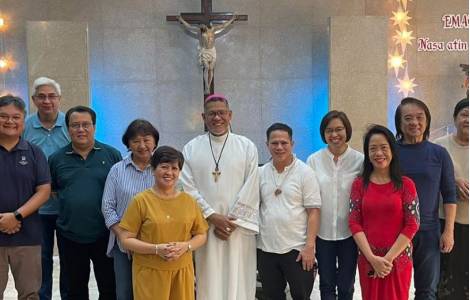
Laiko
by Paolo Affatato
Manila – A mission of “truth and justice”, to be lived out in society and politics, in the fight against corruption and in solidarity with the most vulnerable: this is the vocation of Catholic laypeople in the Philippines, according to Albert Loteyro, president of the Council of the Laity of the Philippines, known as “Laiko”, and Executive Secretary of the Episcopal Commission for the Laity of the Catholic Bishops' Conference of the Philippines (CBCP).
His appeal comes amid the ongoing journey of the local Church, which is urging the faithful to “translate their faith into a tangible presence in society” in the face of challenges affecting the daily lives of millions of people.
Speaking to Fides on the sidelines of the International Forum of Catholic Action (FIAC), held in Rome in recent days, Loteyro said: “As laypeople, we ask ourselves: what is our identity, our vocation and our mission? For me, and for each one of us, our identity, by virtue of Baptism, is that of being a child of God. My vocation is a call to holiness,” he said. “This is how we can reflect on the identity and mission of our lay organizations and associations,” he added.
The president of “Laiko” coordinates a broad network comprising approximately 58 national lay organizations and 56 diocesan councils of the laity. “We work together through a participatory and consultative approach to leadership and engagement,” he told Fides, highlighting the importance of fostering collaboration and networking among associations, communities and ecclesial bodies throughout the country. “The role of laypeople in the Philippines, given the current social, political and economic landscape, is extremely important. We work alongside the clergy and bishops, fully aware of our mission.”
“The mission of us laypeople,” he stressed, “is to bring the light of faith to temporal affairs and to take an active part in social and political life.”
This responsibility translates into a commitment to truth and justice in public life. “For example, when it comes to corruption, we want to uphold truth and fairness in the conduct of politics. Whether in response to the latest scandals involving so-called ‘ghost projects’ for flood prevention or in the impeachment proceedings concerning Sara Duterte, our compass as Catholic laypeople is to follow, promote and act in the cause of justice and truth.”
The reference to flood-control projects points to an issue that has taken centre stage in public debate in the Philippines. In 2025, investigations were launched into widespread irregularities in flood-control infrastructure projects, including allegations concerning incomplete or substandard works and the use of public funds. The allegations and questions of responsibility remain subject to investigation and legal proceedings. For this very reason, Loteyro observes, “the demand for transparency and accountability must remain an essential criterion for anyone involved in public life.”
Corruption in the Philippines is a major issue in public debate and has also featured prominently in statements by the country’s bishops. In the Transparency International Corruption Perceptions Inde2025, the Philippines scored 32 out of 100, with zero indicating a very high perceived level of public-sector corruption and 100 indicating a very high level of integrity in the public sector.
Alongside corruption, Loteyro identifies poverty and unemployment as challenges that directly concern Christian communities. According to official figures from the Philippine Statistics Authority for 2025, approximately 10 per cent of the country’s population — around 11 million people — live below the national poverty line, lacking the resources needed to meet basic needs. As for employment, the average annual unemployment rate in 2025 stood at 4.2 per cent, equivalent to approximately 2.14 million people, while millions more work in the informal economy or rely on day-to-day employment.
“Poverty and unemployment are major challenges that must be addressed and require us to make our own contribution,” Loteyro said. In response, Catholic lay organizations across the archipelago seek to be present wherever hardship is most keenly felt. “Members of our organizations go to the outskirts and marginalized communities to identify people’s needs. They are present, attentive and committed to building an extensive network of human and social support.”
For the president of Laiko, this presence is an integral part of proclaiming the Gospel. The mission involves more than pastoral activities and the animation of Christian communities; it also means “helping to build a more just society, combating falsehood and promoting responsible participation in democratic life”.
These themes were also at the heart of the National Week of the Laity, organized by Laiko and held last September. The initiative focused on the so-called “5 Ks”: Korapsyon (corruption), Kahirapan (poverty), Kriminalidad (crime), Kasinungalingan (lies and disinformation) and Kataksilan (civic betrayal). The week featured political education initiatives and parish-based mobilization, inviting the faithful to recognize and confront these social ills.
The next milestone in this process will be the National Assembly of Filipino Catholic Laypeople, organized by Laiko and scheduled to take place in Cebu on 6–7 November. The first gathering of its kind will bring together national presidents of lay associations, heads of diocesan commissions and lay leaders from across the country. Its chosen motto, “One Laiko. One Mission”, expresses the intention to strengthen communion and cooperation among the various groups, renewing the presence of laypeople in both the Church and society.
“The aim,” Loteyro told Fides, “is to listen: to listen to our lay leaders, to listen to people’s needs and to listen so that we can reassess how we are present in society. The key themes are listening and participation, so that our mission in society may bear ever greater fruit according to God’s will.”
The assembly will therefore provide an opportunity for dialogue and collective discernment, in keeping with the vision of a synodal Church capable of understanding the needs of communities and responding to them through shared responsibility.
Loteyro concludes with a hope that sums up the vocation of Filipino laypeople: “My hope is that all laypeople in the Philippines will fulfil their missionary vocation. We are all called and sent forth to proclaim the Gospel. I hope that we may all respond to God’s call. By virtue of our Baptism, we are called to be missionaries, and the world awaits from us words and deeds that bring light and hope.”
(Fides News Agency, 22/10/2026)