Information service of the Pontifical Mission Societies since 1927
OFM Conv
by Paolo Affatato
Tashkent (Fides News Agency) – Two new parishes in a Muslim-majority country, and a small Catholic community quietly growing, step by step. In Uzbekistan, the Catholic Church is a numerically small presence, yet it continues to put down roots through personal relationships, the witness of the faithful and encounters with those seeking a place to pray and feel part of a community.
“Sometimes we start a new parish with three, four or five people. That is how it begins, with a small seedling,” Bishop Jerzy Maculewicz, OFM Conv, a Conventual Franciscan and Apostolic Administrator of Uzbekistan, tells Fides News Agency. “We do as the Apostles did, as we read in the Acts of the Apostles: we start with very little, but we make a beginning, and the Lord guides our steps.”
Over the past two years, he reports, two new parishes have been established in the country: one dedicated to Divine Mercy and the other to Saint Joseph. For the bishop, these new ecclesial realities are signs of change in the country’s environment. One is located in Angren, about 90 kilometres from the capital, Tashkent. “This new parish has just over 20 faithful, two-thirds of whom are children. It is the beginning of a new ecclesial reality in a place where we had not been present before.”
In a journey marked by small numbers, growth becomes visible over time. “I am a Polish priest, and I have been in Uzbekistan for 21 years. I can say that my story is linked to that of Saint John Paul II: the Apostolic Administration was established and I was appointed on 1 April 2005, the day before the Pope died. I was one of the last bishops he appointed.”
When the time came to choose a patron saint for the Apostolic Administration, the community proposed Saint John Paul II, Bishop Maculewicz recalls, partly because there were no local martyr saints in that land who could be chosen as patrons.
When he arrived, there were five parishes, entrusted to the pastoral care of the Conventual Franciscan friars. In 1997, Saint John Paul II had entrusted the Order of Friars Minor Conventual with the task of developing the structures of the Catholic Church in the country. Since then, the Church’s journey has continued in a social and institutional context that, according to the bishop, has undergone significant changes.
“When I arrived, during the presidency of Islam Karimov, the situation was somewhat difficult for all religions, both Muslim and Christian. For example, young people and children were forbidden from attending mosques or churches,” he recalls. “Under Uzbekistan’s second and current president, Shavkat Mirziyoyev, who came to power in 2016, the country has opened up, first to tourists and also to pilgrims. As a Catholic Church, we have been given the opportunity to carry out our work more peacefully and freely.” The opening of two new parishes in recent years, he notes, “is one concrete sign of this change”.
Legislation has gradually moved towards greater liberalization and a reduction in state controls over religious communities, culminating in new regulations introduced in 2021 and 2025. The latest law draws a distinction between the State and religion, seeking to ensure that no faith can be imposed on citizens while strengthening legal protections for religious minorities, particularly Christian communities of various denominations, in a country with an overwhelming Muslim majority.
A small Church on a journey
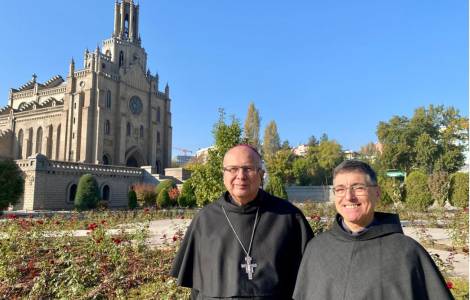
The Catholic Church in Uzbekistan has approximately 4,000 faithful out of a population of 39 million, around ten priests, both diocesan and religious, and approximately 15 religious sisters, along with an equal number of catechists. The country’s only Catholic ecclesiastical circumscription is the Apostolic Administration of Uzbekistan, based in the capital, Tashkent, where the Cathedral of the Sacred Heart of Jesus is located.
It is a small community spread across a vast territory. “We are now seeing people from abroad coming to the country to study or work,” the bishop observes. “Among them are many students from India who have come to study medicine. Some are Eastern-rite Catholics, others belong to Protestant communities, while others are non-Christian. They come to Catholic parishes to pray together.”
“It is interesting: they really want to be with us. They are looking for a sense of community, for the opportunity to be with others and share friendship, spirituality and faith,” he notes. This experience shows “how a parish can become a meeting place even for people who do not share the same religious affiliation but feel the need for human relationships and a spiritual space”.
The growth of the Church, Bishop Maculewicz stresses, can also be seen in the changes that have taken place over the years in the composition of its communities. “In the past, those who asked for Baptism usually came from families in which one member had embraced the Catholic faith. Perhaps a mother became Catholic, or a son or a father, but we did not have entire families.”
Today, however, the fruits of a longer journey are beginning to emerge. “There are young Catholics who have married and already have children. We have Catholic families and children who have been Catholic from an early age. In the past, there were very few.”
It is a gradual transformation that the bishop observes with gratitude. “Over the past 20 years, I have seen this Church’s journey. The numbers are not large, but there are personal contacts, relationships and individual testimonies. We see that every person who draws closer to the Church has received a personal call from God.”
Each year, the community accompanies new candidates preparing for Baptism. During the Easter Vigil in 2026, around ten people, including children, were baptized in Tashkent. Adults undergo a careful period of preparation. “We prepare people for Baptism through a journey that lasts a year and a half. There are also faithful who have already been baptized in other Christian Churches. In those cases, we accompany them as they enter the Catholic Church through a profession of faith, recognizing the validity of the Baptism they have already received.”
The life of the community is also shaped by population mobility. Uzbekistan has experienced significant demographic growth over the past 20 years, and many young people leave the country in search of educational and employment opportunities abroad. “Many people leave to seek a better life for themselves and their children. They go to Europe, Korea, the United Arab Emirates, America and various other countries. Many of our Catholics have also left.”
Dialogue begins in everyday life
In a Muslim-majority society, the Catholic presence develops through good-neighbourly relations and forms of coexistence that the bishop regards as a valuable resource.
“We have good relations with Muslims. In Uzbekistan, there is a tradition of tolerance which, in my opinion, has ancient roots dating back to the days of the Silk Road. At that time, people exchanged not only material goods but also cultures and religions.”
Uzbekistan, Bishop Maculewicz observes, is home to people from more than 120 different nationalities. This diversity creates opportunities for encounters between different religious traditions.
The bishop recalls an episode in Samarkand. “Once, I was in a taxi and the Muslim driver told me that his neighbors were a Jew and a Christian. He said they celebrated one another’s religious holidays together: Muslims, Christians and Jews. This shows how natural tolerance can be.”
Everyday hospitality is another gateway to dialogue. “Uzbeks are very open and interested in other people. When they see someone in need, they are generous in offering help. If they see you for the first time, they may invite you into their home and offer you tea.”
For many people, he adds, “what matters most is knowing that the person they are speaking to believes in God”, rather than knowing which religious denomination that person belongs to.
“There is an openness to the transcendent. That is why blessings are important: I always bless the people I meet. When a man of God arrives, whatever his faith may be, this is perceived as something valuable.”
For the bishop, this openness to encounters can foster relationships of trust and create opportunities for Christian witness.
Dialogue also finds expression in relations with the authorities. Uzbekistan has a State Committee for Religious Affairs, which includes a council that brings together representatives of the various recognized religious communities. Bishop Maculewicz participates alongside representatives of the Orthodox Church, Armenian communities, Lutherans and other religious groups.
“It is a place where we can exchange ideas and offer our views to the government,” he explains. “When the law on the registration of new religious organizations was amended, we were also asked to give our opinion. We made some suggestions that were taken into consideration, and some changes were made. I think this is positive.”
The Mission of all the baptized
In October, the month dedicated to the missions, the bishop recalls the missionary vocation shared by every Christian.
“I would like to repeat the words of Saint Francis Xavier: we must always maintain a missionary spirit, in every moment and in every action of our lives. Jesus sent us forth to proclaim the Gospel to all peoples. He sent all the baptized, not only priests and consecrated men and women, but laypeople as well.”
In Uzbekistan, this mission takes the subtle form of personal encounters, hospitality and witness. “As Catholics, we are present, we build relationships, we accompany those who draw closer to the faith and offer a place of prayer to those seeking a community.”
From this experience comes the message of hope that Bishop Maculewicz offers when reflecting on the future of the Church in this Central Asian country. He returns to the Gospel images of salt and leaven.
“I think of Jesus’ words when he tells us that we are the salt of the earth and the leaven of the world. A little salt is enough to give flavour to food, and a pinch of yeast is enough to make dough rise. This is our inspiration as we consider what we, a little flock of Catholics in Uzbekistan, can do to change the flavour of this nation and bring out its richness.”
The answer lies in a willingness to listen to God and follow his will.
“I believe the Lord has a plan for us. It is up to us to listen to his voice, do his will and fulfil his plan for this land and its people.”
(Fides News Agency, 21/10/2026)
OFM Conv