Information service of the Pontifical Mission Societies since 1927
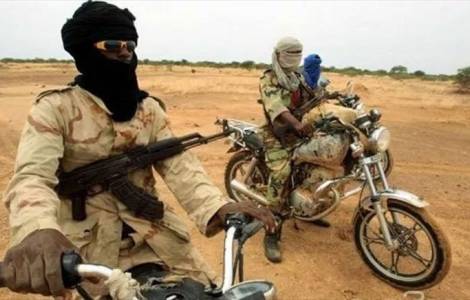
Ouagadougou (Fides News Agency) — A war within a war is being fought in the sands of the Sahara, in the tri-border area where Mali, Niger and Burkina Faso meet. Here, the two main jihadist groups operating in the region are facing each other: Jama’at Nusrat al-Islam wal-Muslimin (JNIM, the Group for the Support of Islam and Muslims) and the Islamic State in the Sahel (ISS).
The former is affiliated with Al-Qaeda, while the latter is linked to the Islamic State. The two groups coexisted for a long time and, in some cases, even cooperated across the three Sahelian countries, despite clashes between jihadist groups with similar affiliations in other parts of the world, including Syria and several areas of Africa.
JNIM was formed in March 2017 through the merger of several katibas (fighting units), under the leadership of Iyad Ag Ghaly. The Islamic State in the Sahel, previously known as ISGS (Islamic State in the Greater Sahara), emerged between 2015 and 2016 around the figure of Adnan Abu Walid al-Sahrawi, who was later killed.
Since 2019, tensions between JNIM and ISS have steadily escalated, leading to increasingly violent clashes. The latest reported incident occurred just a few days ago. According to an report published by Amaq, the Islamic State's propaganda agency, ISS fighters allegedly killed around 400 JNIM members during fierce fighting in Oudalan Province, in northern Burkina Faso, while also inflicting heavy losses in weapons and motorcycles. The report, however, has not been independently confirmed.
According to Amaq, the fighting began on 9 October in the village of Ganadaouri, where ISS militants reportedly repelled a large-scale JNIM offensive. The clashes are said to have lasted approximately an hour and a half.
Earlier, on 1 September, JNIM and ISS clashed in Mali near N'Daki, in the Timbuktu region close to the border with Burkina Faso. ISS emerged victorious, reportedly killing around 100 JNIM fighters, including a senior commander. These clashes followed the killing by JNIM, on 17 August, of Abou Zeid, the head of ISS in Burkina Faso, and commander Saad.
At the heart of the conflict lie political and doctrinal differences between the two jihadist organisations.
JNIM adopts a relatively pragmatic approach and is deeply rooted in local communities. It primarily targets state institutions and their symbols, negotiates with local elites and, in areas under its control, imposes a relatively flexible system of governance. This includes mechanisms such as zakat (the obligatory almsgiving prescribed by Islam), dispute mediation and corrective sanctions, rather than exemplary public punishments. It also tends to avoid practices such as beheadings and public stonings, partly in an effort to preserve a degree of popular support.
ISS, on the other hand, follows a more hard-line approach. It is more inclined to declare Muslims whom it considers insufficiently aligned with its ideology to be unbelievers, targets civilians accused of collaborating with the enemy, and relies on exemplary and punitive violence as a central instrument of control.
Alongside their confrontation with one another, both groups continue to fight the security forces of the three Sahelian countries. The heaviest price is paid by local populations, who remain exposed to violence perpetrated by all sides in the conflict.
(L.M.) (Fides news Agency, 15/10/2026)