Information service of the Pontifical Mission Societies since 1927
Agenzia Fides
by Paolo Affatato
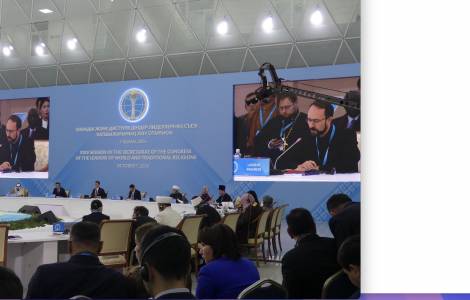
Astana (Fides News Agency) – The 24th session of the Secretariat of the Congress of Leaders of World and Traditional Religions, held in Astana on 7 October, provides a clear picture of the evolution taking place in interreligious dialogue: from discussion to collaboration, from mutual understanding to the search for common answers to the major issues facing humanity. This is the evolution outlined to Fides by Father Laurent Basanese, SJ, Head of Office at the Vatican Dicastery for Interreligious Dialogue, who took part in the meeting in Astana and spoke of “spiritual diplomacy”. This is not an alternative diplomacy to that of States, nor an attempt by religions to assume a political role, but rather an additional space in which religious leaders can meet, listen to one another and place their moral authority at the service of society.
The Astana session adopted three documents on apparently different issues — artificial intelligence, climate change, and the protection of children suffering from incurable illnesses — which in fact converge around a single question: how can human dignity be safeguarded at a time when technological, environmental and geopolitical transformations are advancing more rapidly than the ability of institutions to develop shared responses?
From dialogue to joint action
“The 24th session of the Secretariat of the Congress of Leaders of World and Traditional Religions confirms the value and usefulness of this spiritual diplomacy,” Father Basanese told Fides, recalling that the expression itself has been used by representatives of the organization, in this case by Kazakhstan’s Vice President Erlan Karin.
The Jesuit emphasizes the particular nature of this meeting: “It is inevitable that there is also a political dimension,” he observes, “because some of the participants — in particular several Muslim leaders or representatives linked to State institutions — have relations with governments.” The Catholic Church’s interest, he explains, is above all “to have a fraternal, spiritual encounter, in order to see what we can do and how we can work together”.
This is the most significant development in the Astana experience: for years, interreligious dialogue was above all a dialogue of mutual understanding. “It is a necessary phase: before we can act together, we need to know the other, to understand their faith, philosophy of life, history and sensibilities. But that phase,” Basanese observes, “can now open the way to a second stage: that of concrete collaboration. Today, the aim is to seek more practical ways forward through encounter.”
It is therefore not only a matter of dialogue, but of action. The choice of the three issues discussed in Astana reflects precisely this evolution.
Artificial intelligence, the climate crisis and the protection of vulnerable children are issues from which the spiritual dimension cannot remain separate. At the same time, they are areas in which State legislation faces difficulties or moves more slowly than the pace of change.
For Father Basanese, the Catholic Church comes to this discussion with an already significant body of teaching, including Pope Leo’s encyclical Magnifica Humanitas and Pope Francis’ Laudato Si’, “texts united by the awareness that these issues do not concern only governments, major technology companies or specialists, but concern everyone”, he stresses. “They also concern the spiritual person,” he explains, “because believers and faith communities are at the same time part of society and citizens.”
The documents approved in Astana “are not legal documents,” the Jesuit acknowledges, “but they can provide a framework and contribute to the reflection of those called upon to make decisions”. This is the role of what Basanese describes as an “off-stage” voice: a voice that does not belong to political or economic power, but can accompany and guide its reflection. The perspective, therefore, is one of shared responsibility: “We all belong to the same humanity, to the same earth,” Basanese affirms. “Our skills are different — political, economic, financial, spiritual — but everyone is called to contribute to the common good.” The language of spiritual diplomacy does not replace political actors, but adds a moral dimension to the discussion, one capable of questioning decisions about their impact on people and society.
Three documents, one question: human dignity
The three texts approved in Astana concern different areas, but can be read as parts of a single reflection on safeguarding human dignity and on our shared responsibility for the future of humanity.
The first is the “Ethical Code for the use of Artificial Intelligence in religious contexts”, developed at the initiative of Kazakh President Kassym-Jomart Tokayev. Its starting point is the recognition of an increasingly evident reality: AI is also entering the life of religious communities. New technologies can be used to communicate, educate, produce content and reach people, especially younger generations. But precisely for this reason, they can also become instruments for manipulating religious sentiments, spreading hatred or distorting the content of faith. The Code therefore seeks to provide moral and ethical guidelines so that the use of AI in religious communities remains subject to respect for the dignity of the person and spiritual values. The issue is not addressed merely as a technological issue: religions are called to pose a question that precedes technology itself — not simply what artificial intelligence is capable of doing, but what it is permissible to do with it.
The second issue is the climate crisis. The approved document on the role of religions in the fight against climate change expresses the conviction that protecting the environment cannot be entrusted exclusively to public policy: religious communities can help educate the faithful in responsibility towards creation, promote concrete forms of sustainable behaviour and draw attention to the consequences of the uncontrolled exploitation of resources and climate-related disasters, which particularly affect the most vulnerable populations. Here too, the spiritual dimension becomes a form of social responsibility. The climate crisis is not merely a scientific or economic problem: it concerns the way humanity understands its relationship with the earth, with resources and with future generations.
The third document, the “Charter of the Rights of the Terminally Ill Child”, brings the reflection on a more immediately human dimension. Presented as a joint initiative between Kazakhstan and the Vatican City State (see Fides, 2/10/2026), the Charter places the dignity of minors suffering from incurable illnesses at its centre. The text recalls the right to humane care, medical and palliative assistance, and psychological support. But it also introduces a dimension of particular significance for interreligious dialogue: spiritual accompaniment, with respect for the religious needs and worldview of the child and his or her family. In this third document, technology and politics give way to the fundamental question that also runs through the other two texts: the person cannot be reduced either to data, to a consumer, or to a recipient of a service.
AI, the environment and childhood illness thus become three different areas in which to reaffirm a single principle: human dignity comes before efficiency, technology and economic interests.
From dialogue to the global peace Movement
The discussion on the Global Peace Movement, addressed during the 24th session, represents the possible next step in the “spiritual diplomacy” promoted by Astana.
The proposal, put forward by President Tokayev, seeks to translate spiritual messages into a more stable form of collaboration. The slogan of the 8th Congress — “Synergy for the Future” — thus takes on an operational meaning: bringing together the different capacities of religious communities to address the fractures of a world marked by wars, polarization and a crisis of trust.
One of the tasks identified is particularly delicate: preventing religious beliefs from being manipulated or exploited as a pretext for fuelling armed conflicts, hostility and hate speech. This responsibility directly concerns religious leaders: religion can be used to divide and legitimize violence, but it can also become a resource for reconciliation. Spiritual diplomacy arises precisely from the need to strengthen this second possibility.
According to the material presented in Astana, the Movement also envisages collaboration with the United Nations Alliance of Civilizations (UNAOC) on programs dedicated to protecting places of worship, which are particularly vulnerable in war-torn contexts.
The project aims to establish permanent initiatives, involving young people, academics and media professionals, with the aim of fostering a culture of tolerance and mutual respect amongst the younger generations.
This illustrates the difference between an interreligious conference and a genuine infrastructure for peace: a meeting can produce a declaration; a movement, on the other hand, fosters relationships, formation, networks and actions capable of enduring over time.
Whilst ‘spiritual diplomacy’ teaches that religious leaders, through their moral, educational and community influence, can enrich the reflection of political leaders, the question is what the different religious traditions can do together to protect the individual, peace and the future of the planet. From this perspective, the “Global Peace Movement” will be a concrete testing ground.
(Fides News Agency, 8/10/2026)