Information service of the Pontifical Mission Societies since 1927
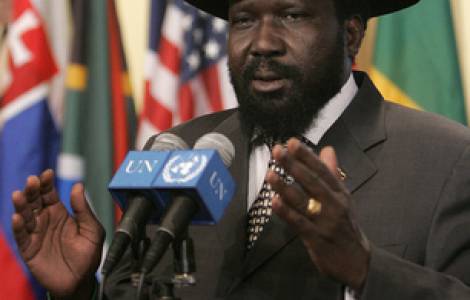
Juba (Fides News Agency) — South Sudan is heading toward elections scheduled for December 22 after President Salva Kiir, on September 22, dissolved the Transitional Government of National Unity and appointed an interim executive. The move brings to an end the power-sharing arrangement established under the Revitalized Agreement on the Resolution of the Conflict in South Sudan (R-ARCSS), signed in 2018 to end the civil war that broke out in 2013.
The decision came a day after Kiir signed amendments to the electoral law removing some of the previous requirements for holding elections, including the completion of the permanent Constitution and the national census. The new provisions also allow the President to remain in office, with his constitutional powers, throughout the electoral period and until the newly elected president is sworn in.
In response to the decree dissolving the government of national unity, eight opposition groups and civil society organizations sent a joint letter on September 23 to IGAD Executive Secretary Workneh Gebeyehu and African Union Commission Chairperson Mahmoud Ali Youssouf. They stated that the Revitalized Agreement on the Resolution of the Conflict in South Sudan (R-ARCSS) had failed as a framework for managing the country’s political transition.
IGAD (Intergovernmental Authority on Development) is the regional organization comprising Djibouti, Ethiopia, Kenya, Somalia, Sudan, Uganda, Eritrea and South Sudan. It mediated the Revitalized Agreement on the Resolution of the Conflict in South Sudan (R-ARCSS), signed in 2018.
The term “Revitalized” refers to the fact that the new agreement “revitalized” the previous 2015 agreement (ARCSS), which failed after fighting resumed between President Salva Kiir and the opposition led by Riek Machar. Machar, who heads the opposition Sudan People’s Liberation Movement-in-Opposition (SPLM-IO), remains under house arrest. He is on trial on charges of treason and murder, which he has rejected.
The opposition is also alarmed by the fact that Kiir will remain President during the transition to the elections, while the First Vice President and the other vice presidents have been removed from office. This effectively leaves him in a position of absolute power.
South Sudan is also heading toward elections without a permanent Constitution, as noted by Bishop Santo Loku Pio Doggale, Auxiliary Bishop of Juba. In a previous intervention, he warned against proceeding with elections without a voter census and without a defined constitutional framework (see Fides, 22/9/2026).
The general elections are scheduled for December 22, 2026. They will be South Sudan’s first national elections since the country declared independence in 2011. The vote, initially scheduled for 2022, has been postponed several times during the transitional period.
(L.M.) (Fides News Agency, 24/9/2026)