
Information service of the Pontifical Mission Societies since 1927
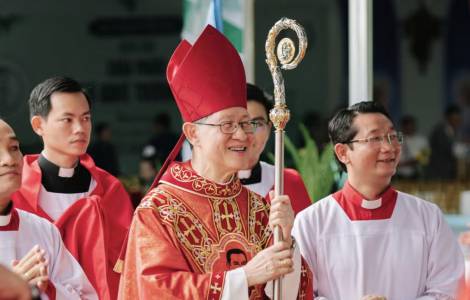
photo Giáo dục & Thời đại
by Marie-Lucile Kubacki
Tac Say (Fides News Agency) - Tens of thousands of faithful converged on July 2, 2026, at the Tac Say Pilgrimage Center in Ca Mau Province, Diocese of Can Tho, for the beatification Mass of Father Francis Xavier Truong Buu Diep, presided over by Cardinal Luis Antonio G. Tagle, Pro Prefect of the Dicastery for Evangelization and Papal Envoy on behalf of Pope Leo XIV. The Vietnamese daily Giáo dục & Thời đại (Education & Times), the official newspaper of the Ministry of Education and Training, devoted an extensive report to the celebration, making it one of the first national media outlets to cover the event in detail. According to the newspaper, pilgrims from across Vietnam and from overseas arrived throughout the night, some sleeping under petrol station awnings for lack of accommodation, others braving the fatigue of advanced age simply to “see with their own eyes” a beatification celebrated for the first time on Vietnamese soil. The same source notes that the event, prepared with the support of local authorities and a strong pastoral mobilization, was experienced as “a great joy for the Catholic Church in Vietnam and a blessing for all,” in continuity with the popular memory of Father Truong Buu Diep as a priest close to the poor who gave his life to protect his flock.
At the beginning of his homily, Cardinal Tagle described the new Blessed as “God’s blessing to the whole Church and to humanity,” and underlined that “through him the Church in Vietnam is also blessed.” Drawing on the Beatitudes, he addressed a question that, he said, many Christians may carry in their hearts: “how can a martyr like Fr. Francis Xavier Truong Buu Diep, who was brutally treated and killed, be considered ‘blessed’? Is it not more logical to call a martyr ‘miserable’ and ‘unhappy’ rather than blessed?” To answer, he returned to Jesus’ words in Matthew 5: “Blessed are the peacemakers… Blessed are those who are persecuted for righteousness’ sake… Blessed are you, when men revile you and persecute you…”, and concluded: “those who are persecuted for the sake of justice and for the sake of Jesus are blessed because, while rejected by the world, they will be rewarded in God’s Kingdom. Persecution for the sake of Jesus is the key to being blessed.”
From there, the Cardinal stressed that persecution only becomes blessedness if it flows from belonging to Christ: “A person can embrace persecution for the sake of the name of Jesus only if he or she belongs to Jesus, and not to the world, if he or she loves Jesus more than the world.” In the light of the Gospel of John proclaimed at the liturgy, he recalled that Jesus “chose us to belong to him and not to evil, to keep his word and not the lies spread by the world, and to be united with him even when it is dangerous and not only when it is convenient.” A true disciple, he said, “profoundly loves Jesus, remains with Him and shares in His persecution.” Thus, Blessed Francis Xavier Truong Buu Diep appears as “inviting each one of us to respond to Jesus’ calling, to choose Jesus, to cling to the words of Jesus and to proclaim the name of Jesus in our daily life.” The Cardinal then translated this call into concrete questions for today’s believers: “What will we choose: becoming rich by corruption or remaining poor but honest? Accumulating property that you do not need or sharing them with the poor and needy? Seeking your own safety and convenience or embracing the suffering of others? If you choose Jesus, you will be blessed. Blessed are you, like Blessed Francis Xavier Truong Buu Diep.”
In the second part of the homily, he purified the notion of martyrdom by recalling its genuinely Christian meaning, far removed from any fascination with suffering or with a form of worldly heroism, and rooted instead in witness to Christ.. “We often associate martyrdom with suffering and death,” he noted, “but like blessedness for the sake of justice and Jesus’ name, martyrdom (marturia) means witnessing to Jesus.” A martyr, he explained, “proclaims the truth about Jesus, through his words, deeds and relationships,” and his willingness to die “for the truth of Jesus brings more credibility to his testimony.” This makes a martyr “a missionary par excellence.” Referring to the second reading from 1 Peter—“Always be prepared to make a defense to anyone who calls you to account for the hope that is in you, yet do it with gentleness and reverence”—he presented the martyr as a gentle, joyful and courageous witness who “keeps the light of Jesus brightly shining even when those who reject Jesus try to extinguish it.” Blessed Francis Xavier Truong Buu Diep, he added, “never wavered in manifesting the charity and justice of Jesus to the poor, the love of Jesus that embraces all, even non-Christians, and the fidelity of Jesus the Good Shepherd who does not leave His flock alone to be devoured by wolves, thieves and marauders.”
Applied to today’s context, this understanding of martyrdom becomes a discernment about truth and falsehood, simplicity and fashion, humility and pride. “Blessed Francis Xavier is inviting all of us not to deny Jesus but to be witnesses or martyrs of His truth,” Cardinal Tagle said. “So I ask, which will we choose: to spread fake news or the teachings of Jesus? To behave and dress according to the latest fashion or according to the charity and simplicity of Jesus? To be proud of our worldly achievements or to be proud of Jesus?” A true martyr, he insisted, “helps a confused world to discover the truth of Jesus. The world needs true martyrs and bearers of truth. Let us not add to the increasing number of messengers of falsehood, hatred, division and violence.”
Finally, the third reflection highlighted hope as the inner force that sustains martyrs in their union with Christ. Citing again 1 Peter, Cardinal Tagle reminded the faithful that Jesus “was put to death in the flesh but made alive in the Spirit” and that his mission “did not end with suffering and death but in His resurrection and glorification.” “Jesus is truly risen,” he proclaimed. “Jesus rules now in God’s Kingdom. Jesus, seated at the right hand of the Father, intercedes for us. The faith in the Risen Lord gives hope to disciples and martyrs.” He evoked the repentant criminal who begged Jesus, “Remember me when you enter into your kingdom,” and received the promise, “today you will be with me in Paradise,” as well as Saint Stephen who, while being stoned, saw “the heaven opened and the Son of Man standing at the right hand of God.” “The world may forget us,” the Cardinal said, “but the Risen Jesus will remember us forever in His Kingdom, starting today.”
In this perspective, he contemplated the interior grace that may have sustained the new Blessed: “We could safely say that Blessed Francis Xavier must have had a vision of Jesus, his eternal King seeing him, remembering him and welcoming him. Hope in Christ makes martyrs firm but gentle before their persecutors.” Once more, he invited the faithful to make concrete choices: “Which will we choose: to rely on earthly wealth or on the everlasting riches in Jesus’ Kingdom? To rely on fame, the number of followers and likes in social media or on Jesus’ promise to be with us? To rely on weapons of war or on Jesus’ gift of peace?” Returning in conclusion to the Beatitudes—“Blessed are the peacemakers… Blessed are those who are persecuted for righteousness’ sake”—Cardinal Tagle entrusted the Church to the Blessed Virgin Mary, “Mother of peace,” and invoked Blessed Francis Xavier Truong Buu Diep as a man whose life of charity, closeness to the poor and pastoral courage culminated in a martyrdom lived not in search of glory, but in fidelity to Christ and protection of his flock. For the Church in Vietnam and for the universal Church, he suggested, the new Blessed offers a non mundane image of martyrdom: not the cult of individual heroic achievement, but humble and credible witness to Christ, rooted in love, truth and hope. That is why the figure of Blessed Francis Xavier Truong Buu Diep stands as a quiet yet demanding teacher for missionaries and disciples today, in Vietnam and throughout the world. (Fides News Agency, 2/7/2026)



 Leo XIV: in the lives of new martyrs and witnesses, the reflection of Christ’s victory over death
 ASIA/SOUTH KOREA - Official hymn for Seoul WYD 2027 unveiled: "Take courage; I have overcome the world"
 Fulton J. Sheen proclaimed Blessed. Cardinal Tagle: “Blessed is the earthen vessel that draws power from Jesus”
 BEATIFICATION OF FULTON SHEEN/VI — At the Vespers for Fulton Sheen, “made holy through his friendship with Christ”
 VATICAN - Cardinal Luis Antonio Tagle is the new Dean of the Sacred College of Cardinals
 Rome, Sassari, the world: The birth of World Mission Sunday in five stages
 Missions in upheaval: World Mission Sunday during the years of war
 Leo XIV to the John Paul I Vatican Foundation Conference: peace is a daily Mission