
Information service of the Pontifical Mission Societies since 1927
by Cosimo Graziani
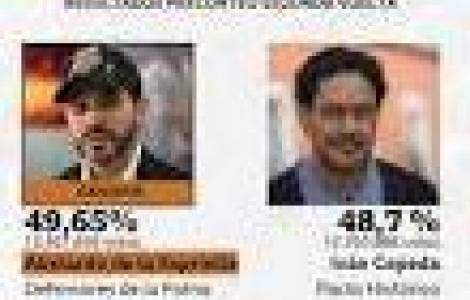
Bogota (Fides News Agency) – In Colombia, right-wing candidate Abelardo de la Espriella has won the presidential runoff election. This was announced based on so-called "preliminary results." According to initial projections, which still require final confirmation, de la Espriella's lead over the candidate of the left-wing coalition, Iván Cepeda, who was supported by outgoing President Gustavo Petro, is less than one percentage point. However, based on these results, de la Espriella immediately declared himself president. Cepeda, on the other hand, announced that he would await the official results before accepting the final outcome and would contest the results from 27,000 polling stations, 27% of the total.
Outgoing President Petro commented on De la Espriella's statements, saying: "Until the official results are in, no one can declare themselves president." Voter turnout was 63 percent – a record for the South American country. In Colombia, the four-year term of a left-wing president is coming to an end – an exception to the trend in South America, where right-wing presidents like Javier Milei in Argentina have been elected in recent years. However, the situation after the election in Colombia is different from that in other countries: Should the preliminary results be confirmed – the discrepancy from the final figures is usually only a few decimal points – the new president would face a polarized nation. This carries the risk of further inflaming the national debate, given the policies De la Espriella intends to implement: His election platform is titled "Patria Milagro" (Homeland of Miracles) and includes, among other things, a ban on abortion, the abolition of same-sex marriage, and a ban on adoptions for same-sex couples. For this reason, his victory is seen as a disaster by LGBTQ+ groups. But broader segments of the population are also concerned about his statements regarding his political opponents: during the election campaign, he declared, among other things, that he wanted to "disembowel the left" if he took power. His proposals also include abolishing "Paz Total," the dialogue policy with armed groups in the country initiated by Petro during his presidency. De la Espriella's idea is to implement a "ninety-day confrontation" plan to confront these armed groups. According to analysts quoted by the newspaper "El País," the plan envisions attacking them and their infrastructure with armed force. The right-wing candidate also intends to implement this "security strategy" by building ten new mega-prisons. Many analysts believe that the failure of Gustavo Petro's policies in recent years, which ultimately led to strong public disapproval, contributed to De la Espriella's victory. Cepeda, the candidate of the outgoing president, would therefore have suffered among the protest voters against Petro. The Colombian Bishops' Conference has not yet commented on the election results, although it has not remained silent in the preceding weeks. On June 17, following the general audience of Pope Leo XIV in Rome, members of the board of the Colombian Bishops' Conference—Bishop Francisco Javier Múnera Correa, President of the Bishops' Conference; Bishop Gabriel Ángel Villa Vahos, Vice President; and Bishop Germán Medina Acosta, Secretary General—addressed a message to the Colombian people. In it, they called on everyone to approach the elections on June 21 with hope, responsibility, and serenity, and to continue on the path of reconciliation, fraternity, and harmony. On June 19, the bishops also called for a day of prayer in the lead-up to the elections. The prayer initiative called on participants to pray for peace, reconciliation, and citizen discernment, as well as for strengthening national unity, at a time when, as the bishops noted, the country seems literally “torn in two.” (Fides News Agency, 24/6/2026)



 AFRICA/ALGERIA - Record of abstention in Algeria's legislative elections
 AMERICA/COLOMBIA - The results of the legislative elections reveal new trends ahead of the presidential elections
 Tomáš Halík at the FABC Assembly: «The future of Christianity will depend upon whether our communities become places where people truly learn to see»
 ASIA/LEBANON - The beatification of Patriarch Hoyek in Lebanon's new time of trial