
Information service of the Pontifical Mission Societies since 1927
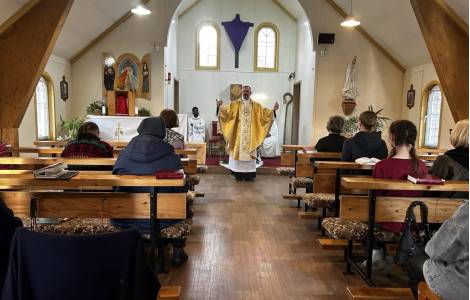
Moscow (Agenzia Fides) – “It is impossible for any of the victims of history, any of the innocent or those who tried in some way to love, to do good, to be caring, to be forgotten.
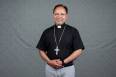
It is the Lord himself who raises them from the grave.” This is what Bishop Stephan Lipke, Auxiliary Bishop of the Diocese of the Transfiguration in Novosibirsk, said during his homily at the Easter Vigil in Nizhny Tagil, an important industrial center in the Urals, where a community of about thirty Catholics lives.
Drawing on his recent trip to the Philippines, where he and Jozef Vert, the Ordinary bishop of the same diocese, traveled to strengthen ties with local churches so that some priests or religious might eventually embrace his mission within the Diocese of the Transfiguration, Bishop Lipke warned against the danger of polarization. “In the Philippines,” he said, “the people are experiencing immense suffering. For example, it has emerged that the state has allocated hundreds of billions of rubles for flood protection, but with this money, the rich have built God knows what, while people continue to die with every new storm. Faced with all this, some succumb to cynicism and say, ‘That’s life, what can you do about it?’ trying to grab at least a slice of this enormous pie. In some, hatred prevails; in others, indifference.” Or, to take another example: a “war on drugs” was waged, during which many young people were killed. Some believe this is not a problem because, in their view, only dangerous drug dealers were killed, and rarely innocent people: they say it’s almost inevitable because “war is war.” Others, however, say no, that many completely innocent young people, or at most, minor drug users, were killed. Clearly, people remember these events differently. But the danger is that polarization, online and elsewhere, makes people indifferent to the suffering of others.” A danger that still concerns conflicts related to the land where Jesus lived and where he showed another way of living and understanding others. The bishop continued: “The same is true today in the Middle East: some say that the Palestinians do not deserve compassion because they supposedly support all terrorists.” Others claim that we shouldn't have pity on Jews, including children and pacifists, because they are supposedly all on the side of the colonizers. Certainly, Christians, of whom the Master said, "Love your enemies, bless those who curse you, do good to those who hate you," cannot participate in this polarization. But, unfortunately, it is sometimes difficult to avoid this temptation. It seems that it is not only the world's fuel reserves that are limited, but also those of compassion. We sometimes fall into the temptation to "save money," to think only of "our own" and to forget the suffering of others.
The risk is living a faith relegated to the private sphere, or perhaps limited to a few liturgical moments, but which in no way influences how we view others and their lives: "These Easter days bear witness to us that it has always been this way." The Gospel of Matthew, in particular, shows that Jesus’ enemies believed he had needlessly meddled in certain subtleties of religion and religious politics; they thought it inevitable, even desirable, to kill him, and that he had been the victim of righteous anger and justified political decisions. Therefore, they decided to carefully close and seal his tomb with a rock and guards: not only was he to be dead, but also well locked away and forgotten. However, Jesus’ enemies were gravely mistaken: (…) it was impossible that He who, by His very Word, created all living beings, should remain in death. It was impossible that infinite love, embodied by the power of the Holy Spirit, should forever remain a victim of hatred or indifference. And, sharing a memory from his childhood in Germany, he added: “That is why, as children, at Easter, we loved to sing: ‘No seal, tomb, or stone, no rock can resist him. Even if unbelief itself imprisoned him, it would see him emerge victorious. Alleluia!’” Bishop Lipke also recalled an ancient Christian tradition, now almost entirely forgotten: “There is also the tradition of ‘Easter laughter.’ This is laughter directed against the devil, against hatred and indifference, against death itself, which was so profoundly and grossly mistaken in thinking it could destroy Life itself.” He then concluded: “That is why Jesus himself rose again, and no stone could hold him. It was impossible for him to remain dead in the tomb. And for this same reason, it is impossible for any of history’s victims, any of the innocent, or those who sought in one way or another to love, to do good, to be caring, to be forgotten. The Lord himself draws them from the tomb, just as in the Byzantine Paschal icon, Christ, through his death and resurrection, draws Adam and Eve out of the realm of death. It cannot be that death triumphs: ‘Where, O death, is your victory? Where, O death, is your sting?’ They no longer exist: at the very moment when it seemed that Christ was defeated, he revealed himself as victorious. And so, let us celebrate together.” Let us remember them all, let us love them all, without asking whether they are “one of us” or “strangers,” and let us cry out—perhaps not with the same assurance as in other years, perhaps with questions in our hearts or tears in our eyes—but let us sing and cry anyway: Alleluia, for Christ is risen!
Approximately 5,000 Catholics participated in the Holy Week and Easter celebrations in the Diocese of the Transfiguration, which covers an area of 2 million square kilometers. This diocese is a suffragan of the Archdiocese of the Mother of God in Moscow and, along with two other dioceses, constitutes the ecclesiastical province of the Catholic Church in Russia. Since Catholics represent less than 1% of the population of the Russian Federation, they mostly gather in small or very small communities, some of which do not have the permanent presence of a priest throughout the year. (CD) (Agenzia Fides, 5/4/2026)



 The Easter of the Archbishop of Tehran: “Even though I am far from you, I know that in Christ, we are truly united”
 Cardinal Vesco: Leo XIV's trip to Algeria will be like a "Visitation"
 VATICAN - Course for new Bishops: Bishop García Macías: Inculturation can become one of the most beautiful forms of Evangelization, “when it enables a people to recognize that Christ is no stranger to them”
 In Dar es Salaam, African Liturgists call for an end to the “folklorization” and “theatricalization” of inculturation
 Mission beyond the illusions of efficiency: following in the footsteps of Venerable Little Sister Magdeleine of Jesus
 Rome, Sassari, the world: The birth of World Mission Sunday in five stages
 CHINA/VATICAN - From “exceptional event” to a common practice: Chinese bishops take part in Holy See initiatives
 ASIA/INDIA - From south India's coastal plains to the Himalayan foothills: the missionary path of Bishop Edward Baretto of Darjeeling