Information service of the Pontifical Mission Societies since 1927
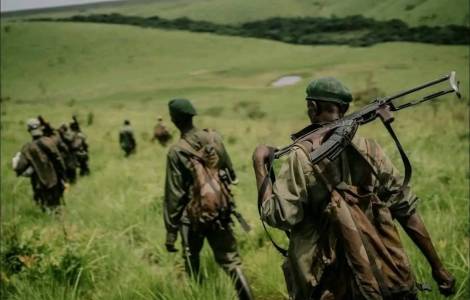
Kinshasa (Agenzia Fides) – A fierce battle is raging in the Masisi region of North Kivu province in eastern Democratic Republic of Congo for control of the strategically important coltan mine in Rubaya. This mining area was offered to the Trump administration by the Congolese government as part of a draft agreement. This agreement stipulates that, in exchange for military aid to the Congolese armed forces (FARDC), the US would receive access to strategic minerals for its military and civilian industries. Coltan is used to produce tantalum, a heat-resistant metal used in the manufacture of semiconductors, aerospace components, computers, mobile phones, and gas turbines. The Rubaya mine contributes approximately 15% to global coltan production. Mining is carried out entirely by hand by local people who earn only a few dollars a day. Estimates suggest that investments of between $50 million and $150 million are needed to develop the mine into an industrial operation.
Rubaya lies within the territory controlled by the pro-Rwandan rebels of the M23/AFC (Congo River Alliance), who seized large swathes of North and South Kivu provinces between January and February of last year. The government in Kinshasa must now regain control of the mines affected by the possible agreements. Currently, the offensive to recapture Rubaya is being led by members of the pro-government Wazalando militia. The recapture began on February 20, when fighters from Wazalando-affiliated groups launched a series of attacks in the Masisi area, targeting the mines in Rubaya.
Following the capture of the towns of Kasenyi, Chugi, and Kinigi, several local sources confirm the advance of the "Wazalando" forces on the villages of Runigi, Kabara, Kiruli, and Kanyalu, located approximately 10 kilometers from the minefield. The military offensive has led to population displacement in the affected areas: Since February 23, significant population movements have been observed in Rubaya. Fearing being caught in the crossfire, many families are fleeing their homes in haste. Some are seeking refuge in the direction of Ngungu, Bihambwe, and Mushaki, others in the direction of Goma, or crossing the border into the neighboring province of South Kivu. Most of the displaced people can only take the bare necessities with them. The offensive by the "Wazalando" militias is supported by armed drones from FARDC, which are bombing rebel positions. Paradoxically, these are highly likely Chinese-made drones being used in a military operation designed to reduce the US's dependence on Beijing-controlled supply chains. The list presented to US investors by the Democratic Republic of Congo includes, among other things, the Manono lithium deposits, the copper and cobalt mines of the mining company Chemaf in Upper Katanga and Lualaba, and the germanium-gallium mine in Lubumbashi. (L.M.) (Agenzia Fides, 24/2/2026)