
Information service of the Pontifical Mission Societies since 1927
VaticanMedia
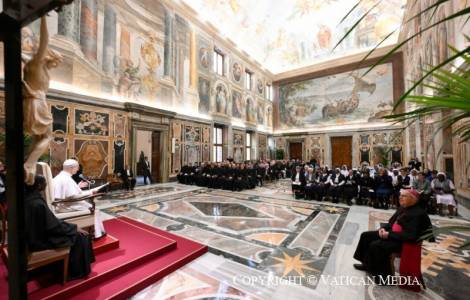
Vatican City (Agenzia Fides) - Every new apostolic and missionary work that flourishes in the Church can become fruitful not through the effectiveness of human strategies, but "through docility to the inspirations of the Holy Spirit and attention to the demands of charity." Pope Leo XIV recalled this today, as he received the Missionary Oblates of Mary Immaculate in audience in the Clementine Hall of the Apostolic Palace, on the occasion of the 200th anniversary of the approval of the Constitutions, and participants in the Plenary Assembly of the Sisters of Our Lady of the Apostles, on the 150th anniversary of their foundation. In his address, the Pope emphasized that these are two religious institutes united by the historical period in which they were founded, by their homeland (France), and, “above all,” by the “missionary vocation” they share.
Saint Eugene de Mazenod (1782-1861) founded the Oblates of Mary Immaculate driven by the desire to return to preaching the Gospel through popular missions in the de-Christianized rural areas of France. At a time, the Bishop of Rome recalled, "complex and dramatic" events that heightened the urgency of proclaiming the Gospel" to "the poor, workers and peasants who were exploited as a mere source of labor with their deepest human needs neglected." But already as Bishop of Marseille, the holy founder had responded promptly and boldly to the requests for help from the Archbishop of Montreal, sending first-generation Oblates "first to Canada and then to Europe, Africa and Asia." This generous openness to the promptings of the Holy Spirit and the most pressing needs of ecclesial charity was "rewarded, in fact, by an impressive flowering of missionary vocations," Pope Prevost recalled. Even today, the more than three thousand religious spread across seventy countries, continue the work begun by Saint Eugene, maintaining a clear "preferential openness to the least among us."
The "Sisters of Our Lady of the Apostles" were also called 150 years ago, according to the intentions of their founder, Father Augustine Planque, "to ensure the indispensable presence of women in the work of the Society of African Missions." The Sisters also bore clear witness to Christ by sacrificing their lives "given the harshness of missionary work, exposure to disease, and, in recent times, martyrdom."
This apostolic activity continues selflessly even in contexts described by the Pope as "difficult contexts."
Both the Sisters of Our Lady of the Apostles and the Oblate Missionaries—as Pope Leo emphasized in the concluding part of his address—were called by their founders to foster in their communities “a sincere and generous family spirit” that arises, among religious as well as the laity, “first and foremost from their encounter with God, from the Eucharist, from prayer, from adoration, from listening to the word and from the celebration of the sacraments." (GV) (Agenzia Fides, 21/2/2026)



 If the "problem" is no longer atheism. Spain's missionary urgency awaits Leo XIV
 The 2026 General Assembly of the Pontifical Mission Societies begins
 "Like clay in the hand of the potter". Work on the "Positio" in the Cause for Canonization of Father Emiliano Tardif begins
 Slovakia celebrates the memory of Veronika Racková, the nun and doctor killed 10 years ago in South Sudan
 ASIA/CHINA - New Church in the Diocese of Wenzhou dedicated to Saint Thérèse of Lisieux
 ASIA/SOUTH KOREA - Five “Patron Saints” for World Youth Day “Seoul 2027”
 ASIA/VIETNAM - Archbishop Joseph Vu Van Thien: “The Church in Vietnam, grateful for the missionaries and martyrs, sings its Magnificat”
 OCEANIA/AUSTRALIA - Cardinal Bo to the Pontifical Mission Societies: "Your collaboration with us is not just charity, it is communion"