Information service of the Pontifical Mission Societies since 1927
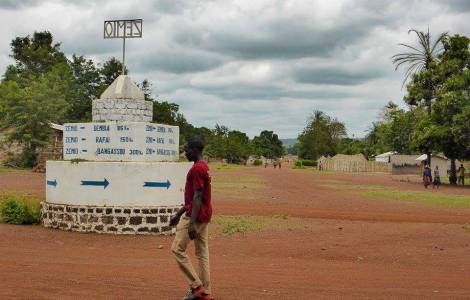
Bangui (Agenzia Fides) – The humanitarian situation in the Zémio area of the Central African Republic has reached alarming proportions. According to Msgr. Aurelio Gazzera, Coadjutor Bishop of Bangassou (in the southeast of the Central African Republic), the total number of displaced people has now reached 30,000. Of these, over 2,000 live in extreme poverty, scattered between the local Catholic mission and the town of Zapaye in the Democratic Republic of Congo.
These people have neither food nor basic necessities, and the children have no access to education. Among those who fled last November are the 72 students of the Zémio high school, compared to 992 students last year. The area affected by the violence is a remote region with no infrastructure compared to the rest of the country. “The road connecting Bangassou and Zémio is 300 km long, but it takes at least 16 to 17 hours to travel it,” reports Bishop Gazzera.
“The Zémio area, like the Mbomou, Haut-Mbomou, and Boki, has been suffering for over 15 years from the violence of armed groups such as the Lord’s Resistance Army (LRA), a Ugandan group that settled in the area; the Séleka, a number of militias that emerged during the 2012 civil war; the Unité pour la Paix en Centrafrique (UPC), a group that split from the Séleka in 2014; and now the Azandé Ani Kpi Gbé (AAKG) militias, which arose as a movement to protect the population but ultimately caused more problems than they intended to solve,” explains the Coadjutor Bishop of Bangassou. Regarding humanitarian aid, Bishop Gazzera explains: “In collaboration with our partners, such as Caritas, we are trying to prepare a shipment of food and basic necessities, but the real problem is getting the aid to the people.” “It’s already complicated to get them to Bangassou,” the bishop emphasizes. “From Bangassou to Zémio, the condition of the road and the insecurity in the area pose various problems for transportation, also because there are well-founded fears that the situation could deteriorate further.” “There have already been cases in which NGO workers traveling on this road have been attacked,” he recalls. The few health facilities in the region are also not spared. “The hospital in Mbomou was attacked by militiamen looking for wounded soldiers whom they believed were being treated there,” says Bishop Gazzera. According to the Coadjutor Bishop of Bangassou, resolving the conflict requires going beyond a military response and addressing the root causes of the local population’s suffering. (L.M.) (Agenzia Fides, 13/1/2026)