
Information service of the Pontifical Mission Societies since 1927
by Cosimo Graziani
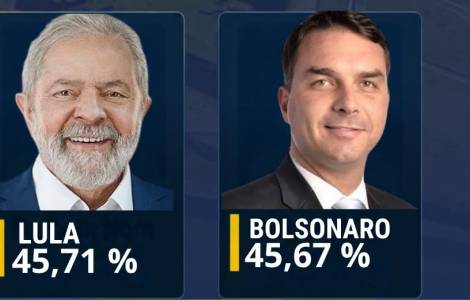
Brasilia (Fides News Agency) – The first round of Brazil’s presidential election on October 4 confirmed analysts’ expectations. The two leading candidates – Flavio Bolsonaro of the Liberal Party and incumbent President Luiz Inácio Lula da Silva of the Workers’ Party – representing the right and the left respectively, will face each other in a runoff on October 25.
Bolsonaro obtained 47% of the vote in the first round, compared with Lula’s 45%, leaving a gap of just over two million votes. Before the election, analysts had anticipated a similar margin, but with the candidates’ positions reversed, with Lula expected to lead. The decisive campaign for the final round is now under way, with the two candidates pursuing different strategies to gain the votes needed for victory.
Bolsonaro must win over voters who supported the other right-wing candidates, who collectively received 7% of the vote. Lula, meanwhile, must appeal to the large number of abstentionists: 21% of eligible voters did not cast a ballot, the highest abstention rate in 28 years.
The election was not just for the President of the Republic. Fifty-four of the eighty-one seats in the Senate were also up for election, as were all the members of the Chamber of Deputies. These elections may prove to be the real political turning point for the country.
In fact, in both cases the Liberal Party emerged as the leading party, winning 29 seats in the Senate and one hundred and twenty-one in the Chamber of Deputies, whilst the Workers’ Party came second in the lower house, with 88 seats, and third in the Senate, with just nine.
In Brazil’s fragmented political landscape, being the largest party – particularly when it is the party of the president or of a candidate who has reached the runoff – can have a significant impact on the political direction of the legislature. In this respect, regardless of the outcome on October 25, Brazil’s political landscape has shifted to the right once again.
Naturally, the identity of the next president will remain a key factor. In light of the results, analysts have outlined two possible scenarios. If Lula wins, he could face a difficult legislative term, with a strong opposition likely to pose serious challenges to his presidency. If Bolsonaro wins, Brazil could return to economic policies centred on the exploitation of resources in the Amazon rainforest, while also potentially reshaping the country’s future political landscape.
Another area likely to be affected by the election results is the composition of the Federal Supreme Court. The next president will have to appoint three new judges to replace those whose terms will end upon reaching the age limit, and one new judge to fill a vacant seat. This represents a quarter of the Court’s 11 members.
The Senate has the authority to remove members of the Court, which makes the outcome of the run-off even more decisive.
Should Lula wins, a system of checks and balances could emerge, with presidential appointments potentially counterbalancing decisions taken by the Senate. Whereas under Bolsonaro, there is a possibility that, in addition to making appointments, the Senate could decide to remove some members of the Court. The first potential target would be Alexandre de Moraes, one of the leading figures in the legal proceedings against Bolsonaro’s father. This could give the Liberal Party an opportunity to bring the Court’s composition further into line with its political positions.
The final significant factor is the election’s potential international impact. At the regional level, a victory for Flavio Bolsonaro would mark a decisive shift towards closer ties with the United States and the Trump administration across Latin America, leaving Mexico as the only major country in the region still governed by a left-wing party.
There would also be implications for global politics. A change of president in Brazil could give political momentum to parties around the world that share the Liberal Party’s ideological outlook. European parties, in particular, could benefit, as the continent approaches a crucial election year beginning with snap elections in Spain in late November, followed by elections in France, Italy and Poland.
(Fides News Agency, 9/10/2026)



 AFRICA/ALGERIA - Record of abstention in Algeria's legislative elections
 Colombian elections reveal a divided country
 ASIA/KAZAKHSTAN - “Spiritual diplomacy” in the face of global challenges: ethics, artificial intelligence and climate change
 POPE IN FRANCE/XI - Leo XIV in Metz: Europe seeks peace in the "Lantern of the Good Lord"
 The BRICS between “global governance” challenges and the growing role of African countries
 ASIA/MALAYSIA - Malaysian Ambassador Assan: "Respect for international law, and the protection of human dignity is the path to peace in the Middle East and Southeast Asia"
 ASIA/SOUTH KOREA - The journey toward WYD 2027 crosses paths with the Church’s social doctrine