
Information service of the Pontifical Mission Societies since 1927
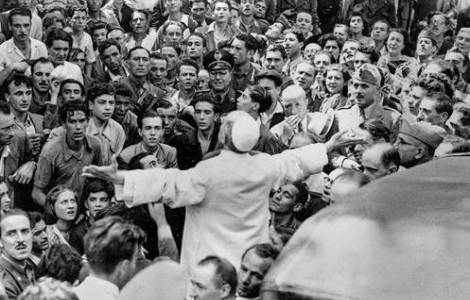
AP (Wikimedia Commons)
by Marie-Lucile Kubacki
Rome (Fides News Agency) – “Our missionaries are there, standing firm in the trenches of faith, like watchful sentinels at the outposts.”
On 19 October 1940, as the war was also devastating Catholic communities in mission territories, Archbishop Celso Costantini, then Secretary of the Sacred Congregation for the Propagation of the Faith (a position he had held since 1935) replied as follows to the question addressed to the listeners during his radio message: “What are our missionaries doing, how are they living, how are they carrying out their work in these times?”
As Secretary of the Congregation for the Propagation of the Faith, Costantini entrusted radio with a message intended to reach the faithful on the eve of World Mission Sunday. In the bulletins of Fides News Agency, the annual event appears as a reminder not to forget those who were far away: interned missionaries, isolated communities, priests and religious women without resources, populations overwhelmed by violence.
Between 1939 and 1944, these messages tell the story of a mission seeking to keep its places of worship, education and care open whilst aid, communications and freedom of movement were dwindling. They asked for donations, but also for prayers and a solidarity capable of crossing the divisions created by the conflict. Their focus was not the prestige or interests of nations, but the people entrusted to the missionaries and the future of the local Churches.
From the distinction between the Gospel and political interests to the hope of rebuilding amid the ruins, Costantini’s words bear witness to a faithfulness put to the test by the war.
The Gospel beyond nations
A document dated 21 October 1939 and published by Fides reports on a conference given by Costantini at the Pontifical Gregorian University in preparation for World Mission Sunday on 22 October. Its title, “Christ and Caesar in the Missions,” explores the relationship between Christian proclamation and political power. Recalling the Gospel saying, “Render unto Caesar the things that are Caesar’s, and unto God the things that are God’s,” the Secretary of Propaganda Fide affirmed the freedom of the mission from State interference and from nationalist temptations that could affect “some missionaries”.
“Christianity did not present itself to the world as the religion of a people, but as the religion of humanity,” the report states. Costantini rejected “a serious and widespread misconception”: that missionaries were “valuable disseminators of the idea and national influence of their own country”, capable of paving the way for its political and commercial expansion. A missionary must not become a “pseudo-consular agent”.
At the beginning of the conflict, these words explicitly removed the mission from the rivalry among the great powers. The conference also pointed to a necessity that the war would make increasingly clear: the formation of a local clergy who “even in the event of war would remain in their place”, and thus overcome the damage inflicted on the missions by foreign policy.
The address concludes by contrasting destruction with a different course of action:
“While people are killing each other,” missionary charity can still kindle “a light of goodness and hope upon this troubled horizon of the world”.
Pius XII’s radio message
In his 1940 radio message, Costantini recounted his own experience in China. During a period of upheaval, a missionary had written to his bishop: “I thank you for offering me the opportunity to seek safety; but our predecessors did not abandon their post in times of danger.”
The letter concluded with a decision: “If we are to add a page to the history of our mission, we must know how to write it in the same style. We will stay.”
Costantini presented this as an expression of a “heroic style”, in which fidelity to the mission prevailed over the search for personal safety. The message nevertheless acknowledged that missionary activity was “necessarily hindered” and at times “completely paralyzed” by the internment or exile of missionaries. Their perseverance therefore had to be matched by concrete support.
In the second part, Costantini refers to the biblical lament, Parvuli petierunt panem et non erat qui frangeret eis, explaining: “some missionaries are truly starving. We stretch out our hand to them.”
Aid from their fellow countrymen and from religious institutes could no longer reach them; listeners were therefore asked to provide, concretely, at least “a little bread for their hard life”.
On that same evening, Saturday 19 October 1940, Pius XII himself delivered a radio message addressed to the bishops and Catholics of the United States. His words crossed the Atlantic to encourage their missionary zeal. The Pope recalled the missionaries and religious women working in hospitals and schools, but also “the great regions bloodied and devastated by conflicts among peoples”.
The image of the evangelical harvest was set against that of the “hurricane of conflicts, ruins, misery and countless hardships”. Pius XII joined prayer to material aid: “The gift of prayer (...) must not be separated from the gift of action.” Donations were intended to make it possible to “promote the good already begun, restore what has been damaged or destroyed”, support what was fragile and strengthen what already existed.
The appeal to mission thus also became an appeal for reconciliation: “For peace in the world, too, is a mission of the Church.” In its account of World Mission Sunday, Fides recalls this papal message, addressed particularly to Americans, but perceived by the faithful as a call addressed to each one of them.
Costantini’s appeal for 19 October 1941, however, began with an expression of gratitude: donations from various countries had exceeded previous budgets by several million. “If we consider the war, and the inevitable hardships which peoples throughout almost the whole world have had to endure and continue to endure, this increase in charity has a profound meaning,” he wrote.
The gift gained its value precisely because it arose from shared deprivation. The contextual documents record the extent of this mobilization. In Italy, the collection of the Pontifical Society for the Propagation of the Faith had risen from 6,635,216 lire in 1939 to 7,564,559 in 1940.
In preparation for World Mission Sunday 1941, circular letters were distributed to parish priests, together with preaching materials, holy images and leaflets. The radio message was broadcast by EIAR (Ente Italiano per le Audizioni Radiofoniche), the predecessor of RAI, and rebroadcast by Vatican Radio in several languages. Solidarity took shape through parishes, the press and radio.
Building amid destruction
“The Builders of the City of God” was the title of the message for World Mission Sunday on 18 October, 1942.
Costantini began by speaking of the hope for a different world, with an obvious Augustinian reference: “The whole world is waiting for a new order to be built upon the smouldering ruins of this war.”
But reconstruction, he asserted, “before being a material reality, must be a spiritual one”. Alongside the soldiers who are fighting, he pointed to “other soldiers, silent and unarmed”, scattered across the most distant regions, who are suffering and working for that new order.
Letters received by Propaganda Fide gave concrete form to the account. A bishop in Central Africa reported that he had been able to maintain his works thanks to the contributions received and had partially replaced the interned missionaries of a neighboring vicariate.
A bishop in West Africa looked to the growth of the African clergy: “The Mission will be mature when it has a well-formed African clergy.” It would then fall to African priests to pass on in turn “the torch of faith”.
Costantini commented that the mission “must culminate in the indigenous Church”. The conflict demonstrated how necessary this was: where foreign missionaries were interned, local priests could replace them and “save the situation”.
Yet the formation of the clergy was not regarded merely as an emergency response, but as a path towards the maturity of Christian communities, “in God’s plans” and “desired by the Pope”.
In September 1943, the appeal bore a title that combined devastation and confidence: “The missions will rise again.”
War was described as a hurricane breaking into a garden, tearing away flowers and branches. The sturdy plants bent, but could rise again and blossom anew.
Propaganda Fide received “voices of pain, voices of imploration” from missionaries lexperiencing inaction, internment, and hunger. Yet, Costantini wrote, “not a single word of discouragement has ever reached us”.
The text did not minimize the losses. A bomb that exploded in a house of religious women killed fifteen of them at once; the wounded survivors, did not abandon their “place of charity”.
Alongside the victims, Costantini remembered those who had been separated from their communities and interned in concentration camps. One bishop called this condition a “white martyrdom”: “It is a martyrdom without blood, but a long, exhausting and terribly painful one”, aggravated by the worry for abandoned Christians.
Another wrote from a concentration camp: “Here we strive to fill our time usefully in prayer and study. God alone knows what the future will bring us. We, however, shall seek, with His grace, to be ready for anything. All the things we have been able to receive in the past, we have accepted and offered to Him with joy. We remember the noble words of our St Columbanus: Christi sumus, non nostri: We belong to Christ, we do not belong to ourselves.”
Here too, seeds of hope could be glimpsed in the local Churches. “Fortunately, the missionaries had founded seminaries everywhere,” Costantini observed. In many places, local priests took the place of those who had been interned.
The seminaries remained open almost everywhere, “but at the price of unheard-of sacrifices”.
The hope of recovery was already alive in those who continued their formation and sustained their communities.
From the ruins to reconstruction
“Sursum corda!” was the title of the radio message for World Mission Sunday on 22 October 1944.
“Five years have now passed since World Mission Sunday has been celebrated amid the desolations of war,” Costantini began. Expectations of a brighter future emerge, but hope did not erase the victims: the message recalled sixty missionaries who had fallen, including one bishop.
The most dramatic testimony came from a religious sister. Transported from one island to another amid bombing, hunger and long marches, she and her companions had been put aboard a ship without knowing their destination.
An air raid struck the vessel. “Of our 47 Sisters, only four were unharmed”; twenty-four died immediately. The priests assisted the dying, and the bishop, wounded in the shoulder, died later.
“With the Sisters who had not died, we renewed our sacred vows and prayed.”
Costantini returned to his appeal: the missionaries were ready to resume their work, but they needed assistance. To the faithful, themselves marked by loss, he asked that offerings also be made in memory of their own dead, looking towards a future of peace:
“Let us all work with firm and generous hearts so that upon the ruins of war, near and far, a new world may arise, more human and more Christian.”
As the months of the war passed, the paper used for the collections held in the Fides Agency’s archive became thinner, rougher, and the ink more faded. In 1944, the following message was found not far from the one for World Mission Sunday: “One hundred and fifteen pages of articles and news is all that we have been able to provide, and unfortunately only for a very small part of the Italian press, in this year 1944. There is no need to appeal to Subscribers and Readers for them to understand that it was neither morally nor materially possible to do more than this. We hope that events will soon make it possible for the Missions in Distant Lands and for Fides News Agency to re-establish the communications interrupted by the war: we shall thus be able to resume our activity in full.”
In 1946, the theme of reconstruction became explicit. “Reconstruction: on what foundations?” asked an article published on 12 October and signed by Monsignor Lazzaro Acquistapace of Fides News Agency, where he served as editor from 1931 to 1955.
Commenting on Costantini’s appeal and on a message from Pius XII to the bishops of Japan, the author recalled the effort to reunite scattered Christians, rebuild walls and reopen Catholic institutions and works.
But first and foremost there had to be a “moral and spiritual” reconstruction: “Upon the foundations of the Gospel, upon Christ the cornerstone, every missionary has always built, and now he will build again.”
From the post-war period to the “Piecemeal Third World War”
The end of the war did not, however, bring the time of trial to a close.
In his message for World Mission Sunday on 23 October 1949, Costantini described the growth of missionary works in Africa and the transition from foreign missions to local Churches in India, while in some regions of the Far East the Church “suffers and bleeds like the Church of the Catacombs”.
The title echoed St Paul: “Maledicimur et benedicimus”—“We are cursed, and we bless in return.”
Costantini then offered a profound reflection on the Christian perspective on martyrdom: “It would be too long if I were to recount the terrible descriptions that reach Propaganda: devastation, flight, deportations, the dispersion of seminarians, dispersal of Christians, robbery, killings and deaths from starvation. Yet, though the flesh is weak, the spirit is ready,” he affirmed.
He added: “Not a word of hatred or discouragement has reached Propaganda, but only words of profound compassion.
Maledicimur et benedicimus.
At Propaganda we are in constant contact not only with natural realities, but with the supernatural: the Church suffers, prays and resists.”
From war to the post-war period, World Mission Sunday was never a worldly event, but was rooted in very concrete realities. And this is precisely what gives meaning to the fact that the faithful are still called today to support the mission: not as an abstract concept, but as a reality embodied in the people who remain and work to build the City of God.
While the world has entered, in the words of Pope Francis, a “Piecemeal Third World War”, this memory deserves today, more than ever, to be known.
(Fides News Agency, 8/10/2026)



 In Malawi, a whole stadium celebrates 100 years of World Mission Sunday: “United in Christ, united in mission”
 VATICAN - Vietnamese-language online missionary formation course on Pope’s Message for World Mission Sunday begins on Saturday, August 8
 EUROPE/HUNGARY - Message of the annual gathering of the Pontifical Society of the Holy Childhood: Different yet united in the love of Christ
 One hundred years later. The long journey of China’s first Bishops to receive Episcopal Ordination from the Successor of Peter
 At the Course for Newly Appointed Bishops, practical tools for missionary communion with the Successor of Peter were presented
 POPE IN FRANCE/XI - Leo XIV in Metz: Europe seeks peace in the "Lantern of the Good Lord"
 ASIA/UNITED ARAB EMIRATES - “The Lion's Roar”: Bishop Martinelli invites everyone to pray the Rosary every day for the gift of peace
 ASIA/INDIA - From south India's coastal plains to the Himalayan foothills: the missionary path of Bishop Edward Baretto of Darjeeling