Information service of the Pontifical Mission Societies since 1927
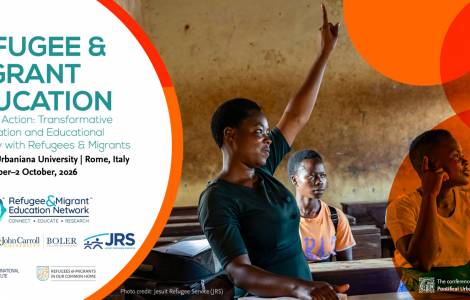
Rome (Fides News Agency) – The international conference “Refugee & Migrant Education: Voices in Action: Transformative Collaboration and Educational Solidarity with Refugees & Migrants” opened on September 30 at the Pontifical Urbaniana University in Rome.
Promoted by the Refugee & Migrant Education Network (RMEN), the conference concludes tomorrow, October 2. It brings together academics, representatives of United Nations agencies, international organizations, scholars and refugee students, civil society representatives and Church-based organizations, with the aim of identifying shared strategies to expand access to education and promote the inclusion of people forced to leave their Countries.
The conference is taking place at a time when, as the presentation of the initiative recalls, millions of people remain displaced by war, poverty, violence and climate change. Families are forced to leave their homes, young people’s education is interrupted, and many communities struggle to guarantee even basic educational opportunities. “Across continents, millions remain displaced by war, poverty, violence, and climate change. Families are uprooted, young people’s education is interrupted,” the Network’s presentation reads.
RMEN was founded in 2018 to connect universities, non-governmental organizations, international agencies and people working in the education of refugees, migrants and displaced persons. The network is based on the conviction that the work of individual actors can be strengthened through collaboration and mutual support. “Education is a journey together and its goals are best achieved through mutual collaboration,” the conference presentation states.
In his welcome message, Anthony J. Cernera, President and founder of the Network, identified the development of concrete proposals and the strengthening of ties among participants as key objectives of the gathering: “Our primary objective for this conference is to develop actionable recommendations that will advance refugee and migrant education while also promoting deeper collaboration between participants.”
The discussion addresses not only education for people on the move, but also education on migration and human mobility.
Welcoming participants on behalf of the University and its Rector, Prof. Vincenzo Buonomo, the Dean of the Faculty of Theology, Prof. Pietro Angelo Muroni, expressed the University’s pleasure at hosting the Network once again.
“We are truly honoured to have you here,” the Dean said, thanking Prof. Cernera and the organizers of the conference.
The Faculty of Theology has in recent years worked to become an integral part of the “choir” of voices in action on migration. Its programs include a Specialization and PhD in Intercultural Pastoral Theology and Theology of Human Mobility, with students from more than 100 countries and 108 affiliated institutes around the world. The programs aim to train experts and practitioners capable of dialogue, comparison, design and transmission, through a multi-, inter- and intra-disciplinary methodology with a strong intercultural dimension.
“The relationship with your institution is not only appreciated, but desired. I hope that your presence here will mark a further concrete step towards a collaboration that is set to continue over time,” the Dean added.
In his opening address, Professor Aldo Skoda of the Scalabrini International Migration Institute and the Pontifical Urbaniana University recalled the Network’s tenth anniversary, highlighting its growth as a space for collaboration among institutions, educators, researchers and communities from different Countries. He also urged not to reduce migration to a crisis or a problem to be managed: every movement of people carries with it a story, aspirations, cultures and knowledge. From this perspective, education is not merely a service, but a means of restoring dignity, strengthening people’s capacity to make choices and creating opportunities. “Education is not simply a service to be provided, but a powerful means of restoring dignity, strengthening agency, creating opportunities,” he said.
The right to education, however, remains far from being fully guaranteed for millions of refugees, migrants, asylum seekers and victims of trafficking. Skoda’s address highlighted the obstacles that may arise at different stages of the journey: from flight and transit to arrival and integration into host communities. Limited resources, interruptions to schooling, language barriers, legal and administrative difficulties, and inequalities in access to technology can prevent young people from continuing their education.
The program addresses these challenges through plenary sessions, round tables and working groups. Topics under discussion include access to higher education and educational continuity in different contexts, the impact of funding cuts and gaps in research. One session focuses on models of cooperation between universities and organizations, including the Mother Cabrini Institute of Immigration, the University of Sanctuary at the University of Exeter, Saint Joseph University of Beirut, Jesuit Refugee Service, Jesuit Worldwide Learning and Refugee Education UK.
The opening day, September 30, featured a workshop on expanding refugees’ access to higher education, presentations on collaboration and solidarity with refugees and migrants, and testimonies from resettled refugee students and young people living in emergency situations. Working groups were also launched in four areas: refugee and migrant education; education on refugee and migration issues; advocacy and accompaniment; and research.
Today, October 1, the conference will focus on the educational continuity across different contexts and levels of education, models of collaboration among institutions, and educational practices based on ethical principles. In the afternoon, there will be parallel sessions on refugee leadership, access to and retention in higher education, pedagogies of solidarity, the resilience of displaced young people, and collaboration between institutions and communities. Tomorrow, October 2, a session will examine the opportunities and challenges posed by artificial intelligence in refugee and migrant education, led by Father Maurice Emelu of John Carroll University. The conference will conclude with the presentation of recommendations developed by the working groups and an appeal for joint action.
(MLK) (Fides News Agency, 1/10/2026)